
If you are wondering how to calm an angry foster child without making the moment worse, the first step is not control. The first step is safety.
Some moments in foster parenting can feel like they come out of nowhere.
One minute, the room is calm.
The next minute, a child is yelling, crying, slamming a door, throwing something, refusing to move, or saying words that cut deeply.
You may look at the situation and think, “What just happened?”
You may feel your own body tighten.
You may want to explain, correct, stop the behavior, or regain control quickly.
That reaction is human. But when a foster child is angry, the goal is not only to stop the noise in the room. The deeper goal is to keep the moment from becoming bigger, louder, and more frightening for everyone involved.
Anger in a child who has experienced trauma, loss, neglect, instability, or repeated stress is not always just anger.
Sometimes it is fear wearing a loud voice.
Sometimes it is grief that has nowhere else to go.
Sometimes it is a nervous system that does not yet know how to come back to safety.
This does not mean the behavior is okay.
It means the response matters.
A calm, steady adult can become the first sign that this moment does not have to turn into another painful memory.
At a Glance
- An angry foster child may be reacting from fear, stress, overwhelm, or survival.
- The first goal is safety and regulation, not a lecture.
- Use fewer words, a lower voice, and one clear limit.
- Do not try to teach while the child is highly escalated.
- Repair after the child calms down.
- Your calm does not fix everything, but it can help change the emotional direction of the moment.
Quick Answer: How Do You Calm an Angry Foster Child?
The safest first response is to lower the intensity, protect everyone’s safety, and help the child regulate before trying to teach a lesson.
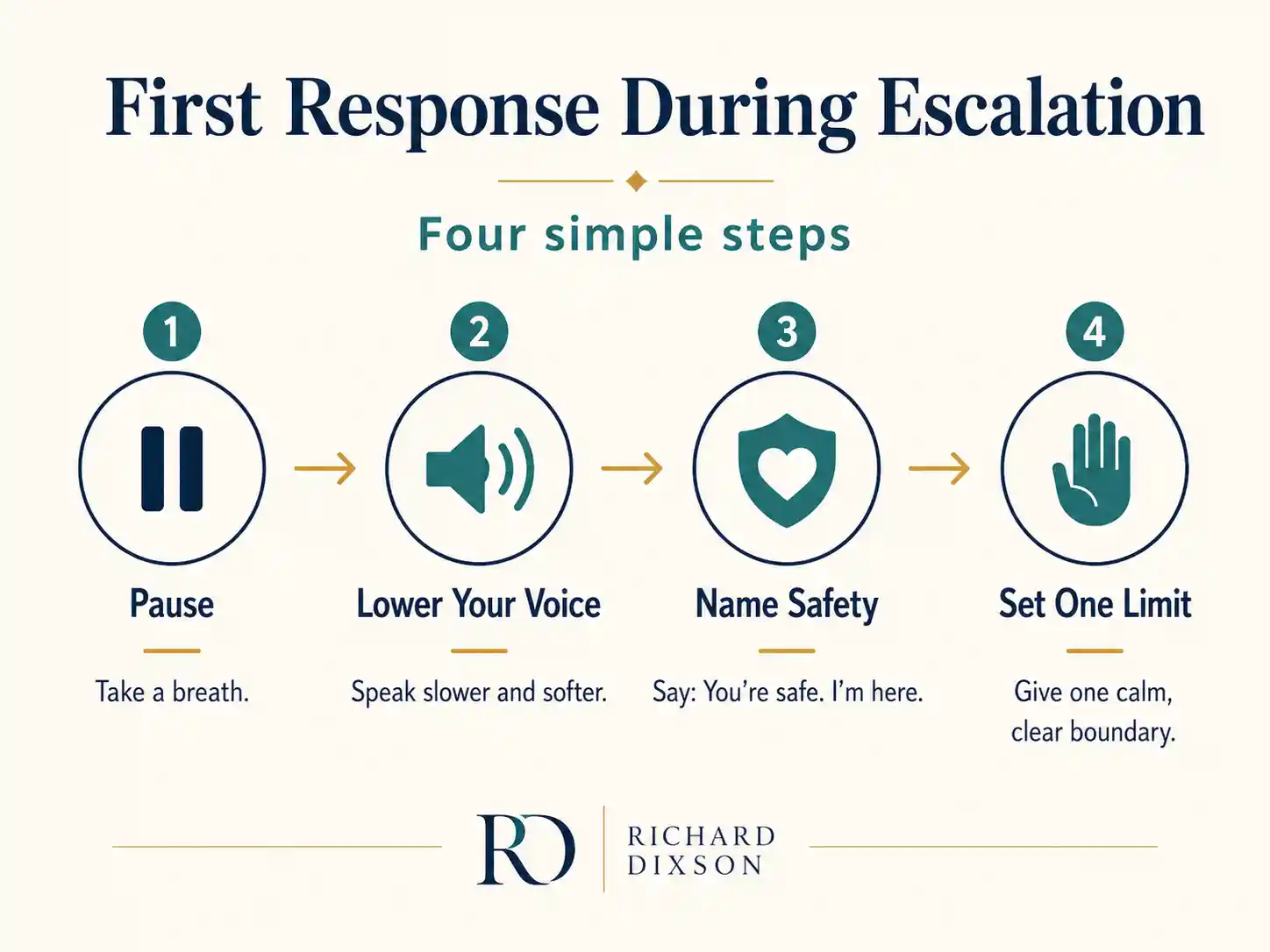
To calm an angry foster child, first lower the emotional intensity in the room. Speak less. Lower your voice. Give space if needed. Name safety. Set one simple boundary. Help the child regulate before trying to correct or teach.
A simple response might sound like:
“You are safe. I am here. I will not let you hurt yourself or anyone else. We can talk when your body is calmer.”
The goal is not to win the argument.
The goal is to help the child’s nervous system move out of danger mode and back toward safety.
Correction can come later.
Connection and safety need to come first.
This trauma-informed approach is consistent with the way TBRI and child trauma resources emphasize safety, connection, regulation, and caregiver awareness. TBRI, developed through the Karyn Purvis Institute of Child Development at Texas Christian University, is commonly used to support children and youth who have experienced adversity.
Why Anger May Not Be the Whole Story
When a foster child becomes angry, it can look like disrespect.
It can look like control.
It can look like defiance.
It can look like the child is trying to make the home difficult.
But behavior is often only the part we can see.
Underneath anger, there may be:
- fear
- shame
- grief
- hunger
- tiredness
- sensory overload
- confusion
- loss of control
- past trauma reminders
- fear of rejection
- fear of being moved again
- fear that adults cannot be trusted
A child may not have the words to say, “I feel unsafe.”
So the body says it through yelling.
A child may not know how to say, “This reminds me of something painful.”
So the behavior becomes resistance.
A child may not know how to ask, “Will you still care about me if I mess up?”
So they test the relationship.
This does not mean you ignore the behavior.
It means you respond to both layers:
The behavior that needs a boundary.
And the fear that needs safety.
If Your Child Is Escalating Right Now, Start Here
If a child is already angry, overwhelmed, or shutting down, do not begin with a long explanation.
Start small.
- Lower your voice.
- Use fewer words.
- Create physical and emotional safety.
- Say, “You’re safe. I’m here.”
- Set one clear limit.
- Come back later for repair when the child is calmer.
The goal in that moment is not to prove your point.
The goal is to help the child borrow some of your calm.
A child who is escalated may not be ready to understand the lesson yet.
But they may be able to feel whether the adult in front of them is safe.
What Not to Do During Escalation
When a child is angry, many normal parenting instincts can make the moment worse.
You may want to explain.
You may want to lecture.
You may want to demand eye contact.
You may want to say, “Calm down.”
You may want to remind them of consequences immediately.
You may want to match their volume so they know you are serious.
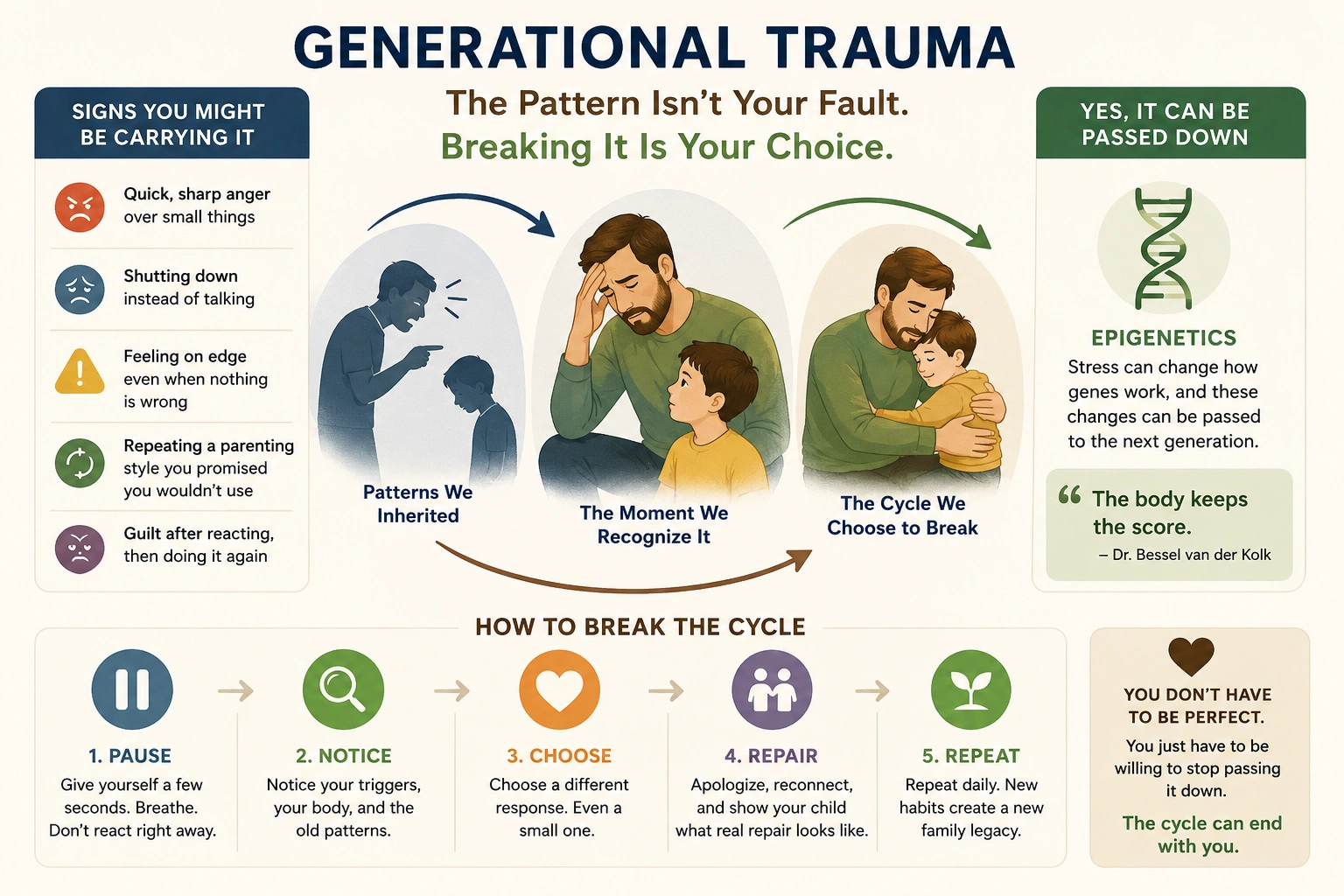
But in an escalated moment, these responses can increase threat. Understanding why parents react the way they do often starts in the nervous system — your own body is responding to perceived danger, just like the child’s.
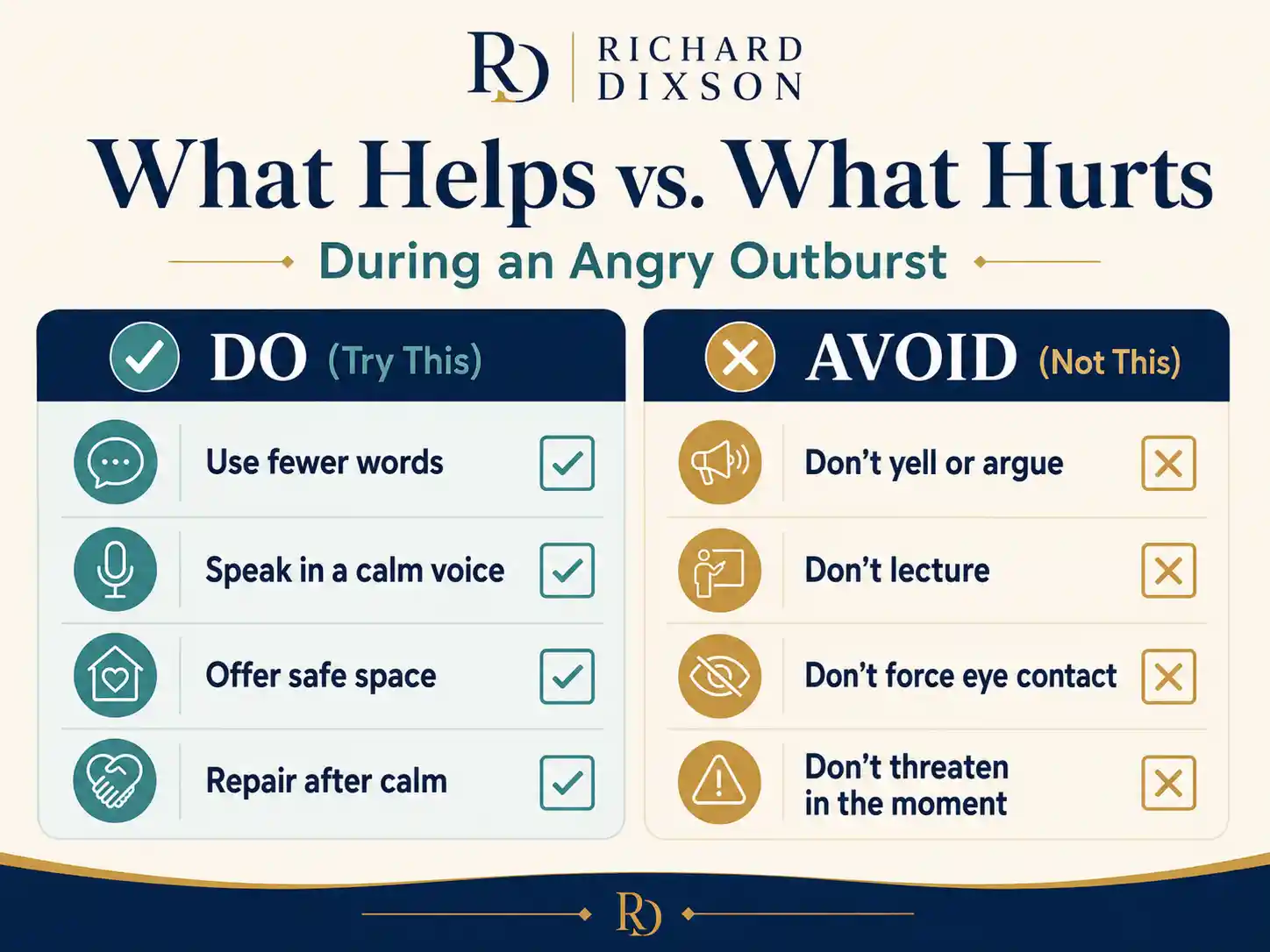
Try to avoid:
- yelling over the child
- giving long lectures
- asking too many questions
- threatening consequences immediately
- forcing eye contact
- crowding the child’s space
- using shame-based language
- saying, “You always do this”
- trying to solve everything while the child is still dysregulated
This does not mean you let the child take over.
It means you lead differently.
You become quieter.
You become clearer.
You become steadier.
Sometimes the strongest parent in the room is not the loudest one.
Sometimes the strongest parent is the one who can stay grounded when the moment wants to pull everyone into chaos.
What to Do in the First 60 Seconds
In the first minute, do not try to solve the whole problem.
Focus on three things:
- Make sure everyone is safe.
- Lower your own voice and body tension.
- Use one short sentence instead of a lecture.
The 90-second rule is worth knowing here: research suggests that the initial wave of an emotional response in the body lasts about 90 seconds. After that, it is the thoughts we keep feeding that keep the feeling going. Giving a child (and yourself) a brief pause can make a real difference.
A helpful first sentence could be:
“You’re safe. I’m here. We are going to slow this down.”
Step 1: Check Safety First
Before anything else, check safety.
Ask yourself:
- Is the child safe?
- Are other children safe?
- Am I safe?
- Are there objects that need to be moved?
- Does the child need more space?
- Do I need help from another adult?
- Is this a situation where professional or crisis support is needed?
If the child is hurting themselves, threatening serious harm, using objects dangerously, or putting others at risk, safety comes first.
In those moments, this blog is not a substitute for professional support, safety planning, caseworker guidance, or emergency help when needed.
Trauma-informed parenting does not mean handling dangerous situations alone.
It means responding with awareness while still protecting everyone in the home.
A safe boundary might sound like:
- “I will not let you hurt yourself.”
- “I will not let you hurt your brother.”
- “I am moving this away to keep everyone safe.”
- “We are going to get help.”
Safety is not punishment. Safety is protection.
Step 2: Lower the Emotional Temperature
An angry child often brings intensity into the room.
The adult’s job is not to add more intensity.
The adult’s job is to lower the emotional temperature.
That starts with your body.
Before you speak, pause.
Take one breath.
Unclench your jaw.
Lower your shoulders.
Soften your face.
Lower your voice.
This does not mean you are not serious.
It means you are regulated enough to lead.
A dysregulated adult cannot easily help a dysregulated child. This is the foundation of co-regulation — when a calm caregiver helps a child’s nervous system find safety again.
You might say:
- “I’m going to speak quietly so we can get through this.”
- “I’m here. I’m not going to yell.”
- “We can slow this down.”
Sometimes children who have experienced trauma are used to adults becoming loud, unpredictable, or frightening. When you stay steady, you are not just managing a behavior.
You are showing the child a different kind of adult.
Free Resource
Want a simple place to start?
Get Richard Dixson’s free guide, 3 Days to a Peaceful Home, and learn practical steps to bring more calm, connection, and emotional safety into your home.
Step 3: Use Fewer Words
When a child is escalated, fewer words are often better.
A long explanation may be too much.
A lecture may feel like pressure.
Too many questions may feel like interrogation.
Keep your language short and steady.
Instead of saying:
“Why are you acting like this? You know better. We talked about this yesterday. If you keep doing this, you are going to lose everything.”
Try:
- “You’re safe.”
- “I’m here.”
- “Throwing is not okay.”
- “We can try again.”
- “I’ll talk when your body is calmer.”
Short phrases are easier for an overwhelmed child to hear.
They also help you stay calm.
When you use fewer words, you give the moment less fuel.
Step 4: Name Safety Before Correction
Many children from hard places need to know that correction will not destroy the relationship.
They may hear correction as rejection.
They may feel a limit as abandonment.
They may experience your disappointment as danger.
This is why naming safety matters. It is also why the principle of connection before correction is one of the most important shifts foster parents can make.
Try phrases like:
- “You are safe.”
- “I am here.”
- “I am not leaving because this is hard.”
- “We are going to get through this.”
- “This behavior is not okay, and I still care about you.”
Notice the balance.
You are not saying the behavior is acceptable.
You are saying the relationship is still steady.
That steadiness matters.
A child who has lived with instability may need repeated experiences of an adult staying present through conflict.
Not perfect.
Present.
Step 5: Set One Clear Limit
In anger, children still need boundaries.
A calm response does not mean no limit.
It means the limit is simple, clear, and not wrapped in threat.
Say one thing. Not five.
Examples:
- “I won’t let you hit.”
- “I won’t let you throw that.”
- “You can be mad. You cannot break things.”
- “You can say, ‘I’m angry.’ You cannot scream in my face.”
- “We are taking a break. We will come back to this.”
The limit should be short enough for the child to understand and strong enough to protect safety.
A good trauma-informed limit is both calm and firm.
It does not shame.
It does not beg.
It does not attack the child’s character.
It focuses on the behavior and the next safe step.
If you have ever wondered why consequences alone are not working, this is often why: the limit lands better when the child already feels safe enough to hear it.
Step 6: Give Space Without Abandoning
Some children need closeness when they are upset.
Others need space.
Some want comfort but do not know how to receive it.
Some push away help because closeness feels unsafe.
Pay attention to the child in front of you.
If the child needs space, you can step back without emotionally disappearing.
You might say:
- “I’m going to give you a little space. I’ll be right here.”
- “You don’t have to talk right now.”
- “I’m close enough to help, but I won’t crowd you.”
This matters because some children experience space as rejection.
So the message is: “I am giving you room, not giving up on you.”
That difference can change the feeling of the moment.
Step 7: Do Not Demand a Lesson Too Soon
When the child begins to calm down, it can be tempting to start teaching immediately.
But calm-looking does not always mean fully regulated.
Give the child a little time.
Let the nervous system settle.
A repair conversation works better when the child can actually hear you.
You might wait a few minutes.
You might offer water.
You might sit nearby.
You might say:
“We’ll talk in a little while. For now, let’s breathe.”
The lesson matters.
But timing matters too.
A child cannot learn well while still drowning in shame, fear, or overwhelm.
Understanding the difference between co-regulation and self-regulation can help here. Self-regulation is a skill children build over time and they build it by borrowing your calm first.

What TBRI Looks Like in a Real Moment
Imagine a foster child becomes angry because screen time is over.
They yell, “I hate this house!”
Then they throw the remote onto the couch.
A reactive response might sound like:
“That’s it. No screens for a week. You’re being disrespectful.”
That response is understandable.
You may be tired.
You may feel disrespected.
You may want the behavior to stop immediately.
But if the child is already escalated, the moment may grow bigger.
A calmer, trauma-informed response might sound like:
“Throwing is not okay. You are safe. I can see this is hard. I’m going to move the remote, and we’ll talk when your body is calmer.”
Then you pause.
You do not lecture.
You do not argue with “I hate this house.”
You do not try to make the child grateful.
Later, when the child is calmer, you return to repair:
“Earlier, you were really angry when screen time ended. It is okay to be angry. It is not okay to throw things. Next time, you can say, ‘I’m mad,’ or ask for help taking a break. Let’s practice what you can say.”
That is the work.
Safety first.
Limit second.
Repair later.
For a deeper look at how TBRI applies in practical everyday scenarios, see what foster parents need to know about TBRI.
Helpful Scripts for Foster Parents
Sometimes it helps to have words ready before the hard moment comes.
Here are simple scripts you can practice:
When the child is yelling
“I hear that you are angry. I am going to speak calmly.”
When the child says hurtful words
“You are really upset. I will not let those words decide how I respond to you.”
When the child throws something
“Throwing is not safe. I am moving this now. We will talk when your body is calmer.”
When the child refuses to move
“You can walk with me now, or we can take one minute and try again.”
When the child says, “You’re not my real parent”
“You’re right. I am not replacing anyone. I am here to keep you safe and care for you right now.”
When the child cries after anger
“That was a hard moment. I’m still here.”
These scripts are not magic.
They are anchors.
They help you know what to say when your own nervous system wants to react.
How to Repair After the Child Calms
Repair is where learning often begins.
Not during the yelling.
Not during the throwing.
Not during the slammed door.
After.
When the child is calmer, you can return gently.
Repair might include:
- naming what happened
- validating the feeling
- restating the boundary
- practicing a better response
- making amends if needed
- reminding the child the relationship is still intact
A repair conversation might sound like:
“That was a big moment earlier. You were angry when I said no to screen time. It is okay to feel angry. It is not okay to throw things. Next time, we can try using words or taking space. I still care about you, and we can practice again.”
Repair teaches something important:
Conflict does not have to end in disconnection.
Hard moments can be repaired.
The relationship can survive the storm.
For children who have experienced broken trust, that lesson matters deeply. If you want to understand more about how that broken trust develops, learning about what traditional parenting advice misses for children with trauma is a helpful next step.
How Richard Dixson’s Work Connects to This
Richard Dixson’s work is built around a simple but powerful idea:
A calmer home is not created by control alone.
It is built through safety, connection, structure, repair, and repeated moments of choosing a different response.
When a foster child is angry, the adult is not just managing behavior.
The adult is shaping the emotional climate of the home.
That does not mean being passive.
It means leading with calm.
It means understanding that behavior often has a story.
It means holding boundaries without using fear as the teacher.
It means remembering that children do well when they feel safe enough to do well.
And it means giving yourself grace as the caregiver too.
You will not handle every moment perfectly.
No parent does.
But each time you pause before reacting, soften your voice, set a clear limit, and come back for repair, you are practicing a different pattern.
That pattern can become part of the child’s healing environment.
For a Deeper Approach
For a deeper approach to trauma-informed parenting, explore Richard Dixson’s book, The Drama-Free Parent.

What If the Child’s Behavior Becomes Unsafe?
If a child’s anger becomes physically unsafe, take it seriously.
Trauma-informed parenting does not mean staying in a dangerous situation without support.
You may need to:
- move other children away
- remove dangerous objects if safe to do so
- call another adult for help
- follow the child’s safety plan
- contact the caseworker or professional support team
- seek emergency help if there is immediate danger
You can be compassionate and still act firmly.
You can understand trauma and still protect the home.
You can love a child and still need more support.
Those things can all be true at the same time.
Foster caregivers carrying this kind of weight may also benefit from looking into kinship caregiver support resources — the emotional toll on caregivers is real and worth taking seriously.
Key Takeaways
Calming an angry foster child is not about having the perfect words.
It is about becoming a steady presence in a difficult moment.
Remember:
- Anger may be covering fear, grief, stress, or overwhelm.
- Safety comes before teaching.
- Fewer words are often better.
- A lower voice can help reduce threat.
- A clear limit is still necessary.
- Correction works better after regulation.
- Repair helps rebuild connection.
- Foster parents need support too.
The goal is not perfection. The goal is a different pattern. One calmer response at a time.
FAQ
Why does my foster child get angry so quickly?
A foster child may get angry quickly because their nervous system has learned to stay alert for danger, rejection, or loss. Anger may be a protective response, especially when the child feels overwhelmed, ashamed, unsafe, or out of control. The Child Welfare Information Gateway has helpful resources on understanding how trauma shapes a child’s behavior.
Should I discipline my foster child during an outburst?
During a major outburst, the first priority is safety and regulation. Correction and teaching usually work better after the child has calmed down. You can still set a clear limit in the moment, but save the deeper conversation for later.
What should I say to an angry foster child?
Use short, calm phrases such as: “You are safe,” “I am here,” “I will not let you hurt yourself or anyone else,” and “We can talk when your body is calmer.” Avoid long lectures while the child is escalated.
Does staying calm mean I am letting the child get away with bad behavior?
No. Staying calm does not mean there are no boundaries. It means you are setting limits without adding fear, shame, or more escalation. Calm correction can still be firm. How to be a calmer parent covers this in more depth if you want a practical guide.
What if my foster child says hurtful things?
Try not to respond to the hurtful words as if they are the whole truth. You can say, “You are really upset. I will not let those words decide how I respond to you.” Address the words later when the child is calmer.
How can I stay calm when I feel triggered too?
Start by noticing your own body. Take one breath before speaking. Lower your voice. Use fewer words. If another safe adult is available, ask for support. You are human, and your regulation matters too. Many foster and kinship caregivers find that understanding their own nervous system response helps them pause before reacting.
What if the child becomes physically unsafe?
If the child becomes unsafe toward themselves or others, follow the child’s safety plan, involve appropriate professional support, contact the caseworker if needed, or seek emergency help if there is immediate danger.
Can anger improve over time with trauma-informed parenting?
Many children can learn healthier ways to express anger when they repeatedly experience safety, structure, connection, and repair. Change usually takes time and support. The American Academy of Pediatrics guidance on childhood trauma is a good external reference if you want clinical context. The goal is not instant perfection, but a safer pattern over time.
What if my foster child has angry outbursts every day?
If angry outbursts happen daily or feel increasingly unsafe, the child may need more support than one caregiver can provide alone. Track patterns such as time of day, transitions, hunger, sleep, contact visits, school stress, or sensory overload. Why children melt down after school is a useful read for patterns tied to transitions. Share those patterns with the child’s caseworker, therapist, or support team so the response plan can become more specific and supportive.
Final Next Step
If you are trying to create more calm in your home, start small.
Richard Dixson’s free guide, 3 Days to a Peaceful Home, gives you practical steps to begin building more emotional safety, connection, and calm during difficult moments.