
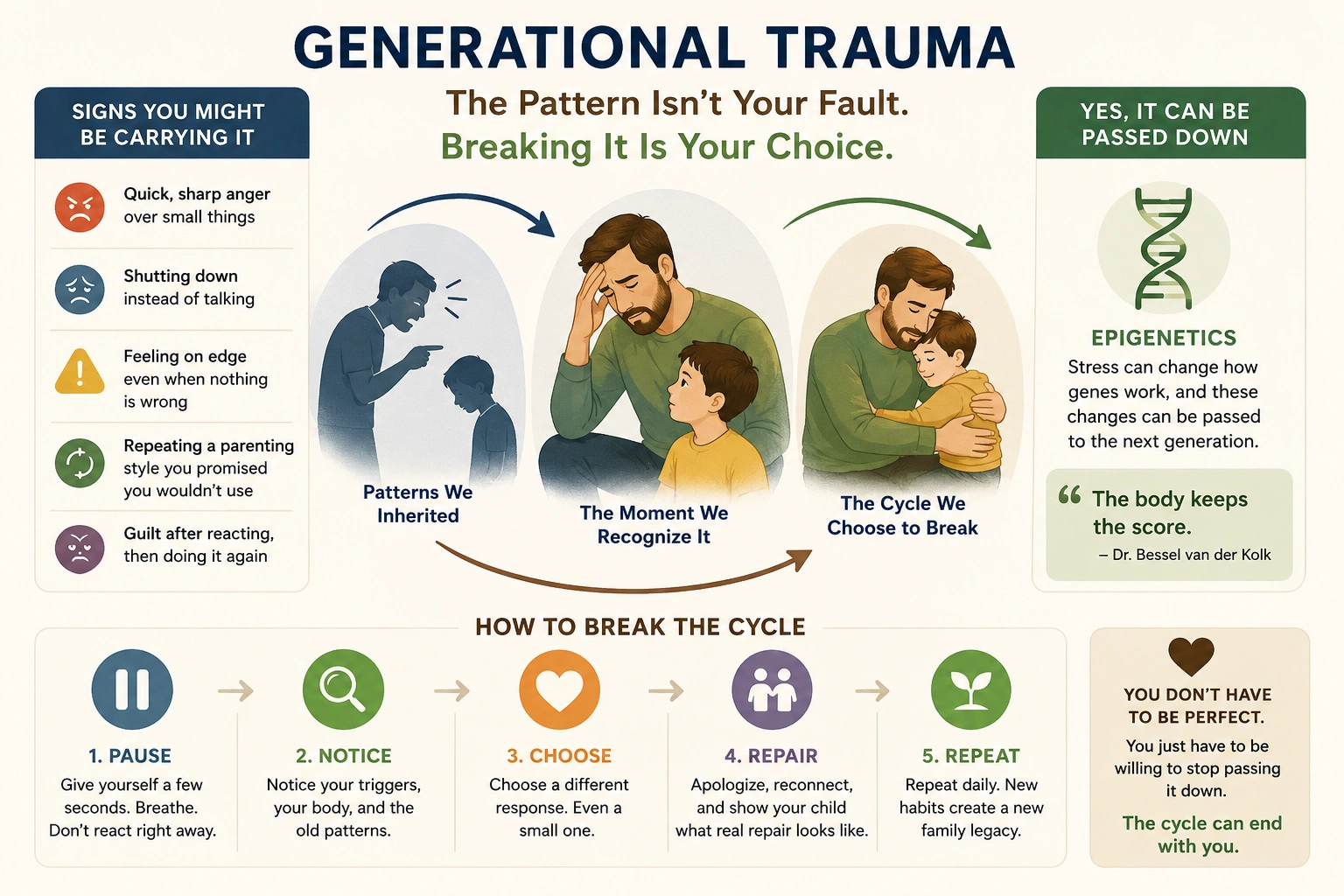
Generational trauma shows up as feelings and reactions that get passed from parent to child, without anyone meaning for it to happen. The most common signs are quick anger over small things, shutting down instead of talking, harsh discipline, or a tight, anxious feeling in your body when things get tense at home. If any of this sounds like you, you are not broken. You are carrying something that was never healed. And the good news is, it can stop with you.
What Are the Signs of Generational Trauma?
Generational trauma does not always look big or dramatic. Most of the time, it looks like small habits that repeat without anyone noticing. Here are the most common signs:
- Quick, sharp anger over things that are not really a big deal
- When things get difficult, shutting down rather than speaking
- Feeling on edge, even when nothing is wrong (this is called hypervigilance)
- Repeating a parenting style you told yourself you would never use
- Having trouble maintaining control under pressure in front of your children
- Feeling guilty immediately after reacting, then experiencing the same reaction later
None of these signs mean something is wrong with you as a person. They mean your body and mind learned certain reactions a long time ago, and those reactions are still running the show. If you want to understand where this pattern comes from in the first place, our guide on what generational trauma really is breaks it down further.
Why Do I Continue to React the Way My Parents Did?
Generational trauma is easiest to understand through a real moment, not a definition.
I once asked my child to do something simple. They did not listen. I asked again, a little louder. Still nothing. Then it happened. My voice came out sharp and loud, way harsher than I meant it to be. I made a self-promise to never use that tone.
For a second, everything got quiet. Not outside. Inside.
Because that reaction felt familiar. Not just the anger, but the whole feeling behind it. I was not just hearing myself. I was listening to my own father.
Instead of just feeling horrible about it, that one event motivated me to read about generational trauma. If you have had a moment like that, you already know exactly what I am talking about. I wrote more about that full story and what changed after it in the day I realized I was repeating my father’s patterns.
How Can You Tell If You Have Generational Trauma?
If you frequently behave in ways that you subsequently regret, especially when those behaviors feel automatic or bring back memories of your own childhood, you may have generational trauma. One of the clearest signs is noticing yourself saying or doing things you once promised you never would.
A simple way to check is to ask yourself a few honest questions:
- Do I react before I even think about it, especially when I feel disrespected or ignored?
- Do I use words or a tone I heard from my own parents, even though I hated it as a kid?
- Do I feel calm one minute and overwhelmed the next, with no real warning?
- Do I avoid conflict completely, or do I go too far the other way and control everything?
- Do I feel guilty after I react, but find myself doing the same thing again soon after?
If you answered yes to two or more of these, that is a sign your nervous system learned these patterns early in life, and it is simply repeating what it knows. You are not a horrible parent because of this. It makes you a human being who has not had the chance to unlearn it yet.
Can Generational Trauma Be Passed Down Genetically?
This is one of the most asked questions about generational trauma, and the answer is yes, in part.
Researcher Dr. Rachel Yehuda studied children of Holocaust survivors and found changes in stress hormones like cortisol that were passed down, even in children who never lived through the trauma themselves.
This field is called epigenetics, and in simple terms, it means stress can change how genes are switched on or off, and that change can be passed to the next generation.
“As trauma researcher Dr. Rachel Yehuda has explained, trauma does not just affect the people who experience it directly. Its biological effects can sometimes influence future generations as well. Her work has helped researchers better understand how stress can leave lasting marks on the body across generations.”
This does not mean trauma is permanent or unchangeable. It means the body remembers stress even when the mind does not, which is why healing has to include the body, not just talk therapy.
“As Dr. Bessel van der Kolk writes in The Body Keeps the Score, “the body keeps the score.” His research explains that traumatic experiences are often stored in the nervous system long after the original event has passed. “
What Are Examples of Generational Trauma in Everyday Parenting?
Generational trauma shows up in ordinary, everyday parenting moments, not just big blowups. A few real examples:
- Yelling first, then feeling terrible about it later
- Expecting instant obedience instead of connection
- Feeling triggered by small things, like whining or a messy room
- Struggling to comfort a crying child because comfort was never modeled for you
- Avoiding rest or asking for help because you were taught to “push through”
If you are parenting a child who came from a hard background, whether through foster care, kinship care, or raising grandchildren, these patterns often show up even stronger. Our post on secondary trauma in grandparents raising grandchildren covers this in more depth.
How Do You Start Breaking the Cycle?
Breaking a generational pattern does not start with a big change. It starts with a pause.
Over the years, I have noticed something interesting. Parents rarely struggle because they do not love their children enough. They struggle because their nervous system reacts before their values have a chance to. Once they learn to notice that moment, real change becomes possible.
The next time you feel triggered, try giving yourself space before reacting, even just a few seconds. This short pause gives your nervous system time to settle before your mouth or hands do anything. We call this the 90-second rule, and it is one of the simplest tools we teach.
From there, healing generational trauma is less about becoming perfect and more about noticing, pausing, and repairing when you get it wrong. Our full guide on how to break generational trauma step by step walks through this process in detail, and our post on healing generational trauma while caregiving speaks directly to grandparents and kinship caregivers doing this work later in life.
Why Isn’t Knowing About Generational Trauma Enough to Break the Cycle?
Naming generational trauma is not the finish line. It is the starting line.
A lot of parents stop right after they understand where the pattern came from. They feel relief, then nothing changes. Real change only happens when awareness turns into daily practice, pausing before reacting, repairing after mistakes, and choosing calm on purpose, over and over, until it becomes normal.
Chaos was inherited. Calm has to be learned.
Understanding your patterns is important, but awareness alone does not change a family. What changes a family is practicing something different in the small moments especially the ones that feel hardest. Every calm response becomes something your children can learn instead of recover from.
That is the whole difference.
If you are ready to put this into practice instead of just understanding it, The Drama-Free Parent walks through exactly how, step by step. You can also grab our free guide to calmer days at home, or join The Parents Hub for ongoing support from other parents doing this same work.