
TBRI (Trust-Based Relational Intervention) is a trauma-informed, attachment-based parenting approach that helps foster parents respond to a child’s behavior by addressing the fear, safety, and attachment needs underneath it.
Foster parenting brings moments that don’t make sense at first a child lying when the truth would’ve been easier, refusing comfort, exploding over something small, then testing the relationship again the next day.
From the outside, this can look like defiance. Underneath, it’s often fear a nervous system that learned to protect itself before it learned to trust.
TBRI doesn’t ask you to become a perfect parent. It asks you to pause before reacting and ask a different question: what does this child need from me right now to feel safe enough to do better?
Unlike general parenting advice, TBRI was developed specifically for children affected by trauma, disrupted attachment, and adversity. That makes it especially relevant for foster parents who often discover that traditional discipline alone doesn’t change the behaviors they’re seeing.
At a Glance
- TBRI stands for Trust-Based Relational Intervention.
- It helps foster parents understand what may be underneath a child’s behavior.
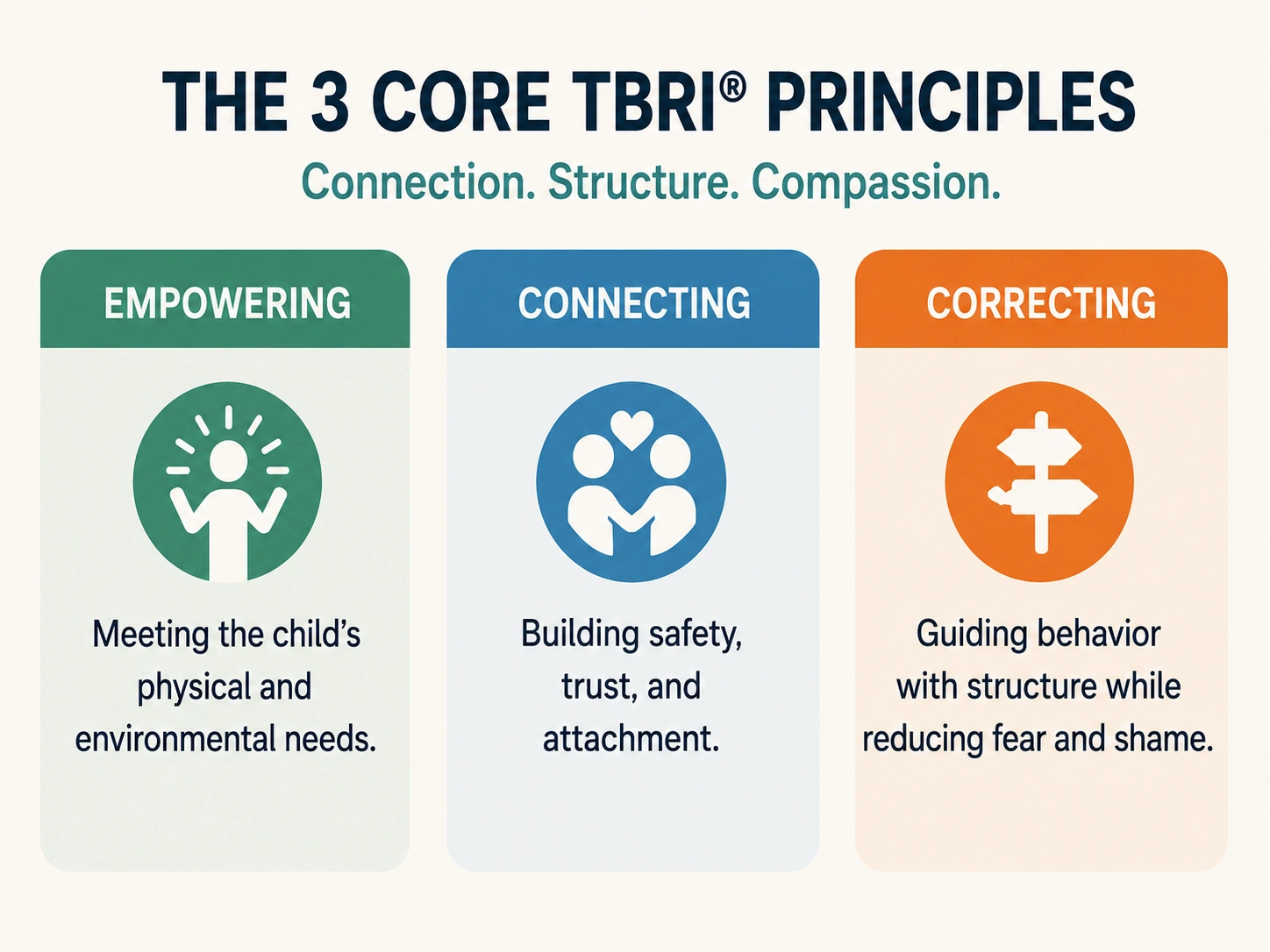
- The three core areas are Empowering, Connecting, and Correcting Principles.
- TBRI doesn’t remove boundaries it changes how correction happens.
- The goal is safety, connection, structure, and trust.
TBRI isn’t only for foster parents; kinship caregivers and grandparents use it too, and it doesn’t mean “no consequences.” More on both below.
In One Sentence
TBRI helps foster parents understand that challenging behavior is often a child’s attempt to feel safe rather than an attempt to be difficult, allowing caregivers to respond with connection, structure, and trust instead of fear or punishment.
What Is TBRI?
TBRI is a trauma-informed approach that helps caregivers support children who’ve experienced adversity, neglect, or instability. It was created by Dr. Karyn Purvis and Dr. David Cross through the Karyn Purvis Institute of Child Development at Texas Christian University.
It’s built around three connected principles Empowering (meeting physical and environmental needs), Connecting (building trust and safety), and Correcting (guiding behavior without fear or shame). Instead of treating hard behavior as disrespect, TBRI asks: what is this behavior trying to communicate?
If Your Child Is Escalating Right Now, Start Here
In the moment, don’t explain; regulate first.
Lower your voice, use fewer words, and say, “You’re safe. I’m here.” Set one clear limit, then come back later to talk once things are calmer. This helps the child’s nervous system borrow some of your calm, often called co-regulation.
For a full toolkit of in-the-moment techniques, see our co-regulation strategies for caregivers guide. If meltdowns tend to happen in public, TBRI techniques for public meltdowns cover that specific scenario.
Why Foster Parents Need a Different Lens
Many foster children also experience multiple placement transitions before arriving in a stable home. Each move can reinforce the belief that relationships are temporary, making it much harder to trust new caregivers even when they provide safety and consistency.
That’s the gap between actual safety and a child’s felt safety, what their nervous system believes to be true. It’s why a consequence may not teach if a child is in survival mode and why TBRI asks you to slow down and see the moment differently rather than just louder or firmer.
One thing I’ve noticed over the years is that many foster parents assume difficult behavior means the child doesn’t appreciate their care. More often, the behavior reflects a child testing whether this home is truly different from the ones they’ve known before, a pattern explored further in Why Does My Child Only Melt Down with me?
Behavior Is Often a Signal, Not the Whole Story
Behavior is often the visible part of an invisible need, not simple disrespect.
- A child who steals food may fear scarcity.
- A child who lies may be avoiding shame.
- A child who rejects affection may be protecting against another loss.
Seeing only the behavior leads to control. Seeing what’s underneath it allows connection plus structure, and that’s where healing tends to start.
Common Foster Parenting Challenges TBRI Can Help With
| Challenge | How TBRI Helps |
| Food hoarding | Builds felt safety through predictable access |
| Lying | Reduces shame while encouraging honesty |
| Bedtime struggles | Uses regulation before correction |
| Aggression | Co-regulation before consequences, see how to calm an angry foster child |
| Attachment difficulties | Builds trust through repeated connection |
| Transition anxiety | Uses routines and predictability |
| Difficulty accepting affection | Builds trust gradually without forcing closeness |
The Three Core Parts of TBRI
TBRI’s three principles work together: if a child’s body doesn’t feel safe, connection is harder; without connection, correction feels like threat; without correction, boundaries never take hold. Here’s a short overview of each with links to our full breakdown of each principle.
1. Empowering Principles
Before a child can listen or cooperate, their body often needs support first: enough food, rest, predictability, and a regulated sensory environment. A hungry, tired, or overstimulated child simply has less capacity to respond well.
2. Connecting Principles
Connection isn’t a reward for good behavior; it’s part of what creates better behavior. Trust is built through small, repeated moments of safety: a softer tone, a choice instead of a command, staying near without crowding.
Free Resource: Want a simple place to start? Get Richard Dixson’s free guide, 3 Days to a Peaceful Home. [GET THE FREE GUIDE]
3. Correcting Principles
TBRI doesn’t remove correction; it changes how correction happens. For a child with a trauma history, a harsh consequence can feel like danger rather than guidance. TBRI-informed correction stays firm and connected: “This isn’t okay, and I’m still here.”
This article focuses on how foster parents apply these principles in everyday life. For a complete explanation of each principle, read our full guide: TBRI principles every parent should know.

What TBRI Looks Like in a Real Moment
A foster child throws a toy after screen time ends. A reactive response might be, “Stop it right now; you’re losing screen time tomorrow too.” Understandable, but it can escalate an already overwhelmed child, and often turns into a power struggle that has little to do with the original request.
A TBRI-informed response instead: “Throwing is not okay. You are safe. Let’s take a breath, then we’ll try again.” Later, once calm: “The toy was thrown, so we need to make that right.”
The boundary stays. So does the relationship.
With an older child or teen, the same sequence applies: a slammed door after being told to get off the phone often comes from the same place as a younger child’s tantrum. Pause, hold the boundary, and repair later. The words change with age; the approach doesn’t.
What TBRI Is Not
TBRI isn’t a magic fix, and it’s not a replacement for therapy or professional support when those are needed.
It asks the caregiver to hold two truths at once: the child needs compassion, and the child still needs guidance. If you want to go further, formal TBRI training is available through TCU’s Karyn Purvis Institute, though you don’t need it to start using these ideas today.
How Is TBRI Different From Gentle Parenting?
TBRI is built specifically for children impacted by trauma; gentle parenting is a general parenting philosophy. Both value connection, but TBRI adds explicit structure and correction designed around fear, attachment, and a nervous system on alert.
| TBRI | Gentle Parenting | |
| Designed for | Children impacted by trauma or attachment disruption | General parenting philosophy for all children |
| Core focus | Felt safety, connection, structured correction | Empathy, respect, non-punitive guidance |
| Best suited for | Foster, adoptive, and kinship caregivers | Any parent seeking a connection-based approach |
TBRI and Kinship or Grandparent Caregivers
TBRI isn’t only for licensed foster parents; kinship caregivers and grandparents raising grandchildren face the same dynamics, often with less preparation time. See what no one tells grandparents raising grandchildren or our broader kinship caregiver support guide.
The Foster Parent Needs Support Too
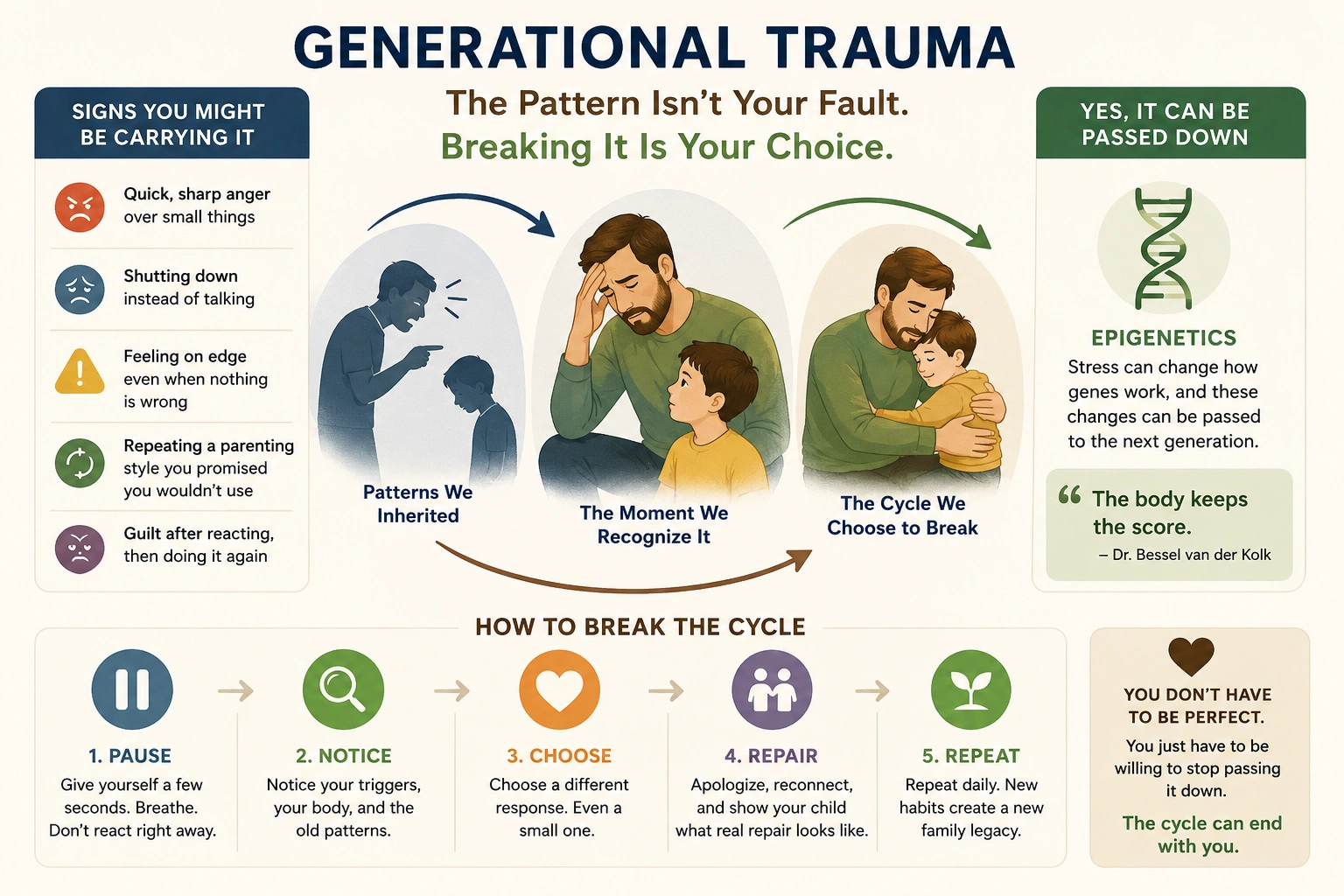
Your own regulation matters as much as the child’s. You can be triggered and get tired and still be a good caregiver. The goal is steadying yourself first so you can respond from peace, not panic. If your own history plays into this, see generational trauma and parenting.
How Richard Dixson’s Work Connects to TBRI
Richard Dixson is a trained TBRI facilitator who, together with his wife, has applied trauma-informed parenting principles while raising their own grandchildren. Rather than offering theory alone, he shares practical strategies shaped by real caregiving experiences, helping parents and caregivers build calmer, more connected relationships with children affected by trauma.
Richard Dixson’s work focuses on helping families move from chaos toward calm, not by pretending hard moments are easy, but by learning to respond differently inside them. For foster families, that matters: many kids aren’t just learning new rules; they’re learning whether home can feel different this time.
A Simple TBRI-Informed Practice for Today
Try this four-step pause during one hard moment this week:
- Pause before you speak.
- Soften your voice and face.
- Name safety: “You’re safe. I’m here.”
- Set the limit simply, then try again.
You don’t have to do it perfectly; just practice a different pattern.
For a deeper approach, explore Richard Dixson’s book, The Drama-Free Parent. [VIEW THE BOOK]

Is This Guide Right for You?
This guide is especially helpful if you’re:
- a new foster parent
- caring for siblings in foster care
- preparing for your first placement
- supporting a child with trauma-related behaviors
- looking for alternatives to traditional discipline
Key Takeaways for Foster Parents
- Behavior is often communication.
- Safety comes before trust.
- Connection prepares the child for correction.
- Boundaries still matter.
- Repair is part of healing.
- Small, consistent moments of safety build trust over time.
FAQ
What does TBRI stand for?
Trust-Based Relational Intervention is a trauma-informed approach for caregivers supporting children who’ve experienced adversity or instability.
Can TBRI Help a Foster Child With Attachment Difficulties?
Yes.
While every child is different, TBRI was specifically developed for children who’ve experienced disrupted attachment, neglect, or trauma. By consistently creating emotional and physical safety, caregivers can begin rebuilding trust over time.
Is TBRI only for foster parents?
No. It also supports adoptive parents, kinship caregivers, grandparents, and educators.
Does TBRI mean there are no consequences?
No. It keeps boundaries and correction, but delivers them in a way that protects safety and connection.
Why is connection important before correction?
A child who feels safer is more able to listen, learn, and repair afterward.
Can TBRI help with emotional outbursts?
Yes it helps caregivers respond with more calm and structure, though it won’t guarantee instant change.
What if my foster child’s behavior feels unsafe?
Involve your caseworker, therapist, or crisis resources. Asking for help doesn’t mean you’ve failed.
Can I use TBRI without formal training?
Yes. Formal training helps you go deeper, but isn’t required to begin.
How long before I see a difference?
Small shifts often appear within weeks; deeper trust usually builds over months.
Can TBRI be used alongside therapy?
Yes many caregivers use both together.
Looking for more support? Visit the Parents Hub for more foster-parenting guides and tools.
Final Next Step
Every calm response won’t change everything overnight, but repeated moments of safety, connection, and repair can gradually reshape how a child experiences relationships. That’s the long-term goal of TBRI and the journey Richard Dixson’s resources are designed to support.