Have you ever heard someone say,
“That’s generational trauma.”
Then someone else describes a similar experience as childhood trauma. It’s easy to understand why these terms are frequently confused.
Both can shape how we think, feel, relate to others, and even how we parent. However, they don’t represent the same thing.
I’ve noticed that many people carry unnecessary guilt because they aren’t sure where one ends and the other begins.
You may be wondering:
- Was my childhood traumatic?
- Are these patterns something I learned growing up?
- Or am I carrying something that started long before I was born?
Understanding the difference won’t change your past, but it can help you understand your story with greater clarity. In this guide, we’ll look at what makes childhood trauma and generational trauma different, where they overlap, and why that distinction matters.
Childhood Trauma vs Generational Trauma: The Quick Answer
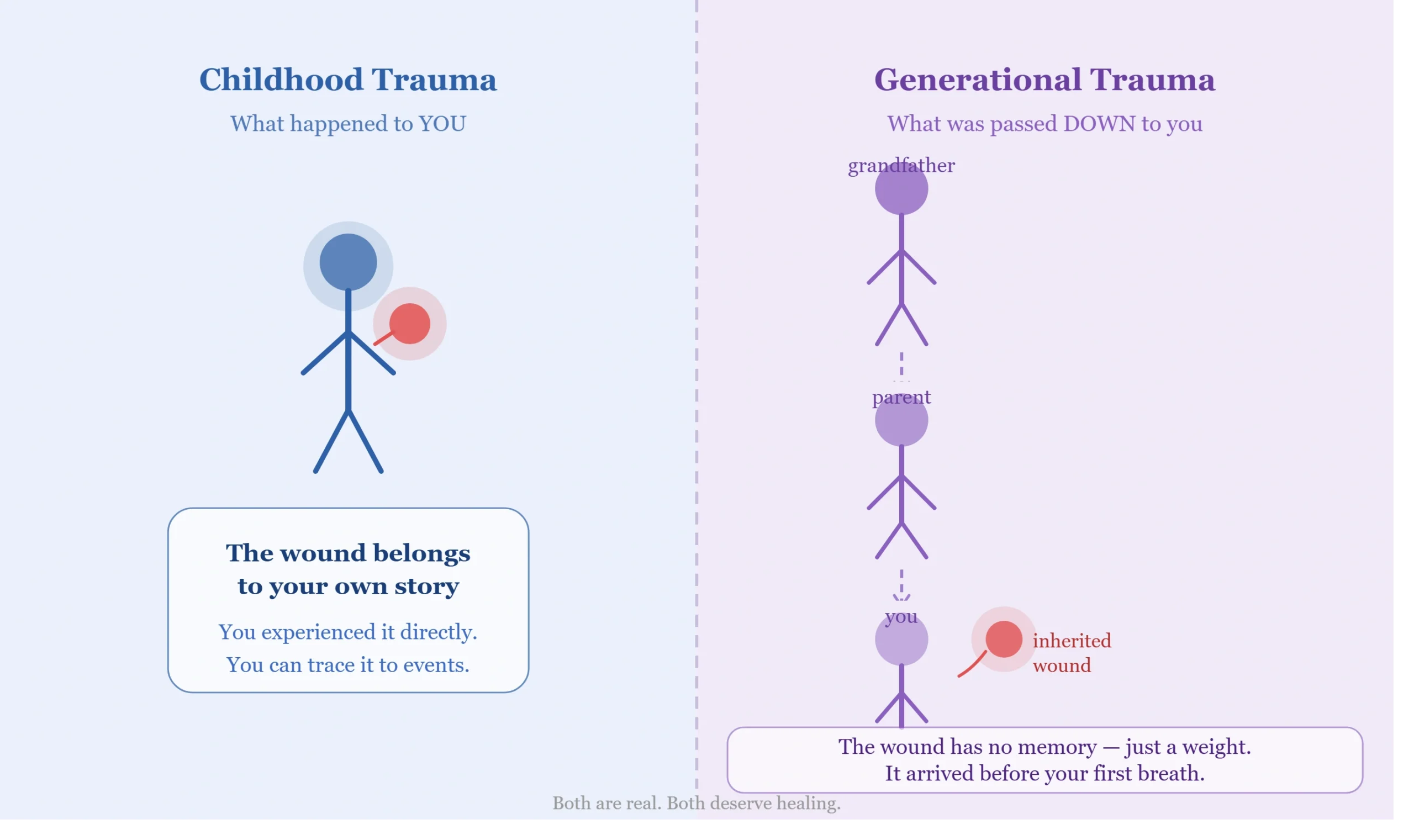
Think of it this way: childhood trauma explains the child’s experience, while generational trauma explains the family context around that experience.
They’re connected.
But they aren’t interchangeable. A person can experience childhood trauma without generational trauma.
A family can carry generational trauma even if no one talks about where those patterns began.
And many people experience both at the same time. Understanding that distinction doesn’t change the past. But it can change how you understand it.
Before comparing them side by side, let’s quickly look at how each one is different at a glance.
Childhood Trauma vs Generational Trauma at a Glance
| Childhood Trauma | Generational Trauma |
| Happens directly to a child | Develops across multiple generations |
| Begins with personal experiences | Begins with family patterns and coping strategies |
| Shapes one person’s emotional development | Can influence an entire family system |
| Focuses on what happened to the child | Focuses on what has been carried through the family |
| May affect future relationships and parenting | May influence the environment children grow up in |
If you’re reading this and thinking,
“They still sound very similar.”
You’re not alone.
Now let’s look at what each one actually means before comparing them in more detail.
What is childhood trauma?
Childhood trauma isn’t only about what happened. It’s also about how those experiences affected a child’s sense of safety and emotional well-being.
For some children, trauma may follow a single overwhelming event. For others, it develops through repeated experiences that leave them feeling unsafe, unseen, or emotionally unsupported.
The simplest way to think about it:
Childhood trauma explains what happened to you and how those experiences may still affect you today. It reflects what you experienced and how those experiences may continue to influence relationships, stress, and parenting later in life.
In fact, according to the CDC’s Behavioral Risk Factor Surveillance System, nearly 64% of U.S. adults report experiencing at least one adverse childhood experience (ACE), and 1 in 6 report four or more.
What is Generational Trauma?
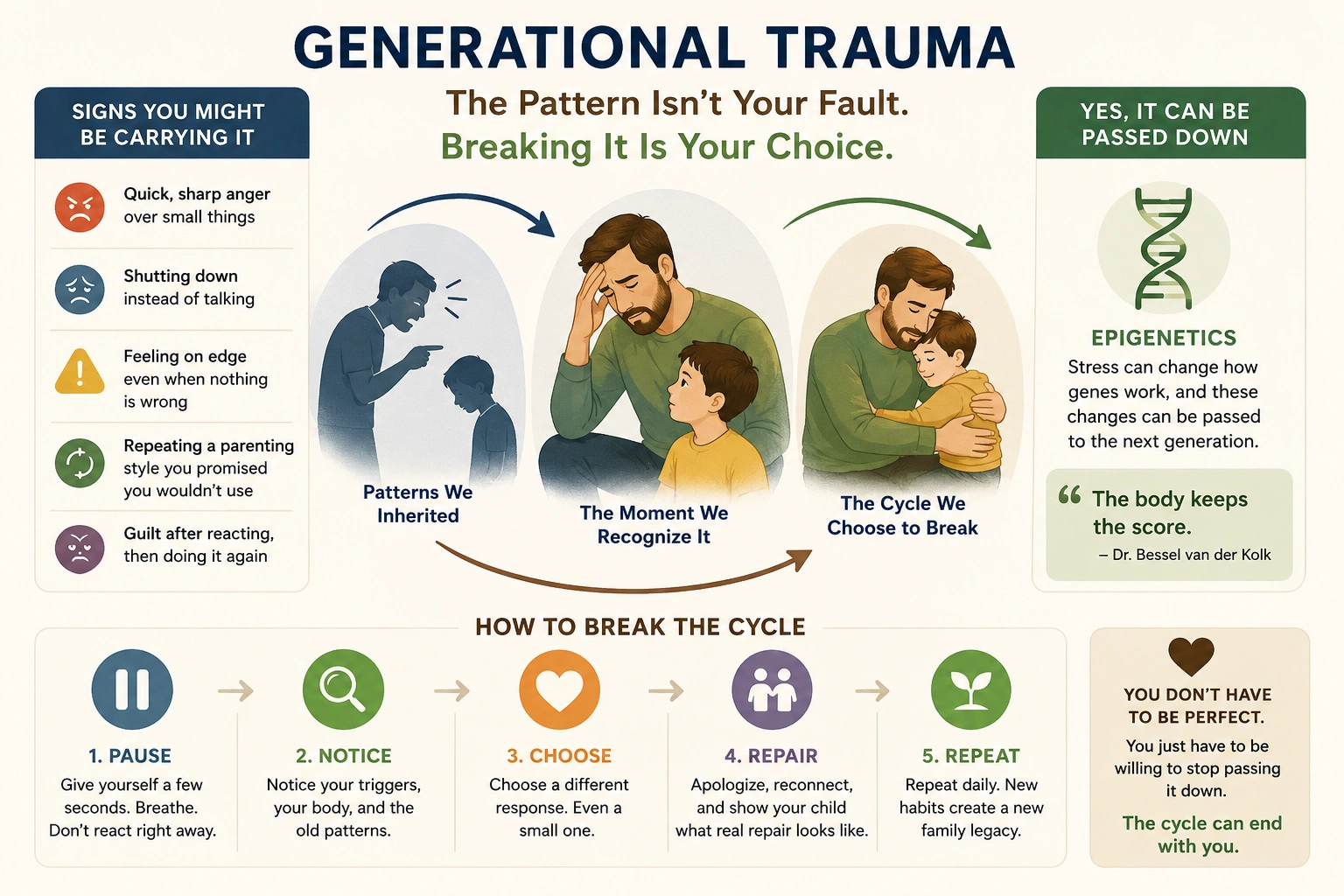
Unlike childhood trauma, generational trauma isn’t about one person’s experiences; it’s about patterns that continue across generations.
I’ve noticed that many parents genuinely want to do things differently, yet during stressful moments they find themselves reacting in familiar ways. That doesn’t automatically mean they’re repeating trauma, but it reminds us that we all learn from the families we grow up in.
Over time, those learned ways of coping can become part of a family’s emotional culture. Children observe them, adapt to them, and may carry some of those patterns into adulthood without realizing where they began.
Think of it this way:
Childhood trauma explains the child’s experience.
Generational trauma explains the emotional patterns a family may carry across generations.
If you’d like to explore how these patterns develop and why they can continue across generations, our complete guide on generational trauma explains it in more depth.
Childhood Trauma vs. Generational Trauma: The Differences That Matter Most
Now that we’ve defined both concepts, the differences become much easier to see.
I’ve noticed that this is the point where many people stop thinking they’re the same thing.
1. They Don’t Begin in the Same Place
The biggest difference is where each one starts.
Childhood trauma begins with your own experiences.
Generational trauma begins with patterns that may have existed in your family before you were born.
2. One Explains Your Experiences. The Other Explains the Environment.
Childhood trauma helps explain what you experienced growing up.
Generational trauma helps explain the emotional patterns or family dynamics that may have shaped that environment.
One focuses on the individual.
The other looks at the bigger picture.
3. They Don’t Always Happen Together
It’s easy to assume they always overlap—but they don’t.
Someone can experience childhood trauma without generational trauma.
Likewise, a family may carry generational patterns without every child experiencing childhood trauma.
4. One Can Influence the Other
This is where many people get confused. Generational trauma can shape the environment a child grows up in.
That environment may contribute to childhood trauma.
5. Understanding the Difference Brings Clarity
I’ve noticed that many people stop asking,
“What’s wrong with me?”
and start asking,
“What shaped my experiences?”
That shift often replaces self-blame with understanding.
6. It Helps You Parent With Greater Awareness
If you’re a parent, understanding the difference isn’t just about your past.
It’s about recognizing what you’ve experienced, noticing what may have been carried through your family, and choosing how you want to respond moving forward.
The easiest way to see this difference is through a real family example.
A Family Story That Brings It All Together
Imagine three generations of one family.
A grandfather grows up believing emotions should never be shown. He raises his children the same way because it’s all he knows.
Years later, his daughter becomes a loving parent, but during stressful moments she instinctively withdraws emotionally.
Her son grows up believing his feelings don’t matter.
The repeated family pattern is generational trauma.
The son’s experience may become childhood trauma.
One describes what the family carried. The other describes what the child experienced.
Key Takeaways
If you’re looking for the simplest way to remember everything we’ve covered, here it is.
- Childhood trauma and generational trauma are connected, but they are not the same thing.
- Childhood trauma focuses on what happened directly to a child.
- Generational trauma focuses on patterns, beliefs, and coping strategies that continue across generations.
- A person may experience childhood trauma, generational trauma, both, or neither.
- Understanding the difference helps you make sense of your experiences without assuming every family struggle has the same cause.
- Awareness doesn’t change the past—but it can influence what happens next.
Frequently Asked Questions
Is childhood trauma the same as generational trauma?
No. Childhood trauma is about experiences that happened directly to a child. Generational trauma is about emotional patterns that continue across generations. They often overlap, but they aren’t the same thing.
Can someone experience both childhood trauma and generational trauma?
Yes. Many people experience both, but they’re still separate concepts. One describes the child’s experiences, while the other describes the family’s patterns.
Can you have childhood trauma without generational trauma?
Yes. A child can experience trauma without it being part of a generational pattern.
Can generational trauma exist without every child experiencing childhood trauma?
Yes. Family patterns can exist across generations, but each child experiences them differently.
Can childhood trauma become generational trauma?
It can. If painful patterns continue into future generations, they may become part of a family’s emotional history.
Why do people confuse childhood trauma with generational trauma?
Because both can influence emotions, relationships, and parenting. The difference is that one explains the child’s experiences, while the other explains the family’s patterns.
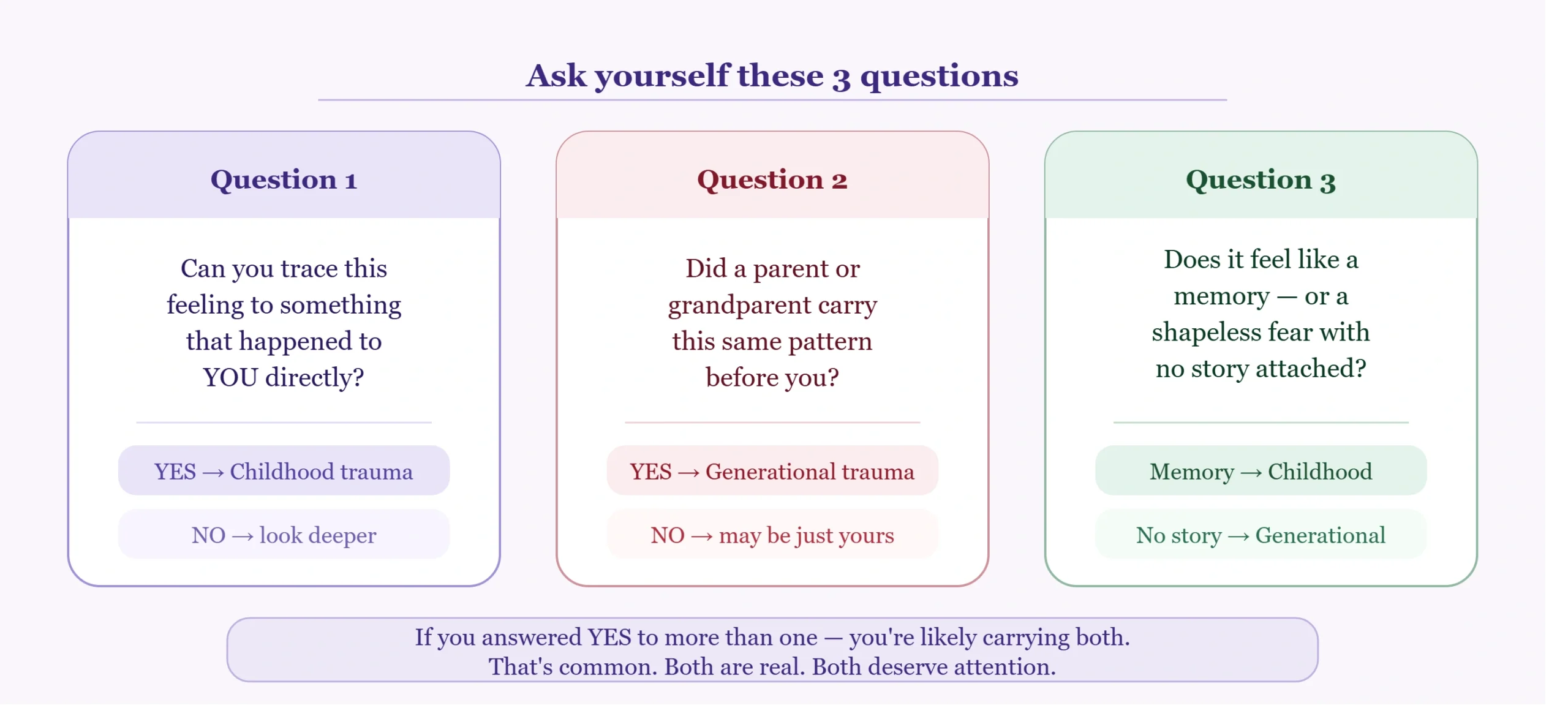
How do I know which one applies to me?
Sometimes it’s one, sometimes it’s both. Understanding your own experiences and your family’s patterns can help you see which parts of your story each one explains.
Does understanding the difference really matter?
Yes. It helps you better understand your experiences, your family, and the choices you make moving forward.
Yes, and it can directly shape which type of support actually helps. Research shows that therapies like EMDR and narrative therapy are effective for both personal and intergenerational trauma, but the approach shifts depending on where the wound started. Understanding whether your pain began with your own experiences or your family’s patterns helps you and any therapist you work with target the right root.
Understanding Your Story Is the First Step
If you’ve made it this far, you may be realizing that this isn’t about choosing between childhood trauma or generational trauma.
It’s about understanding your story more clearly.
You don’t have to decide whether your story is childhood trauma or generational trauma.
For many people, it’s both.
The important part isn’t choosing a label.
It’s understanding which part of your story each one helps explain. Understanding the difference isn’t about blaming yourself—or anyone else.
It’s about giving yourself the clarity to move forward with greater awareness.
If today’s article answered one question but raised another, that’s okay. You don’t have to figure everything out today.
If you’re beginning to recognize these patterns in your own family, our guide on Signs of Generational Trauma is a great place to continue.
And if you’re looking for practical ways to build calmer, more connected relationships with your children, explore our Parenting Hub or download our free guide.
Small moments of understanding often lead to meaningful change.
You may not be able to change what shaped your story. But you can choose what happens next.