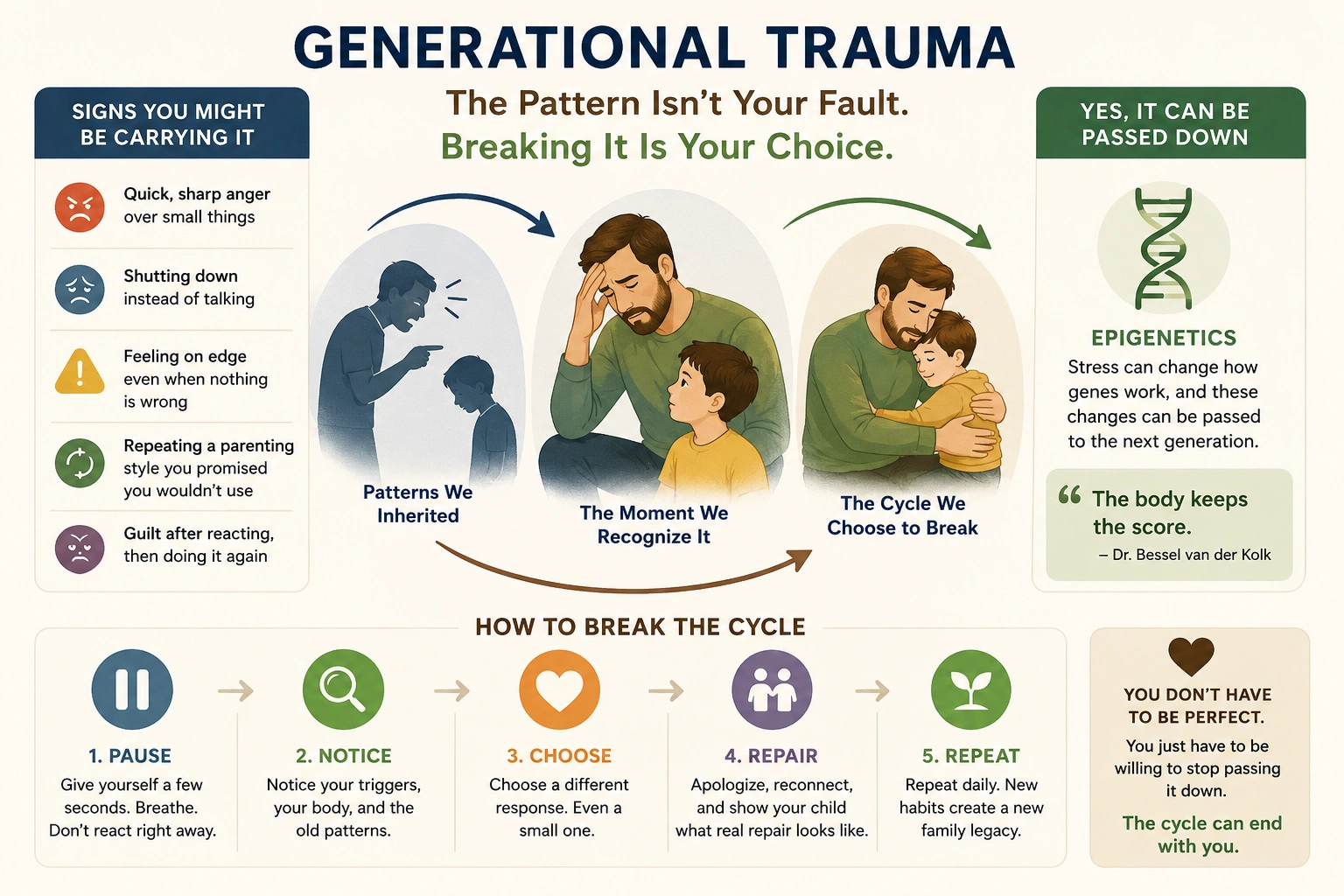

Most of the time when a child misbehaves, the adult in the room does one of three things.
They correct. They punish. Or they lecture.
I know because I did all three. For years.
I raised my own children that way. And when my grandchildren came to live with me, I started doing it again — this deeply grooved reflex of going straight to correction whenever something went wrong. It felt efficient. It felt like what a responsible adult was supposed to do.
What I did not understand then was that I was skipping the only step that actually works.
The Step Nobody Taught Us
There is a phrase I have come back to again and again in my own home and in my work with families: Connection before correction.
It sounds almost too simple. It sounds like something you put on a motivational poster and then forget about by Tuesday morning when the shoes are missing and the bus is in three minutes.
But it is not a philosophy. It is brain science. And once you understand what is actually happening in a child’s nervous system when they feel disconnected from you, you will never look at misbehavior the same way again.
Here is what the research tells us, plainly: a child cannot learn, grow, feel safe, or respond to guidance when their nervous system is in a state of threat. The Harvard Center on the Developing Child confirms that responsive relationships are the most critical factor in building a child’s brain architecture — and that felt safety directly impacts a child’s ability to learn.
And the fastest trigger for a nervous system threat in a child is not danger in the outside world. It is the felt sense of disconnection from the adult they depend on.
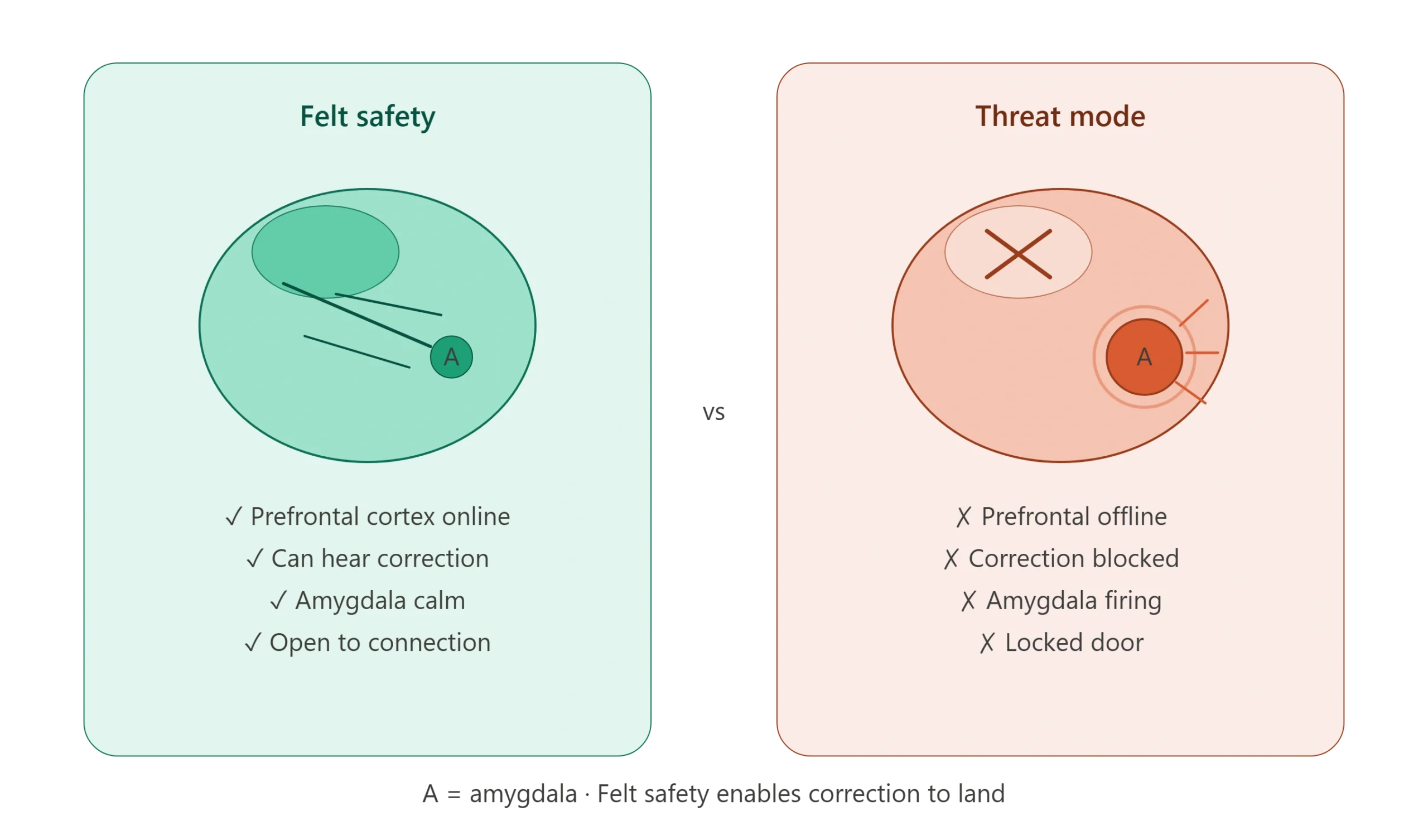
When a child feels disconnected, their brain registers it as an emergency. Not a metaphorical one. An actual biological one. The amygdala fires. The stress chemicals flood the system — a biological stress response documented by the National Scientific Council on the Developing Child showing how toxic stress disrupts developing brain circuits responsible for learning and behavior.
The rational, reasoning part of the brain — the part that would hear your correction and actually take it in — goes offline.
You can correct all you want in that moment. You are speaking to a locked door.
What I Watched Happen in My Own Home
When my grandchildren first came to live with me, there was a lot of behavior that needed addressing. A lot. Some days it felt relentless.
And I kept doing what I had always done: address the behavior directly, swiftly, and firmly. That is what I thought “being responsible” looked like.
But something was not working. The same behaviors kept repeating. The same cycles kept spinning. was correcting constantly and changing almost nothing.
This is exactly why traditional discipline often fails with trauma-affected children and understanding the reason behind it changes everything
It was not until I slowed down and started asking a different question — not “what do I do about this behavior” but “what does this child need from me right now” — that things began to shift.
I wrote about this more in What Your Child’s Behavior Is Actually Communicating. But the short version is this: most behavior is a nervous system signal, not a character problem. And a nervous system that feels unsafe cannot be corrected into safety. It has to be led there.
The lead comes from connection.
What “Connection Before Correction” Actually Looks Like
This is where I want to be practical, because I have seen this concept used as an excuse to avoid setting limits altogether. That is not what this is.
Connection before correction is not permissiveness. It is not letting everything go. It is not pretending the behavior did not happen.
It is sequencing. It is doing the right thing first — closing the gap between you and the child — so that the correction you offer afterward actually lands.
Here is what it can look like in a real moment:
You get on their level. Literally. You crouch down or sit beside them. You close the physical distance. You let your body say I am here with you before your words say anything else.
You name what you see. Not to analyze them. Not to fix them yet. Just to let them feel understood. “You seem really frustrated right now.” That is it. That is the whole move. A child whose feelings are named before their behavior is corrected immediately has a different experience of what is about to happen.
You hold both things at once. This is what ‘kind and firm’ really means the same balance that makes it possible to stay firm during a power struggle without losing the connection. I love you and the answer is still no. This is not contradiction. It is the highest form of parenting holding warmth and boundary in the same sentence without collapsing either one.
Then you correct. Clearly. Calmly. Once.
The correction does not disappear. It is not sacrificed on the altar of connection. It just arrives in a different order and in a nervous system that is open enough to receive it.
Why Skipping Connection Always Costs More Than It Saves
I understand the temptation to skip straight to correction. When you are exhausted, when the behavior has happened for the hundredth time, when you are running late and everyone is watching — taking a breath and connecting first feels like a luxury you cannot afford.
But I have learned through experience, and now through the neuroscience behind everything I write and teach, that skipping connection does not save time. It borrows it. You pay it back later, with interest, in the form of repeated behavior, eroded trust, and a child whose nervous system slowly learns that the adult in their life is someone to manage or hide from — not someone to turn toward.
I talk about this nervous system cost in detail in Why You Keep Reacting (Even When You Know Exactly What to Do). The same mechanism that makes a parent reactive under stress is the same mechanism that makes a child unreachable under correction: a nervous system that feels unsafe shuts down higher-order processing. For them, it shows up as defiance or shutdown. For us, it shows up as yelling or controlling. Same root.
The solution in both directions is regulation, which is just another word for returning to connection — with yourself first, then with your child.
Sometimes that disconnection shows up most clearly after school, when a child has spent the entire day holding themselves together emotionally.
I talk more about that in Why Children Melt Down After School (And What It Really Means).
The Specific Moves That Build Connection Fast
You do not need an hour. You do not need a perfect moment. You need a handful of small moves that signal to your child’s nervous system: you matter, you are safe, and I am with you.
Stop what you are doing completely. Not partially. Not while checking your phone. When a child is in distress or misbehavior, the single most powerful signal you can send is full presence. Put the device down. Turn your body. Make eye contact. That act alone changes the neurological climate in the room.
Listen without fixing. Most adults, when a child talks about a problem, immediately move to solution mode. What I have learned — and what I try to model in how I engage with my own grandchildren — is that a child who feels truly listened to becomes a child who is willing to listen. They cannot do both at the same time. You go first.
Say “I hear you” before “here is why that is not okay.” Validation is not agreement. You are not saying the behavior was fine. You are saying their experience of the moment was real and you see it. That gap between validation and correction is exactly where most parents rush — and exactly where the most important neurological work happens.
Use touch when appropriate. A hand on a shoulder. A brief hug before the conversation. This is not manipulation. It is co-regulation. The nervous system settles faster through physical connection than through words, and a settled nervous system is one that can actually hear you.
Repair after rupture. If you corrected before connecting — if the exchange went badly, if voices were raised, if you handled it in a way you are not proud of — the repair is itself an act of connection. Going back later and saying “I came at that too hard, and I want to do better” is not weakness. It is the most powerful parenting move there is. I explore this more in How a Simple 3-Day Reset Brought Peace to Our Grandparent-Led Home.
A Note for Grandparents Raising Grandchildren
If you are in a kinship care situation — raising a grandchild, a niece, a nephew — the connection piece is not just important. It is foundational in a way that parents of children who have not experienced early trauma or disruption may not fully grasp.
Children who have come through instability have nervous systems that have been trained to expect disconnection. They may test connection precisely because they do not trust it will hold. They may push against correction more intensely because correction without connection is all they have ever known — and it never felt safe.
This does not mean you lower the limits. It means you raise the connection — consistently, patiently, and sometimes in the face of behavior that makes connection feel like the last thing you want to offer.
The science, and my own lived experience of this, is clear: the children who need connection most are the ones who make it hardest to offer. That is not a reason to withhold it. It is the whole reason to lean in.
I go deeper on this in What No One Tells Grandparents Raising Grandchildren — if that is your season, that post was written for you.
The Sequence That Changes Everything
Connection before correction is a sequence, not a philosophy. It does not require a perfect temperament. It does not require that you never feel frustrated or reactive. It requires only this: that before you address the behavior, you take one deliberate step toward the child.
One breath. One name of a feeling. One act of being fully present before you speak.
The correction still comes. The limits still hold. The expectation is still clear.
But it arrives into a nervous system that is open rather than defended. Into a relationship that feels safe rather than threatening. Into a child who can actually hear you — not because you earned their compliance, but because you earned their trust.
That is what drama-free parenting is built on. Not the absence of difficulty. But the presence of genuine connection inside it.
A Step Worth Taking Today
If your home has been heavy on correction and light on connection lately — no judgment here, because every honest parent has seasons like this — today is a clean slate.
Pick one moment today. One exchange that normally goes straight to correction. And before you say anything about the behavior, say something that closes the gap first.
Watch what happens in them. Watch what happens in you.
If you are ready to go deeper into building this kind of home — calm, connected, and genuinely drama-free — everything I have learned from raising my grandchildren and working with families over the years is inside The Drama-Free Parent. It is the book I needed when I was standing in that gap, knowing better and not yet knowing how.
You do not have to figure this out alone.