
Kinship caregiving often begins with love.
But it may also begin with a phone call, a crisis, a sudden change, a family disruption, or a child who needs somewhere safe to stay.
One day, you may be a grandparent, aunt, uncle, older sibling, cousin, or close family friend.
Then suddenly, you are also the daily caregiver.
You may be making school decisions. Handling bedtime. Managing big emotions.
Trying to understand behavior that does not make sense at first.
Holding family tension. Answering hard questions.
And trying to create stability while your own heart is still catching up.
If you are looking for kinship caregiver support, it may be because you love the child deeply, but you are also tired, overwhelmed, confused, or unsure where to begin.
That does not mean you are failing.
It means this is a big role. And big roles require support.
Kinship care means a child is being cared for by a relative or someone with a close family connection when their parents are unable to provide care.
At a Glance
- Kinship caregivers often need emotional, practical, parenting, and community support.
- Children in kinship care may be carrying grief, fear, confusion, loyalty conflict, or trauma.
- Calm routines and predictable structure can help the child feel safer.
- Trauma-informed parenting tools can help caregivers understand behavior without excusing unsafe actions.
- Caregivers need support for their own nervous system too.
- Asking for help is not failure. It is part of building a steadier home.
Quick Answer: What Support Do Kinship Caregivers Need Most?
Kinship caregivers often need layered support because they are caring for a child while also navigating family history, emotional stress, behavior challenges, and practical responsibilities.
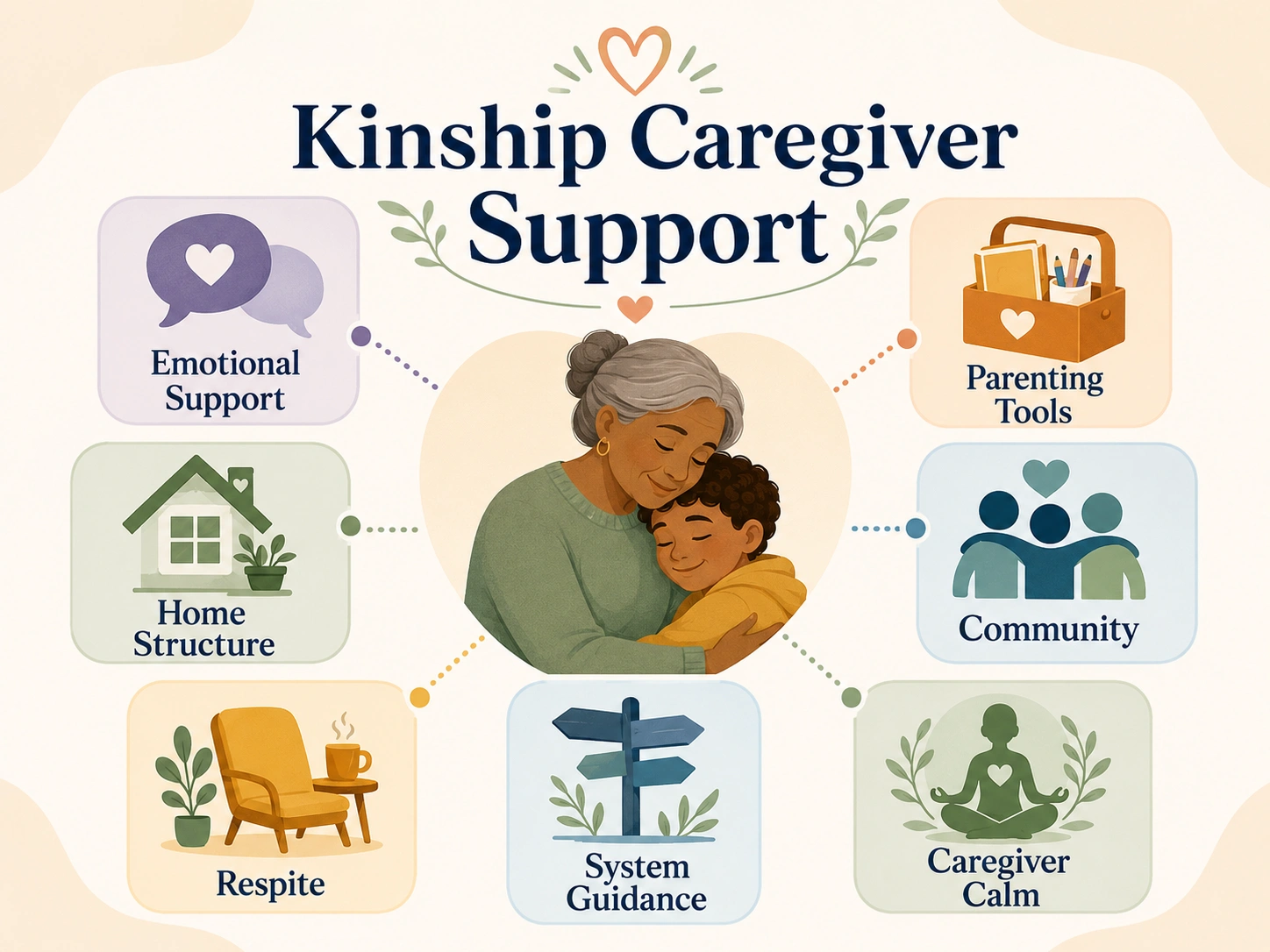
The most important types of kinship caregiver support include emotional support, trauma-informed parenting tools, predictable home structure, community support, respite, legal or financial guidance from appropriate professionals, and support for the child’s grief, fear, or behavior.
Many kinship caregivers also need help caring for their own nervous system.
Love matters deeply.
But love alone does not remove exhaustion, confusion, or the need for tools.
A kinship caregiver needs a support path that helps both the child and the adult feel safer, steadier, and less alone.
A Source-Backed Lens
Kinship care can help children remain connected to family, familiar relationships, culture, and community when their parents cannot safely provide care.
At the same time, children in kinship care may be adjusting to family separation, grief, instability, or trauma. Trauma-informed support recognizes that behavior may be shaped by stress, fear, loss, or past experiences.
This is why kinship caregivers often need layered support: practical guidance, emotional support, predictable routines, and tools that help both the child and caregiver feel safer over time.
Why Kinship Care Can Feel So Heavy
Kinship care can be emotionally complicated because it is rarely only about parenting.
It may involve family grief. Broken trust. Loyalty conflicts. Legal or financial pressure. Family members who disagree.
A child who misses their parent. A caregiver who is trying to be strong for everyone.
- You may love the child and still feel overwhelmed.
- You may be grateful the child is with family and still feel exhausted by the daily responsibility.
- You may want to protect the child and still feel unsure how to handle the behavior.
- You may feel guilty for needing a break.
- You may feel invisible because everyone sees what the child needs, but not always what you are carrying.
This is one reason kinship caregiving can feel different from expected parenting.
You are not only creating a home rhythm. You are often helping a child live inside a changed family story.
That takes patience.
It also takes support.
Where Should Kinship Caregivers Begin?
Start with the needs closest to daily life.
You do not have to solve every legal, emotional, family, and parenting issue at once.
Begin with:
- emotional steadiness for the caregiver
- predictable routines for the child
- trauma-informed tools for behavior
- outside support where the family needs more help
A support pathway works best when it starts small and becomes consistent.
Emotional Support
Kinship caregivers need emotional support because the role can carry grief, pressure, and loneliness.
- You may be grieving what happened in the family.
- You may be worried about the child’s parent.
- You may be managing tension with relatives.
- You may feel caught between protecting the child and staying connected to the larger family.
- You may not have had time to prepare.
- You may be hearing advice from people who do not understand the full situation.
Emotional support may look like:
- someone safe to talk to
- a kinship caregiver support group
- trusted family or friends
- counseling or professional support when needed
- spiritual or community support
- regular check-ins with people who understand the role
The point is not to complain.
The point is to stay supported enough to keep showing up with steadiness. Caregivers who are carrying everything alone often become depleted.
And a depleted caregiver may struggle to offer the calm a child needs.
Trauma-Informed Parenting Support
Children in kinship care may love the caregiver and still struggle in the home.
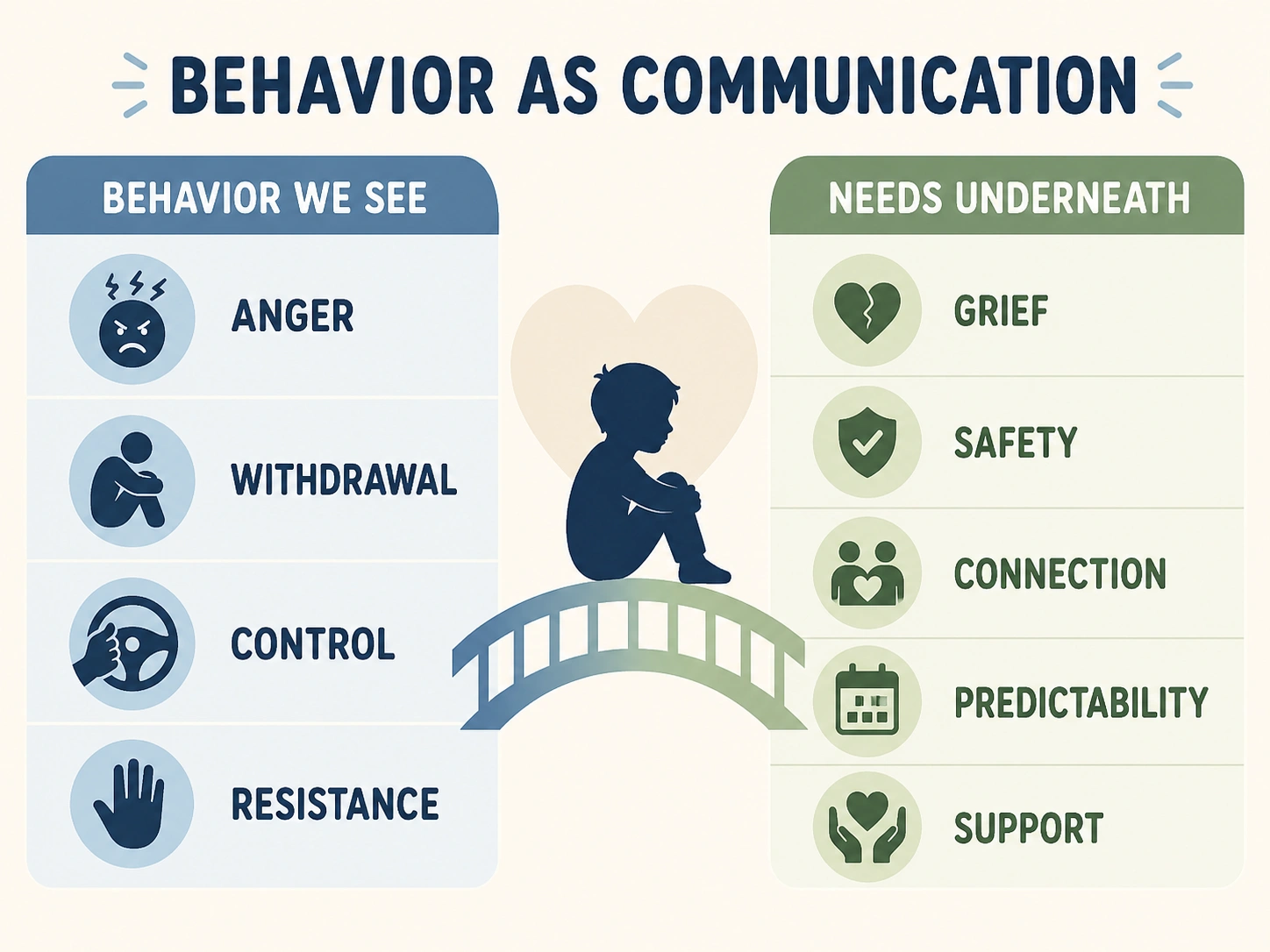
They may become angry. Withdrawn. Clingy. Controlling. Defiant. Fearful. Shut down.
Or overly independent.
- Some children may test the relationship because they are afraid another adult will leave.
- Some may reject comfort because closeness feels unsafe.
- Some may say hurtful things because they do not know how to express grief.
- Some may struggle with transitions, bedtime, food, school, or correction.
Trauma-informed parenting support helps caregivers ask a better question:
Not only, “How do I stop this behavior?”
But also:
“What might this behavior be communicating?”
This does not mean every behavior is okay.
It does not mean there are no limits.
In many cases, traditional discipline strategies do not address the deeper needs driving the behavior.
A child still needs boundaries.
But the way those boundaries are delivered matters.
A calm voice, predictable routine, repair after conflict, and connection before correction can help the child feel safer while still learning what is expected.
If the child becomes angry or overwhelmed in the home, knowing how to calm an angry foster child without escalating can help you respond with both firmness and care.
Practical Home Structure
Kinship caregivers also need practical home structure.
Children who have experienced instability often need to know what happens next.
Predictability can help reduce stress.
That does not mean the home has to be perfect.
It means the child benefits from simple rhythms they can begin to trust.
Practical structure may include:
- consistent wake-up and bedtime routines
- predictable meals and snacks
- simple house rules
- visual schedules
- warnings before transitions
- calm consequences
- regular connection time
- repair conversations after hard moments
Structure is not control.
Structure is safety.
When a child knows what to expect, the home can begin to feel less threatening.
When expectations are clear, correction can become less confusing.
When repair is part of the rhythm, conflict does not have to mean disconnection.
Free Resource
If kinship caregiving has left your home feeling overwhelmed, Richard Dixson’s free guide, 3 Days to a Peaceful Home, can help you begin with small, practical steps toward more calm, connection, and emotional safety.
Legal, Financial, and System Support
Kinship caregivers may also need legal, financial, or system-related support. This can feel overwhelming because every situation is different.
Some caregivers are working with child welfare agencies. Some are caring for a child through an informal family arrangement.
Some need help understanding school forms, medical decisions, guardianship questions, benefits, court processes, or available local resources.
This blog is not legal or financial advice.
But it is important to say clearly:
You may need guidance from qualified professionals, local agencies, child welfare contacts, legal aid, school staff, or community organizations.
You do not have to figure out every system alone.
Practical system support may include:
- asking the child’s caseworker what resources are available
- contacting local kinship care programs
- speaking with school support staff
- asking about counseling or trauma support for the child
- looking into respite options
- asking about legal aid or guardianship guidance
- checking whether financial assistance or benefits are available locally
The right supports depend on the situation, location, and legal arrangement.
But the need for guidance is real.
Community and Respite Support
Kinship caregivers often need community and respite support.
This is especially true for grandparents or relatives who did not expect to return to full-time parenting. You may love the child deeply and still need rest.
You may be committed and still need a break. You may be strong and still need people around you.
Respite does not mean you do not care. It means caregiving is demanding.
Community support may look like:
- trusted relatives
- church or faith community
- local caregiver groups
- school support staff
- parent support groups
- trained respite care
- family friends who can help with practical needs
- online or local kinship caregiver communities
The goal is not to hand off responsibility. The goal is to make sure the caregiver is not carrying the entire emotional and practical load alone.
Support helps the caregiver stay steady. And steadiness helps the child feel safer.
Support for the Child’s Grief and Behavior
Children in kinship care may be carrying more than they can explain. Even if they are living with someone they know and love, they may still be grieving.
- They may miss a parent.
- They may feel confused about loyalty.
- They may feel angry about the change.
- They may wonder if they caused the situation.
- They may feel embarrassed at school.
- They may feel different from other children.
- They may feel relieved and guilty at the same time.
- Those feelings can show up as behavior.
A child may not say:
“I am sad.”
They may argue. A child may not say:
“I miss my mom.”
They may refuse bedtime.
A child may not say:
“I feel out of control.”
They may try to control every detail.
A child may not say:
“I am afraid this home will not last.”
They may test the relationship.
Support for the child may include:
- patient conversations
- predictable routines
- trauma-informed parenting
- counseling or therapy when needed
- school support
- space to talk about family feelings
- calm correction
- repeated reassurance
- repair after conflict
The goal is not to force the child to move on quickly.
The goal is to create enough safety for the child to begin processing what has changed.
Caregiver Nervous System Support
A child’s nervous system matters.
But so does yours.
Kinship caregivers are often so focused on the child’s needs that they ignore their own stress until they are exhausted.
But your calm is part of the home environment.
- Your tone matters.
- Your breathing matters.
- Your ability to pause matters.
- Your support system matters.
- You will not respond perfectly every time.
No caregiver does.
But if you are constantly depleted, triggered, or unsupported, it becomes harder to respond instead of react.
Caregiver nervous system support may include:
- taking short pauses before responding
- asking another adult for help
- creating a few minutes of quiet each day
- getting enough rest when possible
- joining a support group
- learning calming scripts
- practicing repair after hard moments
- reminding yourself that progress is built slowly
You are not weak because you need steadiness.
You are human.
And your steadiness helps shape the emotional climate of the home.

A Simple Support Pathway for Kinship Caregivers
When everything feels urgent, it can help to have a simple pathway.
You do not have to fix everything at once.
Start here:
- Stabilize the home rhythm.
- Learn what behavior may be communicating.
- Create predictable routines.
- Build connection before correction.
- Ask for outside support.
- Take care of your own nervous system.
- Use repair after hard moments.
This path is not about perfection.
It is about direction.
A child who has experienced disruption needs repeated experiences of safety.
A caregiver who is carrying a heavy role needs repeated experiences of support.
Both matter.
A Real-Life Example: When a Grandchild Pushes Away Care
Imagine a grandmother begins caring for her grandson after a family crisis.
She loves him deeply.
But he is angry.
He refuses bedtime.
He says, “You are not my mom.”
He hides snacks.
He argues about small things.
The grandmother feels hurt and confused.
She may think:
“I gave him a safe place. Why is he fighting me?”
But through a trauma-informed lens, the behavior may be communicating something deeper.
The child may be grieving.
He may feel loyal to his parent.
He may be afraid to trust this new arrangement.
He may be trying to control food because life feels unpredictable.
He may be rejecting care because receiving care feels vulnerable.
A support pathway for this grandmother might include:
- emotional support for her own grief and exhaustion
- trauma-informed parenting tools
- predictable food and bedtime routines
- calm limits around disrespectful language
- space for the child to miss his parent
- school or counseling support if needed
- repair after hard moments
A calmer response might sound like:
“You are right. I am not your mom. I am not trying to replace her. I am here to care for you and keep you safe right now.”
Then the limit stays clear:
“You can be angry. You cannot scream at me. We can take a break and try again.”
That response holds compassion and structure.
Both are needed.
You Are Not Weak for Needing Support
Kinship caregivers are often strong people.
But strong people still need support.
- You are not weak because you feel tired.
- You are not failing because the behavior feels hard.
- You are not selfish because you need a break.
- You are not a bad caregiver because you do not know what to do in every moment.
This is a big responsibility.
Love does not remove exhaustion.
Commitment does not erase stress.
Family connection does not automatically make the transition easy.
The child may need time.
You may need tools.
The home may need a new rhythm.
And everyone may need more support than they expected.
That is not failure.
That is reality.
And naming reality is often the first step toward creating a calmer home.
What This Does Not Mean
Support does not mean you are failing.
Trauma-informed parenting does not mean there are no boundaries.
Needing help does not mean you do not love the child.
Taking a break does not mean you are giving up.
Asking questions does not mean you are unprepared.
And seeking outside support does not mean the family is broken.
It means the situation deserves care.
This blog is not legal, financial, medical, or clinical advice.
If the child’s behavior becomes unsafe, if you feel unable to protect yourself or others, or if the family situation involves urgent legal, safety, or mental health concerns, involve the appropriate professionals, support team, or emergency services when needed.
Compassion and safety can exist together.
Support and responsibility can exist together.
Love and limits can exist together.
How Richard Dixson’s Work Supports Kinship Families
Richard Dixson’s work is built around helping families move from chaos toward calm, connection, and emotional safety.
For kinship families, that message matters.
Because many caregivers are not only raising a child.
- They are helping a child live through a family disruption.
- They are trying to create steadiness where there has been uncertainty.
- They are trying to hold boundaries without adding shame.
- They are trying to understand behavior without excusing harm.
- They are trying to break cycles while still loving the family they came from.
In The Drama-Free Parent, Richard’s message points caregivers toward calm leadership, connection before correction, repair after hard moments, and behavior as communication.
His approach does not ask caregivers to be perfect.
It invites them to practice a different pattern.
One calmer response.
One repaired moment.
One predictable rhythm.
One safe interaction at a time.
That is how trust begins to grow.

Ongoing Support
If you want ongoing support, tools, and encouragement for creating a calmer home, explore The Parents Hub.
Key Takeaways
Kinship caregiver support is not only about resources.
It is about helping both the child and caregiver feel safer, steadier, and less alone.
Remember:
- Kinship caregivers often need emotional, practical, system, and community support.
- Children in kinship care may be carrying grief, fear, confusion, or trauma.
- Behavior may be communication, not only defiance.
- Predictable routines can help create felt safety.
- Connection before correction does not remove boundaries.
- Caregivers need support for their own nervous system too.
- Asking for help is not failure.
- A calmer home is built one steady pattern at a time.
FAQ
What is kinship caregiver support?
Kinship caregiver support includes emotional, practical, parenting, community, legal, financial, and system-related guidance for relatives or close family friends caring for a child when the child’s parents cannot provide care.
What do kinship caregivers need most?
Kinship caregivers often need emotional support, trauma-informed parenting tools, predictable home routines, community help, respite, system guidance, and support for the child’s grief, behavior, and adjustment.
Why is kinship care emotionally hard?
Kinship care can be emotionally hard because it often involves family disruption, grief, loyalty conflicts, sudden responsibility, financial pressure, behavior challenges, and complicated family relationships.
What support do grandparents raising grandchildren need?
Grandparents raising grandchildren often need emotional support, practical parenting tools, predictable routines, school and community guidance, and time to care for their own health and stress. They may also need help understanding the child’s grief, loyalty conflicts, or behavior after family disruption.
How can I support a child after family disruption?
Start with safety, predictability, and connection. Keep routines simple. Offer reassurance. Allow space for grief. Set calm limits. Use repair after hard moments. Seek professional support if the child’s behavior or emotional pain feels too big to manage alone.
Do kinship caregivers need trauma-informed parenting tools?
Yes, many kinship caregivers benefit from trauma-informed parenting tools because children may be reacting to grief, instability, fear, loss, or past stress. These tools help caregivers respond with calm, structure, connection, and repair.
Where should kinship caregivers look for help?
Kinship caregivers can ask local child welfare agencies, caseworkers, schools, legal aid organizations, community groups, faith communities, support groups, and qualified professionals about available resources. The right support depends on the family’s location and situation.
What if the child’s behavior is difficult?
Difficult behavior may be communicating fear, grief, overwhelm, or a need for safety. Keep boundaries clear, use calm routines, look for patterns, and seek support when behavior is unsafe, frequent, or overwhelming.
How can caregivers take care of themselves too?
Caregivers can take care of themselves by asking for help, joining support groups, taking short pauses, getting rest when possible, learning calming tools, practicing repair, and remembering that needing support does not mean they are failing.
Final Next Step
If kinship caregiving has left you feeling overwhelmed, start with one small step toward calm.
Richard Dixson’s free guide, 3 Days to a Peaceful Home, can help you begin creating more emotional safety, connection, and steadiness at home.