
You didn’t plan for this.
Maybe you were enjoying retirement. Or finally getting a little more time for yourself. Then the call came. And everything changed.
Now you’re raising your grandchild, feeding them breakfast, helping with homework, showing up to school meetings. You’re doing everything a parent does. Because right now, you are their parent.
If that’s where you are, you’re not alone.
There are millions of grandparents across the United States doing exactly what you’re doing. They stepped up when no one else could. They said yes when it would have been easier to say no.
This guide is written for you.
We’ll explain what a custodial grandparent is, what rights you may have, where to find help, and — just as importantly — how to help your grandchild feel safe again.
What Is a Custodial Grandparent?
A custodial grandparent is a grandparent who has taken on full-time care of a grandchild. This means the grandparent is the child’s primary caregiver the person responsible for their daily life, safety, and wellbeing.
This can look different from family to family.
Some grandparents have formal legal custody through the court system. Some have guardianship, which gives them legal authority to make decisions for the child. Others are caring for grandchildren informally, no paperwork, just love and commitment.
All of these situations are part of something called kinship care when a child is raised by a relative instead of their parents.
The word “kinship” simply means family connection. Kinship caregivers can be grandparents, aunts, uncles, older siblings, or other relatives. But grandparents are by far the most common.
Custodial Grandparents at a Glance
| Question | Quick Answer |
| What is a custodial grandparent? | A grandparent who has taken full-time responsibility for raising a grandchild |
| What is kinship care? | When a child is raised by a relative (like a grandparent) instead of their parents |
| Do grandparents have legal rights? | Rights depend on custody, guardianship, or adoption arrangements — varies by state |
| Why do grandparents become caregivers? | Most often due to parental substance misuse, mental health struggles, incarceration, or neglect |
| What support is available? | Financial assistance, kinship support programs, respite care, counseling, and parenting resources |
What You Can Do—and Where Legal Help May Be Needed
One of the first things grandparents ask is: What can I actually do for this child?
That depends a lot on your legal arrangement. Here’s a simple breakdown.
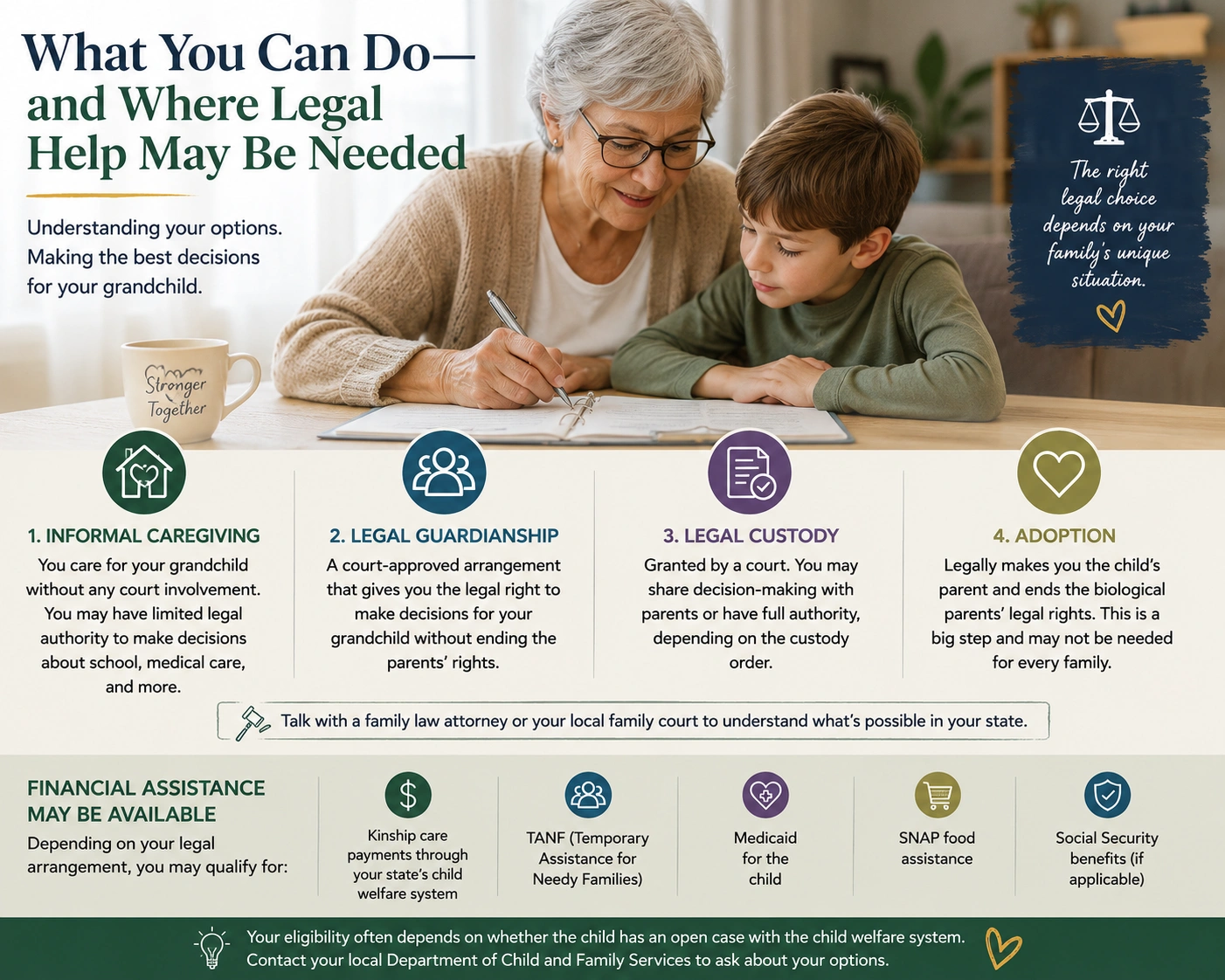
1- Informal Caregiving
This is when you’re caring for a grandchild without any court involvement. You may have no legal paperwork at all.
Without formal legal authority, you might struggle to:
- Enroll the child in school
- Consent to medical care
- Apply for financial assistance
- Make emergency decisions
This doesn’t mean you’re doing anything wrong. Many families start here. But getting some form of legal authority makes things much easier.
2- Legal Guardianship
Guardianship is a court-approved arrangement. It gives you the legal right to make decisions for the child including school, medical care, and housing without terminating the parents’ rights.
Guardianship is often a good middle step. It gives you authority while keeping the door open for the parents to eventually get help and reconnect.
3- Legal Custody
Custody is also granted by a court. Depending on the type of custody order, you may share decision-making with the parents or have full authority yourself.
Custody arrangements vary widely. An attorney or your local family court can explain what’s possible in your state.
4- Adoption
Adoption legally makes you the child’s parent. It ends the biological parents’ legal rights. This is usually a bigger step and often not necessary but it may be right for some families.
A Note on Financial Assistance
Depending on your legal arrangement, you may qualify for:
- Kinship care payments through your state’s child welfare system
- TANF (Temporary Assistance for Needy Families)
- Medicaid for the child
- SNAP food assistance
- Social Security benefits (if applicable)
Your eligibility often depends on whether the child has an open case with the child welfare system. Contact your local Department of Child and Family Services to ask about your options.
You Don’t Have to Figure This Out Alone: Resources for Grandparent Caregivers
You don’t have to figure this out alone. Here are the main places to look for support.
1- Kinship Care Programs
Many states have kinship navigator programs. These programs help relatives find services, benefits, and support. A kinship navigator can help you figure out what you qualify for and how to apply.
To find your state’s program, search for “kinship navigator program” + your state name or visit Grandfamilies.org, a national resource for grandparents raising grandchildren.
2- AARP Grandfamilies Support
AARP has a free resource called the Grandfamilies Guide. It walks you through legal options, financial help, and state-specific resources. Visit aarp.org/grandparenting to access it.
3- Child Welfare Information Gateway
The Child Welfare Information Gateway provides federal resources on kinship care, including state-by-state guides and financial support options.
4- Support Groups
Talking to other grandparents in the same situation can make a huge difference. Look for:
- Local support groups through churches, community centers, or hospitals
- Online communities like GrandsPlace.com
- Groups through your local YMCA or family resource center
5- Parenting Education
If you’re feeling uncertain about how to help your grandchild especially if they’ve been through hard things parenting education can help.
Richard Dixson’s Parents Hub is a resource designed for caregivers raising children who have experienced trauma. It includes practical tools, strategies, and support for grandparents and kinship caregivers.
6- Counseling Services
Both you and your grandchild may benefit from professional support. Ask your child’s pediatrician for a referral to a trauma-informed therapist. Or contact your local mental health center.
How So Many Grandparents End Up in This Role
You may already know why you’re in this role. But if you’re wondering how common your situation is, it’s very common.
According to the U.S. Census Bureau, approximately 2.4 million grandparents are the primary caregivers for their grandchildren. The actual number of children in kinship care, including informal arrangements, is likely much higher.
The most common reasons grandparents become custodial caregivers include:
- Substance misuse — A parent is struggling with addiction and cannot safely care for the child
- Mental health challenges — A parent is dealing with serious mental illness
- Incarceration — A parent is in jail or prison
- Domestic violence — The home was unsafe
- Child neglect or abuse — Child welfare became involved
- Death of a parent — The child lost one or both parents
- Poverty or housing instability — The parent cannot provide a stable home
The most common reason grandparents assume custody is parental substance misuse, particularly the ongoing opioid crisis, which has affected families across every state and community.
Whatever brought your grandchild to you, they are lucky to have you.

What Your Grandchild Needs Most Right Now
When a child loses their home, their parents, or their sense of safety, it shakes something deep inside them.
Children who have been through these kinds of experiences often carry what’s called childhood adversity; stress, fear, and confusion that their young minds and bodies are still trying to process.
One simple rule many grandparents follow is this: protect the relationship first. Children heal best when they feel safe, connected, and understood.
Here’s what that looks like in real life:
1- Predictability
Children who have lived through chaos crave routine. Knowing what happens next — meals at the same time, bedtime that looks the same every night, familiar rhythms — helps their nervous system settle down.
Small routines send a big message: You are safe here. Things are stable here.
2- A Trusted Adult
Every child needs at least one adult they can count on. For many of these children, that adult is you.
You don’t have to be perfect. You just have to keep showing up.
Research on secure attachment — the bond between a child and a caring adult shows that even one stable, nurturing relationship can protect a child’s long-term emotional health. (American Psychological Association)
3- Emotional Safety
Emotional safety means the child knows they won’t be punished for having feelings. They can be sad, angry, scared, or confused and you won’t pull away.
This is one of the most powerful gifts you can give. You can learn more about what emotional safety for children really means and how to create it at home.
4- Family Connection
Even when family has caused pain, children often still love and long for their parents. That’s normal. It doesn’t mean something is wrong with your grandchild.
Honoring that connection — with appropriate limits — helps children heal.
The Hard Parts No One Prepared You For
Let’s be real.
This is hard.
Most grandparents in this role didn’t ask for it. They were at a different stage of life — and now they’re doing it all over again, often with less energy and more responsibility than the first time.
Here are some of the challenges that don’t get talked about enough:
- Physical exhaustion. Raising young children takes a lot of physical energy. Many grandparents are dealing with their own health challenges at the same time.
- Financial pressure. Adding a child to your household costs money. Many grandparents are on fixed incomes. Financial assistance doesn’t always come quickly or in the amounts needed.
- Grief. You’re grieving too. Grieving for your own child who is struggling. Grieving for the life your grandchild should have had. Grieving for your own plans and routines that changed overnight.
- The role confusion. Are you the grandparent or the parent? This question can feel confusing and so can knowing how to talk about the child’s parents.
- Isolation. Many grandparents feel alone in this. Their friends are traveling, enjoying retirement, or not dealing with anything similar. It can be hard to find people who truly understand.
- Caregiver stress. Taking care of a child who has been through trauma and managing your own emotions at the same time is genuinely hard work. Secondary trauma in grandparents raising grandchildren is real, and it deserves attention.
You are doing something extraordinary. Please don’t forget to take care of yourself too.
Helping Children Heal Through Connection and Stability
Children who have been through hard things don’t always act like it on the outside. Some children seem fine. Some shut down. Some act out. Some swing between both.
Difficult behavior is often a child’s way of communicating what they don’t have words for yet.
One of the most important ideas in trauma-informed parenting is this: connection before correction.
Before you address the behavior, reach for the relationship.
This doesn’t mean ignoring problems. It means making sure the child knows they are loved and safe before you work on the behavior. Understanding what your child’s behavior is actually communicating can help you respond more effectively.
Co-Regulation: The Key That Opens the Door
When a child is upset, their brain is in survival mode. They can’t hear the reason. They can’t learn. They can’t calm down on their own.
What they need is you calm, present, steady.
Co-regulation means your calm nervous system helps regulate their overwhelmed one. It’s how children learn to manage emotions not through punishment, but through connection with a safe adult.
You can read more about co-regulation strategies for parents and caregivers to learn simple, practical ways to help your grandchild when emotions run high.
Responding Instead of Reacting
When a child does something challenging, it’s easy to react out of frustration. Most of us do.
But there’s a difference between reacting and responding. Reacting is automatic. Responding is intentional.
Learning to pause even for just a moment before you respond can change everything. Why parents react the way they do often has more to do with our own nervous system than with the child.
The TBRI Approach
One of the most research-backed frameworks for children who have experienced early hardship is called TBRI Trust-Based Relational Intervention.
TBRI is built on three main ideas: meeting children’s basic needs, helping them feel empowered, and connecting with them through relationships.
Grandparents and kinship caregivers often say that TBRI gave them a completely different way of seeing their grandchild’s behavior. You can learn more about what TBRI is and the core principles behind it.
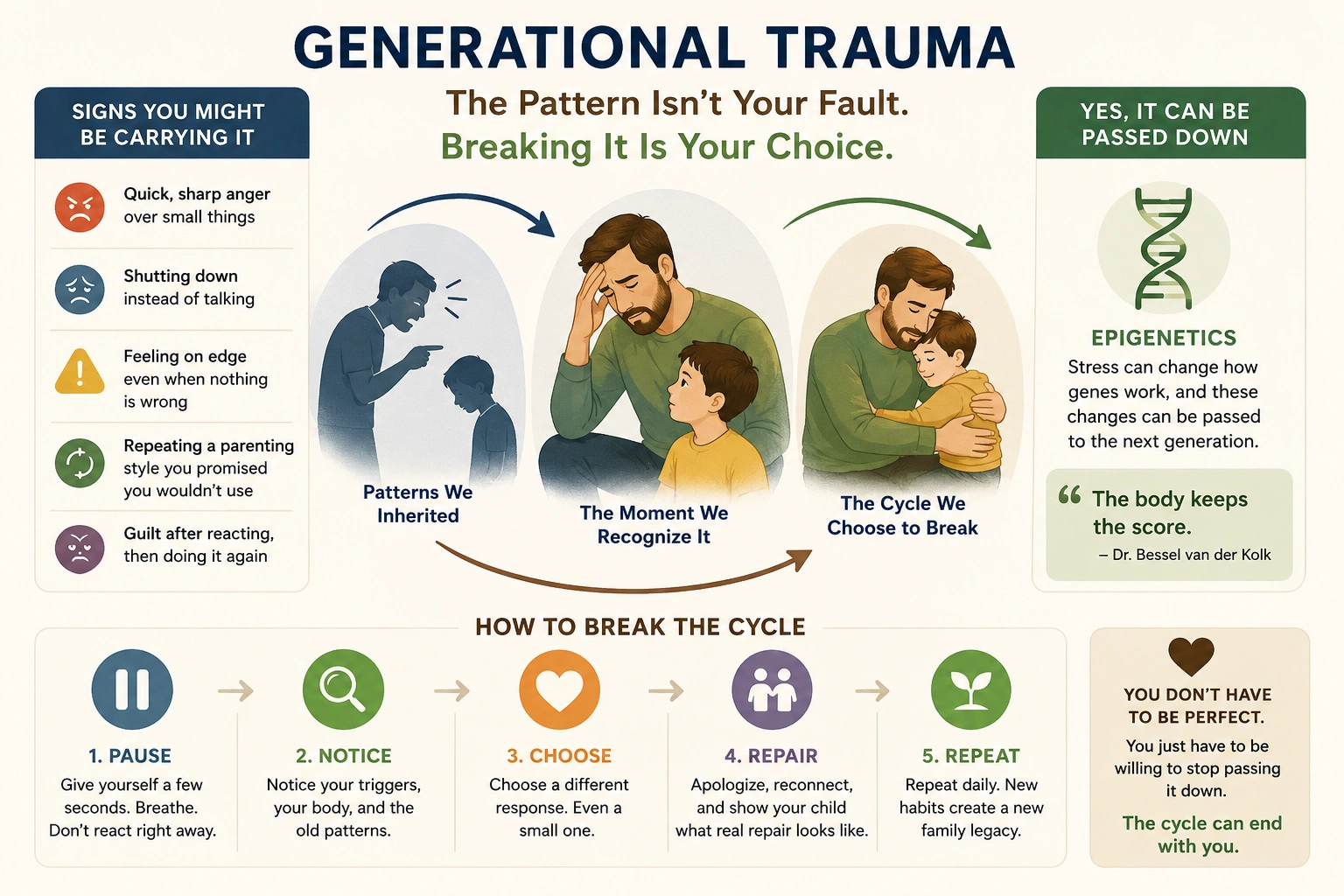
Breaking the Cycle
Sometimes the hardest part is recognizing that some of the patterns we grew up with the ways we were parented may not be what these children need.
Children who have experienced trauma need something different. And the good news is: it’s possible to learn. Breaking generational trauma cycles is one of the most powerful things a caregiver can do not just for the child, but for the whole family.

What Healing Can Look Like Over Time
Margaret was 64 when her daughter called from a hospital emergency room.
Her daughter had struggled with addiction for years. Now, her two grandchildren ages 4 and 7 needed somewhere safe to go. Right away.
Margaret took them in that same night.
The first few months were overwhelming. The youngest couldn’t sleep without nightmares. The older one had angry outbursts at school. Margaret was exhausted, grieving, and unsure if she was doing anything right.
She found a kinship support group at her church. She started reading about trauma and children. She learned about co-regulation that when she stayed calm, her grandchildren settled down faster.
Slowly, things shifted.
The bedtime routine she created became something they looked forward to. The older grandchild started talking more. The youngest started sleeping through the night.
It wasn’t perfect. It still isn’t. But Margaret says the most important thing she learned was this: “They don’t need me to be perfect. They need me to be here.”
Why Family Connections Matter So Much
Research consistently shows that children in kinship care raised by grandparents or other relatives tend to do better emotionally than children placed with strangers.
Why? Because family connections matter. Children in kinship care experience:
- Greater sense of belonging — They are with people who share their history and identity
- More stability — Kinship placements tend to last longer than foster placements
- Stronger family relationships — Staying connected to extended family supports healing
- Better emotional wellbeing — Familiar faces and environments reduce trauma responses
The Child Welfare Information Gateway notes that children in kinship care report higher levels of overall wellbeing compared to those in non-relative care.
You are giving your grandchild something irreplaceable: family.
What to Remember Moving Forward
- A custodial grandparent is a grandparent who is the full-time primary caregiver for a grandchild.
- Kinship care describes any arrangement where a child is raised by a relative instead of their parents.
- Your legal rights depend on whether you have informal care, guardianship, custody, or adoption — each gives you different authority.
- Financial and community resources exist to help you — including kinship navigator programs, AARP guides, and federal assistance.
- Substance misuse is the most common reason grandparents step in to raise grandchildren.
- Children who have been through family disruption need safety, predictability, and consistent connection to heal.
- Trauma-informed parenting tools — like co-regulation, connection before correction, and the TBRI framework — can help you understand and respond to your grandchild’s needs.
Frequently Asked Questions
What does custodial grandparents mean?
A custodial grandparent is a grandparent who is the primary caregiver for a grandchild. They may have legal custody, guardianship, or be providing full-time care through an informal family arrangement.
What rights do grandparents have?
Grandparents’ rights depend on their legal arrangement. Those with custody or guardianship can often make decisions about school, medical care, and daily needs. Specific rights vary by state.
Is a custodial grandparent the same as a legal guardian?
No. A custodial grandparent is the child’s primary caregiver. A legal guardian has court-approved authority to make decisions for the child. Some custodial grandparents are legal guardians, while others are not.
What is kinship care?
Kinship care is when a child is raised by a relative instead of their parents. This may include grandparents, aunts, uncles, or older siblings. Kinship care helps children stay connected to family relationships and familiar support systems.
What is the most common reason grandparents assume custody of grandchildren?
The most common reason is parental substance misuse. Other reasons include mental health challenges, incarceration, neglect, domestic violence, or the death of a parent.
How can grandparents help grandchildren heal after family trauma?
Grandparents can help by providing safety, routine, emotional support, and consistent relationships. Trauma-informed parenting strategies such as co-regulation, connection before correction, and secure attachment help children feel safe and supported.
You’re Not Doing This Alone
If you’re a grandparent raising a grandchild, what you’re doing is extraordinary. It’s not easy. It’s not what you planned. But you showed up and that matters more than you know.
You can find more support, practical tools, and guidance inside the Parents Hub a resource built specifically for caregivers like you.
And if you’re looking for a deeper foundation in trauma-informed parenting, The Drama-Free Parent book walks you through how to stay calm, connect with your grandchild, and build the kind of relationship that helps them heal one day at a time.
You’ve already done the hardest part. You said yes.
Richard Dixson is a trauma-informed parenting educator and author. He helps grandparents, foster parents, and kinship caregivers build safer, calmer homes for children who have been through hard things.