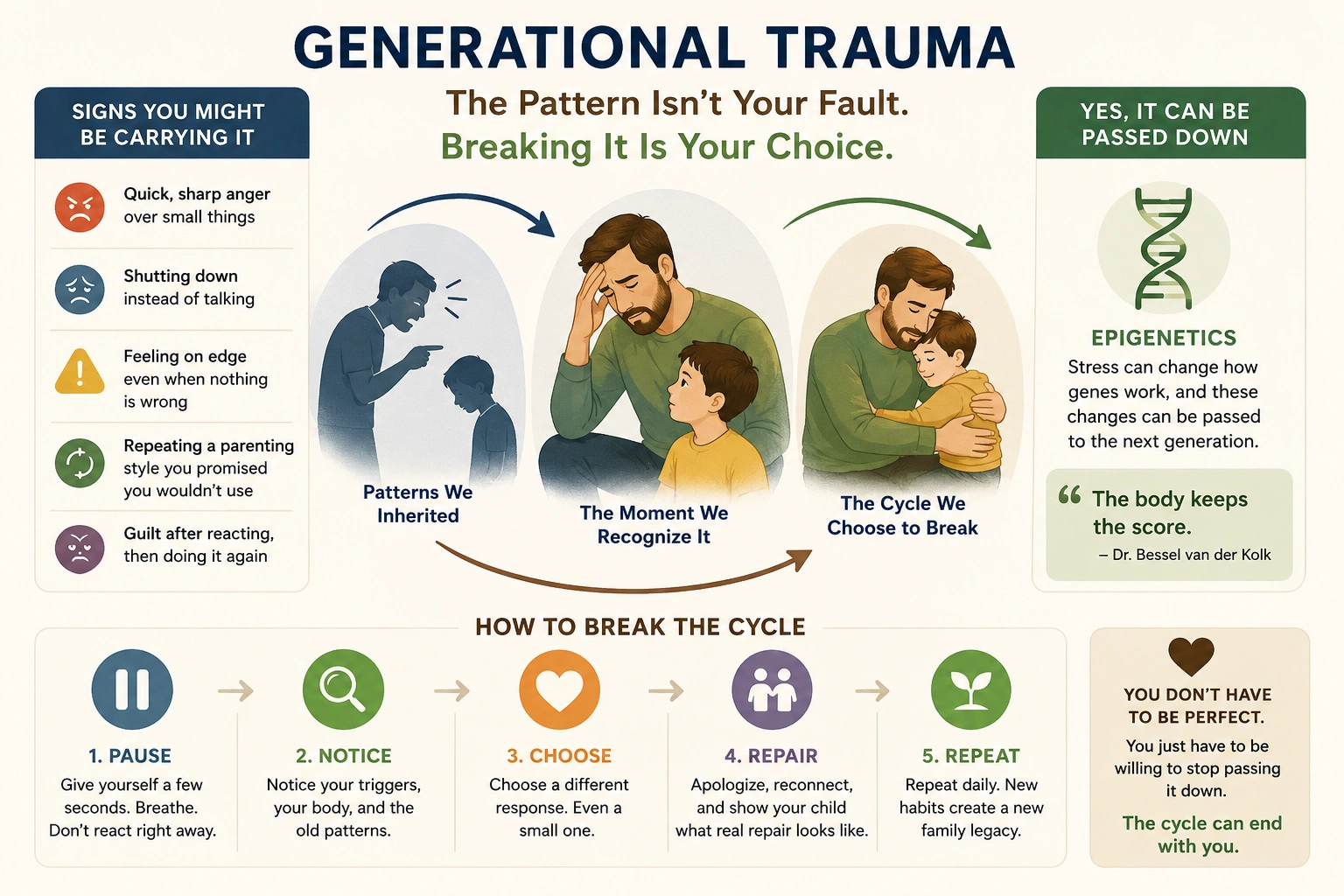

Breaking generational trauma in your parenting means recognizing inherited emotional patterns, regulating your nervous system before reacting, and intentionally practicing new responses in everyday moments. You can’t change what happened in your childhood, but you can stop passing it forward through awareness, emotional regulation, and connection. The goal isn’t to be a perfect parent. It’s a parent who responds instead of repeats.
This guide is for parents who keep reacting in ways they promised they never would and are ready to replace old patterns with healthier ones.
Every small pause you create today helps build a healthier emotional future for your child.
Breaking Generational Trauma at a Glance
- Notice emotional triggers before reacting
- Understand where the reaction comes from
- Regulate your nervous system
- Reparent yourself with compassion
- Set healthy emotional boundaries
- Connect before you correct
- Practice new family patterns consistently
Repeated consistently, these seven habits replace inherited trauma responses with patterns your child can carry into adulthood.
How Generational Trauma Gets Passed Down
Generational trauma is passed down through repeated family patterns rather than intention. Children learn emotional responses from what they consistently experience, including emotional invalidation, harsh discipline, silence around feelings, and unpredictable caregiving. Over time, these experiences become inherited parenting patterns and are often linked to Adverse Childhood Experiences (ACEs).
Because these patterns are learned early in life, many parents react automatically without realizing it. When stress increases, the nervous system falls back on familiar survival responses, leading to anger, emotional shutdown, control, or overwhelm instead of calm connection.
Research Snapshot
“63.9% of U.S. adults report at least one Adverse Childhood Experience (ACE).” Childhood adversity can affect emotional regulation and stress responses well into adulthood. (CDC)
I’ve worked with parents who spent years blaming themselves for reactions they believed were personal failures. What I’ve consistently seen is that these responses are learned nervous system patterns not character flaws. The encouraging news is that learned patterns can also be changed.
Key Takeaway
Recognizing that reactive parenting is a learned nervous system response not a character flaw is the first step toward breaking the cycle of generational trauma.
Why Breaking the Cycle Feels So Difficult
Breaking generational trauma doesn’t mean forgetting your childhood or never making a mistake. It means recognizing inherited emotional patterns, responding with awareness instead of survival instinct, and building secure attachment and emotional safety in place of fear or shame.
For most of the parents I’ve coached, healing starts with understanding how attachment, emotional regulation, and coregulation shape everyday parenting decisions long before any “technique” comes into play.
Attachment theory reminds us that children develop emotional safety through consistent, responsive relationships rather than perfect parenting.
7 Steps to Break Generational Trauma in Everyday Parenting

Step 1: Notice Your Triggers Early
Your body signals a reaction before it happens: a tight chest, a racing heart, sudden irritation.
Try this the 4-7-8 pause: Breathe in for 4 counts, hold for 7, breathe out slowly for 8. It takes under 30 seconds and tells your nervous system you’re not in danger, creating the gap between trigger and reaction that everything else in this guide depends on.
Key Takeaway:
Noticing physical signals before reacting is what creates the pause that makes a different response possible.
Step 2: Understand the Reaction, Don’t Blame Yourself
Shift one belief: instead of “what’s wrong with me,” ask “what happened to me?” Trauma research consistently shows survivors either repeat the cycle or interrupt it and that shift starts with understanding, not blame.
Repeated awareness also changes the brain itself. Research on neuroplasticity shows that the more consistently you pause before reacting, the easier emotional self-regulation becomes over time.
Step 3: Regulate Your Nervous System in the Moment
You don’t need a perfect response, you need a pause. When you’re overwhelmed, your nervous system can shift into fight, flight, or freeze mode, making calm parenting much harder.
When triggered, say quietly: “This feeling is old. My child is safe. I can choose.” It names the reaction as inherited, grounds you in the present, and reminds you that you have a choice.
As you practise this consistently, emotional regulation, co-regulation, and secure attachment begin to feel more natural. Try pairing this with the 90-second rule the next time you feel a reaction building.
Not sure where to start putting this into practice today? [Download the free starter guide]
Step 4: Reparent Yourself
You can’t give your child what you never received until you give it to yourself first. That means replacing self-criticism with compassion, allowing emotions instead of shutting them down, and giving yourself permission to slow down.
Try asking, “What did I need as a child that I can give myself now?” instead of “Why am I like this?”
Step 5: Set Healthy Emotional Boundaries
Old family patterns like people-pleasing, silence, or emotional suppression don’t have to continue. You can set these boundaries without yelling: a boundary in this context sounds like : “We don’t use shaming language in this house,” or “I need five minutes before I can talk about this calmly.”
You’re not making rules for your child, you’re building an emotional environment that wasn’t available to you, but is available to them now.
Breaking Old Patterns
| Old Pattern | Healthy Pattern |
| Yelling | Calm conversation |
| Shame | Curiosity |
| Punishment | Teaching, repair |
| Emotional distance | Emotional connection |
| Control | Coregulation |
| Reacting | Responding |
Step 6: Connect Before You Correct
Most of us were taught to correct behavior first. Connection works better: when a child is upset, they need safety before they need correction. Acknowledge the feeling, stay calm, help them feel understood see Why You Have to Connect Before You Correct for a deeper walkthrough. When a child feels safe, they listen more, trust more, and the cycle starts to shift.
This is also where you start to see fewer power struggles in daily routines.
Signs you’re breaking the cycle
you pause before reacting, repair after hard moments, apologize without shame, and respond with curiosity instead of control.
Step 7: Build New Family Patterns
One practice to start this week — the 10-minute repair conversation: once a week, in a calm moment (not right after conflict), ask your child: “What was the hardest part of your day?” or “Is there anything I did this week that didn’t feel good to you?” You don’t need to respond perfectly — just listen without defending. Repeated weekly, this is how new patterns become the family’s new normal, not through big gestures but small, consistent ones.
Key Takeaway:
New family patterns are built through repeated small moments of safety, not single breakthroughs.
Common Mistakes That Slow Progress
- Expecting immediate change
- Trying to be a perfect parent
- Ignoring your own emotional needs
- Believing healing means never making mistakes
- Focusing on behavior instead of emotional safety
These mistakes are common when healing from generational trauma including what to do on the days it doesn’t go well, like after you’ve yelled at your child. Progress comes from consistent practice, not getting every moment right.
What This Looks Like in Real Life
Your child won’t go to bed. Before, you might have reacted with frustration. Now, you pause, notice what’s happening in your body, and connect instead: “I can see you’re not ready to sleep. Something feels hard right now.” The situation doesn’t disappear but there’s less resistance, less disconnection, and more trust. That shift, repeated often enough, is what breaking generational trauma looks like in ordinary parenting moments.
Frequently Asked Questions
Can generational trauma really be broken?
Yes. Neuroplasticity research confirms the brain can form new patterns throughout adulthood. Awareness and consistent small practices reduce the transmission of trauma responses to the next generation.
How long does it take to break generational trauma?
There’s no fixed timeline, but research on trauma-informed parenting shows measurable improvements in family resilience within 8 weeks of consistent practice.
What are the signs of generational trauma in parenting?
Disproportionate reactions to minor triggers, difficulty regulating anger or shutting down emotionally, people-pleasing, harsh discipline despite not wanting to use it, and feeling emotionally disconnected from your child. See the full list of signs of generational trauma.
Can therapy help break generational trauma?
Yes! trauma-informed therapy can speed up awareness and give you regulation tools faster than working alone, though it isn’t the only path to change.
Can you break generational trauma without therapy?
Yes. Consistent awareness, nervous system regulation, and intentional practice like the steps above have been shown to shift these patterns even without formal therapy, though therapy can help for deeper or unresolved trauma.
How does generational trauma affect parenting specifically?
It shows reactive discipline, difficulty staying calm under stress, and repeating discipline styles you didn’t want to repeat, even when you consciously disagree with them.
Can grandparents help stop generational trauma?
Yes. When grandparents become aware of their own patterns and support rather than undermine a parent’s new approach, it reinforces the change across the whole family system.
Does generational trauma pass down biologically?
Research led by Dr. Rachel Yehuda at Mount Sinai found epigenetic changes in children of trauma survivors, meaning trauma can alter gene expression across generations but the same research confirms these patterns can be interrupted through intentional change.
What age can healing start?
Any age. Parents of infants and parents of teenagers both benefit from nervous system awareness; the practices simply look different depending on the child’s developmental stage.
Why Trust Richard Dixson
Richard Dixson has spent years helping parents recognize inherited emotional patterns and build calmer, more connected homes.
The strategies in this guide come from his coaching work and the practical framework he teaches in The Drama-Free Parent, helping families create lasting change through everyday interactions.
Start Today
Change doesn’t happen in one perfect day. It happens one calmer response at a time.
You don’t need more information, you need a starting point you can use in a real moment. Pick one step above and practice it once today, and if you want the fuller picture, how to be a calmer parent is a good next read.
Ready to break the pattern for good? [Download the Free chapter of Drama-Free Parent]