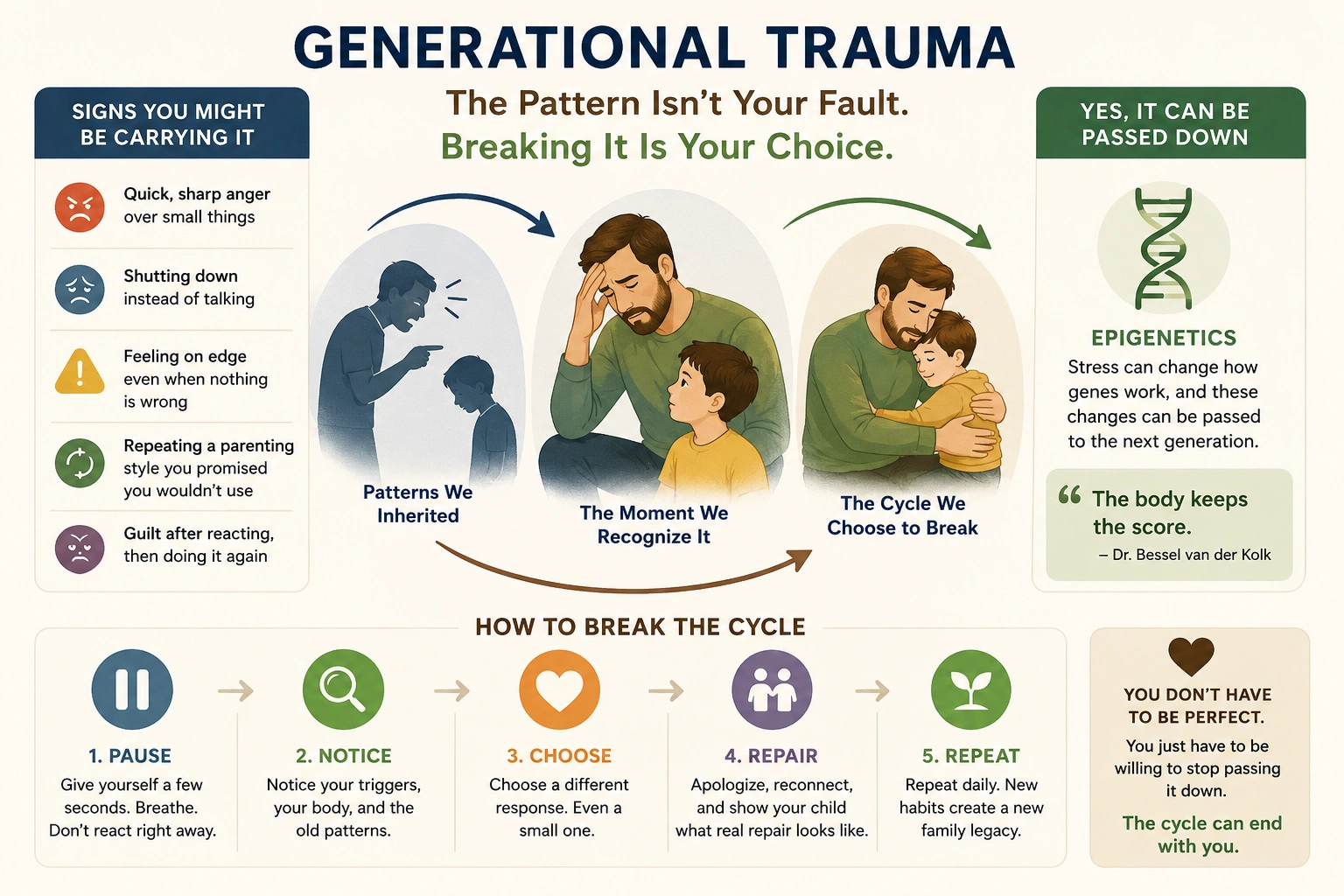

Your child refuses to get dressed. You repeat yourself. They raise their voice. You raise yours. A simple request becomes a power struggle, and minutes later, everyone is upset.
You knew how you wanted to respond. Yet in the moment, stress took over.
If this sounds familiar, you are not a bad parent. You are trying to guide a child through an emotional moment while managing your own emotions, history, expectations, and exhaustion.
Drama free parenting is not about raising children who never cry, argue, resist, or become overwhelmed. It is an intentional approach in which caregivers work to regulate themselves, understand what behavior may be communicating, maintain clear boundaries, and choose connection and teaching over shame or reactive punishment.
The goal is not a home without emotions. It is a home where difficult emotions do not have to become destructive battles.
As a grandfather raising my grandchildren, I did not learn these lessons from theory alone. I learned them in real moments: bedtime resistance, emotional shutdowns, raised voices, second thoughts, and the difficult work of repairing after I responded in a way I regretted. Drama free parenting grew from my need to find a calmer and more connected way forward.
At a Glance
- Drama free parenting does not mean avoiding emotions or conflict.
- Parents work to regulate themselves before attempting to correct behavior.
- A child’s behavior may communicate stress, unmet needs, or undeveloped skills.
- Connection and clear boundaries can be used together.
- Mistakes are followed by repair, not shame.
- The objective is progress and emotional safety, not perfect parenting.
What Does Drama Free Parenting Mean?
Drama free parenting begins with a simple but demanding idea: the adult does not have to match the child’s emotional intensity.
When a child becomes louder, the parent does not have to become louder. Resistance does not have to become a contest of control, and a caregiver’s mistake does not have to become shame or distance.
This approach asks parents to slow down enough to consider four questions:
- What is happening inside me right now?
- What might my child’s behavior be communicating?
- What boundary still needs to be maintained?
- How can I respond without making the situation less safe?
That does not make parenting effortless. It gives you a direction when the moment becomes difficult.
Drama free parenting is less about finding a perfect technique and more about changing how you enter the moment. It shifts the focus from winning the conflict to leading the child through it. Limits, consequences, and correction remain, but they are used to teach rather than humiliate or frighten.
What Drama Free Parenting Does Not Mean
The phrase ‘drama free’ can easily be misunderstood. It does not mean children should hide their emotions or that parents must avoid every disagreement.
It Does Not Mean Avoiding Conflict
Conflict is part of family life. Children will disagree, test limits, and struggle with decisions they do not like. The aim is to move through conflict without adding fear, shame, or unnecessary escalation.
It Does Not Mean Permissive Parenting
Connection does not require giving children everything they want. You can acknowledge a child’s disappointment and still say no:
I know you wanted more screen time. It is hard to stop when you are enjoying yourself. Screen time is finished for today.
The feeling is accepted. The boundary remains.
It Does Not Mean Removing Consequences
Consequences can help when they are reasonable, related to the behavior, and explained calmly. They become less useful when they are delivered primarily to cause fear, pain, or humiliation.
The American Academy of Pediatrics recommends discipline strategies that teach appropriate behavior, use clear and consistent limits, and reinforce positive behavior. Its guidance also discourages spanking, threatening, insulting, humiliating, or shaming children. Read the AAP guidance through HealthyChildren.org.
It Does Not Require Perfect Calm
No parent remains regulated every minute. Sometimes you will recognize the better response only afterward. The work is reflected in your willingness to pause, learn, and repair.
Calm parenting can be firm. Connection and boundaries are not opposites.
Why Parenting Conflicts Escalate So Quickly
Many parenting conflicts are not really about the spilled drink, unfinished homework, ignored instruction, or missing shoe. Those events may be the spark, but stress supplies the fuel.
A parent may interpret resistance as disrespect. A child may experience the parent’s urgency as a threat. Voices rise, bodies tense, and both people become less able to listen or choose their words carefully.
Your past can enter the moment too. If disobedience brought harsh punishment in childhood, a child’s refusal may activate more than ordinary frustration. If your family avoided emotions, crying may feel unbearable. When you are exhausted, even harmless noise can feel like one demand too many.
This is why knowing what to do does not always mean you can immediately do it. Information matters, but regulation helps you use that information under pressure.

For a closer explanation, read Why You Keep Reacting Even When You Know What to Do and The Nervous System Explained for Parents Who Hate Jargon.
Five Principles of Drama Free Parenting
Regulate Yourself Before Responding
When tension rises, notice your body. Is your jaw tight? Is your heart beating faster? Are you preparing to shout? These signals tell you that your ability to respond thoughtfully is narrowing.
If everyone is physically safe, create a small pause:
- Take one slow breath.
- Lower your shoulders and unclench your hands.
- Use fewer words.
- Lower your voice instead of competing with your child’s volume.
- Step away briefly when it is safe and appropriate.
You do not need to become completely calm before responding. The first goal is simply to avoid making the situation more intense.
I am getting frustrated, so I am going to slow down. We still need to solve this.
For a practical reset, read How to Be a Calmer Parent When Your Child Triggers You.
Look Beneath the Behavior
Behavior communicates information, but its meaning is not always obvious. Homework refusal may reflect confusion, fatigue, fear of failure, or ordinary resistance. A public meltdown may reflect hunger, overstimulation, disappointment, or difficulty accepting a limit.
Looking beneath behavior does not mean excusing it. It helps you choose a response that addresses both the behavior and what may be driving it.
- What happened immediately before this?
- Is my child tired, hungry, frightened, or overwhelmed?
- Is the expectation appropriate for their age and current ability?
- Is this a skill problem, a stress response, or a boundary test?
- What else could be true besides ‘My child is trying to make my life difficult’?
Learn more in What Your Child’s Behavior Is Actually Communicating.
Connect Before You Correct
Children are more available for guidance when they feel emotionally safe enough to receive it. Connection before correction does not mean delivering a long speech or offering a reward whenever a child resists. It can be as simple as getting closer, lowering your voice, acknowledging the feeling, and then stating the boundary.

You are angry that playtime is over. I understand. It is still time to put the toys away.
The first sentence communicates, ‘I see what is happening.’ The second communicates, ‘The limit still stands.’
Responsive back-and-forth relationships support children’s development, according to Harvard’s Center on the Developing Child. These interactions involve noticing, responding, and remaining present. Learn about serve-and-return interactions.
For practical examples, read Why You Have to Connect Before You Correct.
Use Calm and Clear Boundaries
Children need connection, but they also need adults who can provide structure. A useful boundary is:
- Clear and brief
- Appropriate for the child’s age
- Connected to safety or family expectations
- Enforced as consistently as possible
- Delivered without attacking the child’s character
Instead of ‘You are so disrespectful. You never listen,’ try:
I will listen when your voice is safe. You may tell me you are angry without calling names.
When possible, offer two acceptable choices: ‘You can put your shoes on by yourself, or I can help you.’ Choices provide some autonomy without surrendering the boundary.
When a child’s behavior presents an immediate safety concern, the adult’s first responsibility is protection. Connection can remain present, but safety does not wait for emotional agreement. You might say, ‘I will not let you hit. I am going to move us apart.’ Teaching can continue after the immediate danger has passed.
Repair After Difficult Moments
Even loving, informed parents lose their calm. Repair teaches children that relationships can survive mistakes and that taking responsibility is a form of strength.
A repair can include five parts:
- Describe what you did.
- Take responsibility without blaming the child.
- Apologize for the harmful part of your response.
- Restate the boundary if it still matters.
- Explain what you will try next time.
I raised my voice earlier. You were having a hard time, but yelling was not how I wanted to respond. I am sorry. The rule about hitting still matters. Next time, I am going to slow down and help us take space before we talk.
Explore additional tools in 10 Co-Regulation Strategies Every Parent Can Use.
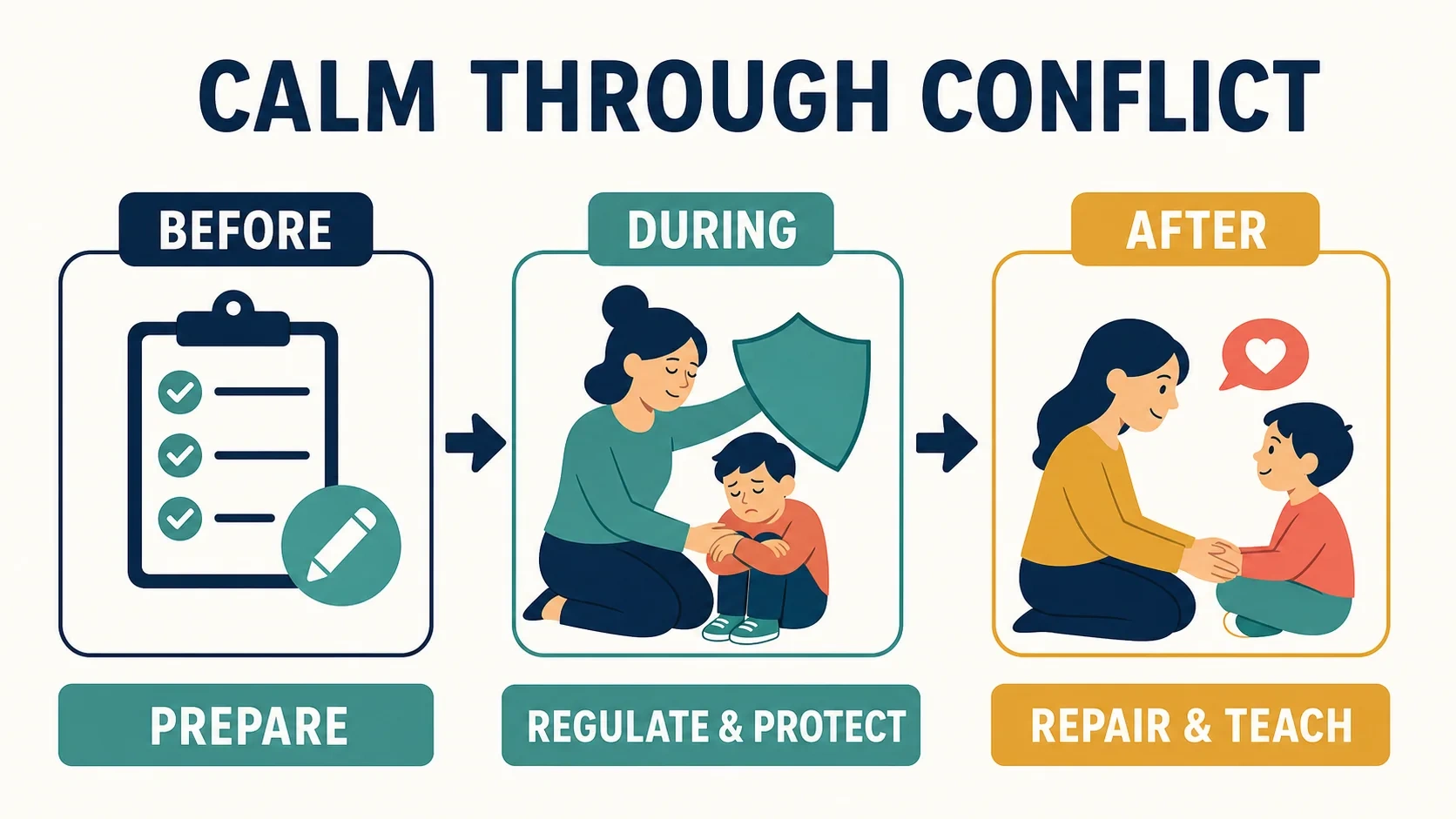
What to Do Before, During, and After a Difficult Moment
Drama free parenting becomes easier when you prepare for predictable conflicts instead of inventing a response while everyone is overwhelmed.
| Stage | Parent’s focus | Helpful response |
|---|---|---|
| Before | Prepare | This transition may be difficult. Let’s make a plan. |
| During | Regulate and protect | I am here. I will not let anyone get hurt. |
| After | Repair and teach | That was hard. Let’s decide what we can try next time. |
Before the Conflict
Notice recurring patterns. Does your child struggle before dinner, after school, during homework, or when leaving enjoyable activities? Preparation may include giving a transition warning, offering a snack, reducing unnecessary demands, reviewing the expectation, preparing one calm sentence, or deciding how you will respond if resistance begins.
Preparation cannot guarantee cooperation, but it reduces the decisions you must make under stress.
During the Conflict
- Use short sentences and reduce lectures.
- Keep your tone as steady as possible.
- Protect immediate safety.
- Name the feeling without assuming you know everything.
- Hold the necessary boundary.
- Wait before attempting a detailed lesson.
After the Conflict
- Reconnect without forcing affection.
- Discuss what happened briefly.
- Invite the child’s perspective.
- Repair any harm.
- Restate the expectation and practise a better response.
The lesson is not only ‘Do not do that again.’ The deeper lesson is, ‘Hard emotions can be handled without destroying connection.’
What Drama Free Parenting Looks Like in Real Life
When Your Child Has a Public Meltdown
What happened: Your child begins crying and shouting because you will not buy something.
What may be underneath it: Disappointment, fatigue, hunger, sensory overload, or difficulty accepting a limit.
What to say: You really wanted that. I know you are disappointed. We are not buying it today. I am going to help you move somewhere quieter.
What to do next: Protect safety, reduce stimulation, use fewer words, and discuss the behavior later.
Your job is not to perform perfect parenting for strangers. It is to help your child through the moment while maintaining the boundary.
When Your Child Refuses Bedtime
What happened: Your child stalls, argues, or repeatedly leaves the bedroom.
What may be underneath it: Difficulty ending the day, separation worries, excess energy, a need for predictability, or ordinary resistance.
What to say: You do not want the day to end. It is bedtime. Would you like to choose the story or choose which pajamas to wear?
What to do next: Keep the routine predictable and the choices limited. The child does not control whether bedtime happens, but they receive some appropriate control over how the transition happens.
When You Lose Your Temper
What happened: You yell after repeating an instruction several times.
What may be underneath it: Exhaustion, urgency, fear of losing control, or an old belief that children must obey immediately.
What to say after you settle: I raised my voice, and that was not the response I wanted to give you. The instruction still matters, but I want to handle it differently. Let’s start again.
What to do next: Follow through on the original expectation without using your apology to remove the boundary.
How Trauma-Informed Care Relates to Drama Free Parenting
Children affected by trauma, loss, disrupted attachment, or chronic stress may respond strongly to situations that appear small to an adult. Correction may feel like rejection, a transition may produce fear, and a raised voice may activate a protective response.
The National Child Traumatic Stress Network explains that traumatic stress can affect children’s functioning in different ways. Not every difficult behavior is caused by trauma, and caregivers should avoid diagnosing a child from a checklist or a blog post.
Trauma-informed parenting asks a different question:
What might have happened to this child, and what does this child need in order to feel safe enough to learn?
This perspective does not remove limits. It considers safety, connection, predictability, sensory needs, and developmental ability when enforcing them.
Trust-Based Relational Intervention, or TBRI, is one recognized trauma-informed approach designed to address the complex needs of vulnerable children through connecting, empowering, and correcting principles. Learn about TBRI from the Karyn Purvis Institute of Child Development.
These ideas can be relevant for biological, foster, adoptive, kinship, and grandparent-led families seeking a calmer response.
Read Why Traditional Parenting Advice May Not Work for Children With Trauma for a deeper discussion.
Important: This article provides educational parenting information and is not a substitute for individualized medical or mental health care. If a child’s behavior creates an immediate safety risk or causes serious disruption, seek support from a qualified pediatrician or mental health professional.
How to Start Drama Free Parenting Today
You do not need to transform your entire family in one afternoon. Start with one recurring moment.
- Choose one conflict, such as bedtime, homework, sibling fighting, or leaving the house.
- Notice what happens inside you before you react.
- Prepare one calm sentence connected to the boundary.
- Connect before correcting by acknowledging what the child may be feeling.
- Follow through clearly. Connection should not make the limit disappear.
- Repair when the response goes wrong.
- Notice small progress, such as a shorter argument, a lower voice, or a faster repair.
Practise during ordinary moments, when the emotional stakes are lower. Calm is something family members learn together.
Frequently Asked Questions
Is Drama Free Parenting the Same as Gentle Parenting?
They share ideas such as empathy, emotional connection, and avoiding shame. However, ‘gentle parenting’ is used in different ways by different people. Drama free parenting, as described here, emphasizes caregiver regulation, understanding behavior, clear boundaries, teaching, and repair. It is not permissive parenting.
Does Drama Free Parenting Mean There Are No Consequences?
No. Consequences can still be used when they are reasonable, related, age-appropriate, and delivered calmly. The objective is to help the child understand the boundary and develop skills, rather than simply making the child suffer for a mistake.
What Should I Do When My Child Will Not Listen?
First, reduce distractions and make sure the child heard and understood the instruction. Move closer, use fewer words, and state the expectation clearly. When possible, offer two acceptable choices. If the child is emotionally overwhelmed, support regulation before attempting a long explanation.
How Can I Stop Yelling at My Child?
Begin by identifying the situations, thoughts, and physical sensations that appear before you yell. Prepare a pause, a calming action, and one sentence you can use instead. You may not stop every instance immediately. When you do yell, repair the relationship and examine what support or preparation could help next time.
Can Drama Free Parenting Work With Teenagers?
Yes, but the approach must respect a teenager’s growing independence. Listen before correcting, avoid public humiliation, explain important boundaries, and collaborate where appropriate. Connection does not mean removing expectations. It means treating the teenager as a developing person rather than a problem to control.
Is This Approach Suitable for Foster and Adoptive Families?
Principles such as predictability, connection, regulation, clear boundaries, and repair may be valuable for foster and adoptive families. Every child’s history and needs are different, so caregivers may also benefit from trauma-informed training and individualized professional support.
Take the Next Step With The Drama-Free Parent
A calmer home is not created by one perfect response. It grows through the choices caregivers make before, during, and after difficult moments.
In The Drama-Free Parent: How 9 Decisions Will Miraculously Transform Your Parenting, Richard Dixson offers a deeper roadmap for caregivers who want to replace reactive patterns with greater calm, connection, and confidence.

The book is written for biological parents, foster and adoptive parents, kinship caregivers, and grandparents raising grandchildren. It combines relatable experiences, trauma-informed insight, and practical tools for the moments when parenting feels hardest.
About Richard Dixson
Richard Dixson is an author and nervous system educator raising his grandchildren. His work helps biological, foster, adoptive, kinship, and grandparent caregivers move from reactive parenting patterns toward greater calm, connection, and confidence.