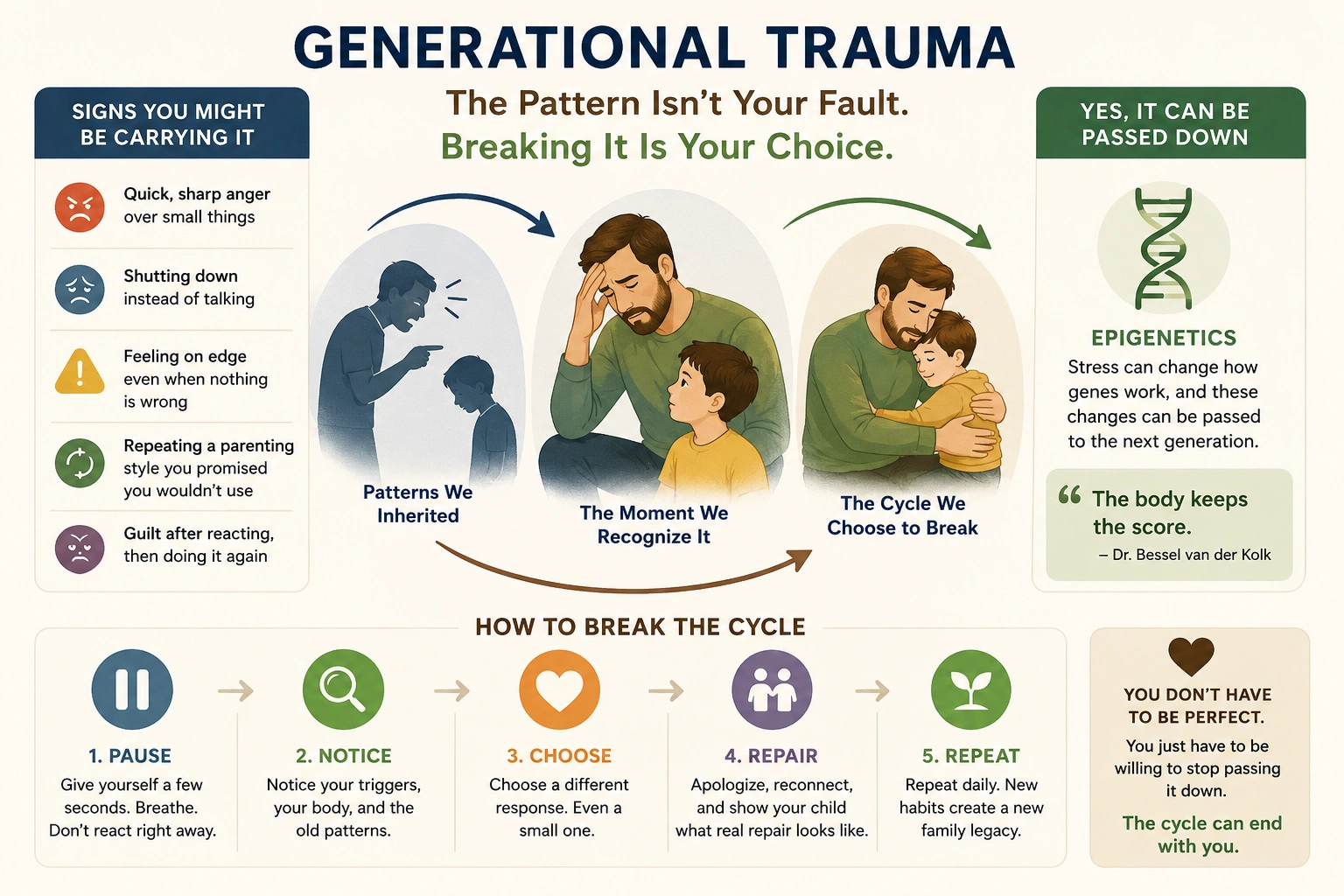

What Is Generational Trauma?
Generational trauma, also called intergenerational trauma, refers to emotional wounds, stress responses, beliefs, and behavior patterns that are passed from one generation to the next.
It often develops when difficult experiences such as neglect, emotional disconnection, chronic stress, family conflict, addiction, abuse, loss, or instability remain unresolved and continue influencing how family members relate to one another.
Unlike a single traumatic event, generational trauma becomes part of a family system. It shapes how people handle emotions, respond to stress, build relationships, and parent their children.
Many people carry these patterns without realizing it. They simply feel normal because they were present throughout childhood.
The good news is that these patterns are not permanent. Once they become visible, they can begin to change.
How Generational Trauma Gets Passed Down Through Families
Most people assume trauma is passed down through stories or memories.
In reality, it is often passed down through everyday interactions.
Children learn far more from what they experience than from what they are told.
If a child grows up around constant criticism, emotional distance, explosive anger, chronic anxiety, or emotional shutdown, those experiences become part of how they understand relationships and safety.
Over time, these patterns become automatic.
They influence:
- Emotional regulation
- Stress responses
- Communication styles
- Attachment and trust
- Parenting behaviors
- Relationship expectations
A parent who was never comforted may struggle to comfort their own child.
Someone raised in a home where emotions were dismissed may find emotional conversations uncomfortable as an adult.
To understand exactly what happens inside your body when these patterns activate, read Why Parents React: The Nervous System Explained.
Without awareness, these patterns continue repeating across generations.
What Causes Generational Trauma in Families?
Generational trauma can begin in many different ways.
Some families experience major traumatic events. Others experience smaller but repeated emotional wounds over time.
Common causes include:
1- Emotional Neglect
When children grow up feeling unseen, unheard, or emotionally unsupported, those experiences can shape future relationships and parenting patterns.
2- Chronic Family Stress
Financial hardship, instability, housing insecurity, or constant conflict can create survival-based responses that continue across generations.
3- Family Violence
Exposure to physical, emotional, or verbal abuse often affects how future generations experience safety, trust, and connection.
4- Addiction and Substance Abuse
Addiction can disrupt emotional security, consistency, and healthy attachment within families.
5- Loss and Grief
Unprocessed grief can continue affecting family dynamics long after the original loss occurred.
6- Emotional Unavailability
Many parents genuinely love their children but struggle to express emotions because they never learned how to themselves.
7- Foster Care and Family Disruption
Repeated changes in caregivers, separation from biological family, or unstable relationships can leave lasting emotional impacts that continue into adulthood.
If you are a grandparent raising grandchildren or a kinship caregiver, read Secondary Trauma: What Grandparents Raising Grandchildren Need to Know.

Signs of Generational Trauma in Families
Generational trauma rarely announces itself. Most of the time, it simply feels like your personality.
But certain patterns often reveal its presence.
Emotional Signs
You may notice:
- Strong emotional reactions that feel larger than the situation warrants
- Difficulty identifying or expressing feelings
- Feeling “too much” or consistently “not enough”
- Chronic anxiety or a persistent sense of dread without clear cause
- Depression that seems to run through the family
Relationship Signs
You may experience:
- Difficulty trusting others
- Fear of vulnerability
- Repeating unhealthy relationship patterns
- Feeling responsible for everyone else’s emotions
Parenting Signs
Parents often notice:
- Reacting before thinking
- Feeling overwhelmed by small situations
- Repeating phrases they once hated hearing as children
- Struggling to stay calm during emotional moments
If these parenting signs feel familiar, How to Be a Calmer Parent When Your Child Triggers You walks through exactly what is happening in those moments.
Physical Signs
Trauma can also show up physically through:
- Chronic tension
- Restlessness
- Hypervigilance
- Difficulty relaxing
- Feeling constantly on edge
These signs do not mean something is wrong with you.
They often mean your nervous system learned survival patterns that once served a purpose.
If you recognized yourself in more than one of these categories, it’s worth exploring them in more depth of our article on Signs of Generational Trauma in detail.
What Richard Dixson Has Learned About Generational Trauma
I want to start with something I know from the inside.
I’m not just a parenting author writing about generational trauma. I’m also a grandparent raising my grandchildren, and I’ve seen firsthand how emotional patterns can quietly pass from one generation to the next.
I’ve lived both sides of this: carrying patterns from my own childhood into parenting and later recognizing those same patterns showing up across generations.
That’s one of the reasons I wrote The Drama-Free Parent.
Over the years, I’ve learned that most parents are not struggling because they don’t care. They’re struggling because they’re reacting from patterns they never consciously chose.
The turning point is awareness.
The moment you recognize, “This reaction feels familiar,” you create an opportunity to respond differently.
And those small moments are often where generational cycles begin to change.
Understanding generational trauma intellectually is one thing. Recognizing it while you’re standing in your kitchen, exhausted after a long day, is something else entirely.
This is where most parents begin to see the pattern for the first time. To understand how these patterns specifically shape your parenting style day to day, read How Generational Trauma Affects Your Parenting Style.
How Generational Trauma Shows Up in Real Parenting Moments
I want to give you something concrete here, because this is where the theory becomes life.
You’re in the kitchen. Your child spills something.
It looks small. But your reaction isn’t.
Your chest tightens before you’ve thought anything. Your voice sharpens. And it’s already out before you catch it.
Then comes the guilt. You didn’t plan this. You promised yourself it would be different.
What you’re experiencing at that moment isn’t a character flaw. It’s a nervous system responding to a threat pattern it learned a long time ago when the emotional environment wasn’t safe, when small mistakes had large consequences, when a raised voice meant danger.
Your brain isn’t reacting to the juice on the floor. It’s reacting to a decades-old map. A map that may have been handed to you long before you became a parent.
This is generational trauma in real time. And this is exactly where the cycle either continues or gets interrupted.
Why Generational Trauma Repeats Across Generations
Most people don’t repeat generational trauma because they want to. They repeat it because the pattern becomes automatic long before they become aware of it.
Here is the painful truth I had to face in my own life: you don’t continue the cycle because you want to. You continue it because the pattern runs faster than your awareness.
The nervous system’s stress responses are designed to be fast, that’s their job. Studies in epigenetics and trauma suggest these stress responses can even influence how genes are expressed in the next generation.
By the time your prefrontal cortex (the thinking brain) catches up, the reaction has already happened.
This is why understanding generational trauma isn’t enough to change it. Insight helps. But the real work happens in the gap between trigger and response in real moments, with real stakes, when everything in your body wants to do what it’s always done.
That gap is small. But it’s real. And it grows with practice.
How to Begin Breaking the Generational Trauma Cycle
Let me be clear: healing generational trauma is real and possible. I’ve seen it happen — including in my own home. But it doesn’t happen in one decision. It happens in accumulated moments where you choose something different.
For a complete step-by-step framework, read How to Break the Generational Trauma Cycle: A Step-by-Step Guide.
Here’s where it actually starts:
Step 1: Name it without shame
The cycle has continued in your family not because anyone was a bad person, but because unprocessed pain passes forward when there’s nowhere for it to go. Naming what you’re carrying — without judgment — is the first interruption.
Step 2: Learn your nervous system’s specific patterns
What triggers your big reactions? What does it feel like in your body right before you react? Where do you feel it — chest, throat, jaw? Learning your early warning signs gives you a window of choice you don’t currently have.
Understanding the difference between co-regulation and self-regulation can help you see how your nervous system and your child’s interact in those moments.
Step 3: Use the pause before the pattern completes
When the reaction starts to rise, the most powerful thing you can do is not move immediately with it. A breath. A few seconds of stillness. Not forcing calm, just not immediately acting. That pause is where the cycle begins to weaken.
The 90-Second Rule for Parents is a practical tool built for exactly this moment.
Step 4: Repair after the reaction
You will still react sometimes. That is not failure, it’s the reality of doing this work. What matters is what you do after. Coming back, acknowledging what happened, and reconnecting with your child is not a weakness. It’s the most powerful modeling of emotional responsibility you can offer them.
Connection before correction explains why this repair matters more than the reaction itself.
Step 5: Build support around the change
Generational trauma is not something that changes through willpower alone. Sometimes this work happens through personal reflection. Sometimes it happens with support. Trauma-informed therapists, attachment-focused practitioners, and safe community spaces can all help reinforce new patterns when old ones feel difficult to change alone.
For foster, adoptive, kinship, and caregiving families: The Parents Hub offers ongoing practical support and resources designed specifically for families navigating inherited trauma in more complex caregiving situations. If you are a grandparent raising grandchildren and looking for a practical place to start right now, the 3-Day Calm Home Reset is a gentle first step.

Real-Life Examples of Generational Trauma
Marcus: The Anger Pattern
Marcus grew up in a home where stress often meant shouting.
As a father, he found himself responding the same way.
At first, he assumed it was simply his personality.
Later, he realized he was repeating what had been modeled for him.
Once he became aware of the pattern, he started pausing before reacting.
The changes were small at first.
But over time, those pauses transformed the relationship he had with his child.
Many parents recognize themselves in this story read Repeating My Father’s Patterns: How I Began to Break the Cycle.
Diana: The Emotional Disconnection Pattern
Diana grew up in a family where emotions were rarely discussed.
When her child became upset, her instinct was always to fix the problem quickly.
She wasn’t ignoring emotions intentionally.
She simply never learned how to stay present with them.
When she began practicing emotional presence instead of problem-solving, her child started feeling safer and more understood.
The transformation began with a single shift in awareness.
Can Generational Trauma Be Healed?
Yes.
Generational trauma can begin healing when people become aware of the patterns they are carrying and start responding differently in everyday situations.
Healing does not require perfect parenting.
It does not happen overnight.
And it does not mean you never become triggered again.
Healing happens when automatic reactions become conscious choices.
Every time you notice a pattern and respond differently, you weaken its influence.
Every time you repair after a difficult moment, you strengthen the connection. For a deeper exploration of what this looks like in a caregiving context, read Healing Generational Trauma While Caregiving.
Over time, those moments create lasting change.
Key Takeaways
- Generational trauma is the transmission of emotional wounds, stress responses, and behavior patterns across generations.
- It often affects parenting, relationships, emotional regulation, and family dynamics.
- Many patterns continue automatically because they were learned in childhood.
- Awareness is the first step toward breaking the cycle.
- Small changes repeated consistently create lasting transformation.
- Healing begins in everyday moments, not perfect ones.
Learn More About Breaking Generational Patterns
Many of the ideas discussed in this article are explored more deeply in The Drama-Free Parent.
If this article helped you recognize patterns in your own family, start with the free first chapter. It will help you better understand how nervous system patterns shape parenting reactions and what it looks like to respond differently in everyday moments.
Families looking for ongoing support can also explore the Parents Hub, where you’ll find practical tools, guidance, and trauma-informed parenting resources designed to help you build calmer, more connected relationships.
Whether you’re a biological parent, grandparent, foster parent, adoptive parent, kinship caregiver, or someone supporting a child through a difficult season, you’ll find encouragement, practical strategies, and a community that understands the journey.
Frequently Asked Questions
What is generational trauma?
Generational trauma is emotional pain, stress responses, beliefs, and behavioral patterns that are passed from one generation to another through family relationships and learned experiences.
What causes generational trauma?
Common causes include emotional neglect, family violence, addiction, chronic stress, grief, emotional unavailability, and unresolved traumatic experiences.
Is Generational Trauma the Same as Intergenerational Trauma?
Yes. The terms generational trauma and intergenerational trauma are often used interchangeably. Both describe emotional wounds, stress responses, and behavioral patterns that are passed from one generation to the next through family systems, relationships, and learned coping strategies.
How does generational trauma affect parenting?
Generational trauma can affect parenting by influencing emotional reactions, stress responses, communication patterns, and the way parents respond to conflict, mistakes, or emotional needs.
What are examples of generational trauma?
Examples include repeating anger patterns, emotional shutdown, difficulty trusting others, anxiety, controlling behaviors, and parenting reactions learned from childhood experiences.
Can generational trauma affect children?
Yes. Children often absorb emotional patterns, coping strategies, and relationship behaviors from the adults around them.
Is generational trauma genetic?
Research suggests trauma may influence biological stress responses, but generational trauma is most commonly transmitted through learned behaviors, relationships, and emotional environments.
Can generational trauma be healed?
Yes. Healing begins with awareness, emotional regulation, repair, and consistently choosing healthier responses over time.
What is the difference between trauma and generational trauma?
Trauma refers to the impact of difficult experiences on an individual. Generational trauma refers to patterns related to those experiences being passed down across multiple generations. For a deeper breakdown, see childhood vs generational trauma.
How do I know if I am repeating generational trauma?
If you notice reactions, beliefs, relationship patterns, or parenting behaviors that feel automatic and resemble what you experienced growing up, generational patterns may be influencing your responses.
Start Changing the Pattern Today
You may not have chosen the patterns you inherited. But you can choose what happens next.
Every time you pause before reacting, you create a different experience for your child. Every time you repair after a difficult moment, you strengthen trust.
Every time you respond with awareness instead of autopilot, you begin changing the future of your family.
Because generational trauma does not end when we understand it.
It begins to end when we choose differently in the moments that matter most.
In The Drama-Free Parent, I explore why these patterns repeat, how the nervous system keeps them alive, and what it takes to create a different experience for the next generation.