You tell your child to put the phone away. They don’t respond.
You repeat it… a little louder.
Still nothing.
And suddenly, your voice snaps. The response seems greater than the actual situation. A few seconds later, the guilt hits. You didn’t want to react like that. You said you’d do it differently… So why does it still happen?
If you’ve ever felt that gap between what you intend to do and what actually comes out, you’re not alone.
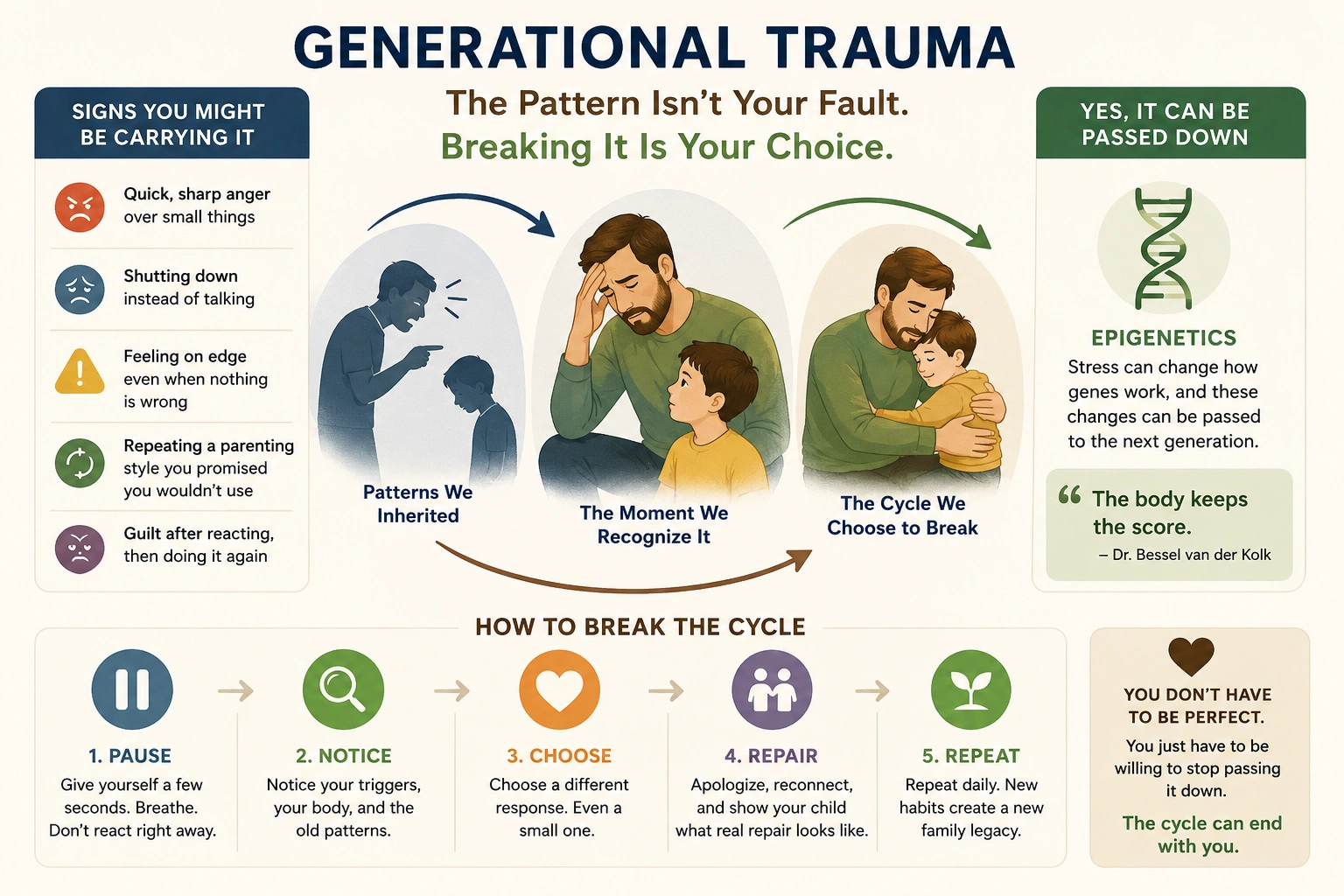
And more importantly, it’s not random. This is often how generational trauma parenting quietly shows up in everyday moments.
Why Your Parenting Style Feels Automatic (Even When You Try to Change It)
Have you ever noticed this? You pause after reacting and think:
“That sounded exactly like my parents…”
Even when you’ve promised yourself you wouldn’t repeat those patterns. That’s because a lot of your parenting doesn’t start at the moment.
It starts years earlier.
The way you handle stress, emotion, and conflict is shaped by your early environment. These parenting patterns from childhood don’t just disappear when you become aware of them.
They become defaults.
So when your child ignores you, pushes boundaries, or has big emotions, your response often comes from what feels familiar, not what feels intentional.
That’s why it can feel automatic.
Not because you’re not trying… but because these patterns were learned before you even realized it.
Why You React the Way You Do With Your Child (And It’s Not Random)
The reactions you have, even the ones you regret, usually follow a pattern.
And once you start seeing it, it becomes a lot clearer why it keeps happening.
1- Why Small Situations Trigger Big Reactions
It’s rarely about the small thing in front of you. A spilled drink. A messy room. Being ignored.
But your body reacts like it’s something bigger. This is one of the ways trauma affects parenting; it wires your system to respond quickly to stress, even in normal situations.
So the reaction comes out stronger than expected… before you can stop it.
2- Why You Shut Down Instead of Staying Present
Sometimes, instead of reacting, you go quiet. You disconnect. Withdraw. Avoid the moment.
Not because you don’t care.
But because, at some point, emotions may have felt overwhelming or unsafe. So your system learned to step away instead of lean in.
These are unconscious parenting behaviors, not chosen, just practiced over time.
3- Why Control Feels Like the Only Option
You might notice yourself correcting quickly, stepping in often, or needing things to go a certain way.
On the surface, it looks like control. Underneath, it’s often about safety. When things feel unpredictable, control becomes a way to feel stable.
That’s how generational trauma parenting can quietly shape your style, not through intention but through protection.
4- Why Staying Calm Feels So Hard in Emotional Moments
Your child cries, argues, or melts down. And something shifts inside you.
You want to stay calm… but it feels hard.
Because those moments don’t just belong to your child, they can activate older emotional responses in you.
This is where regulation becomes difficult, and reactions feel faster than thoughts.
Emotional Triggers in Parents: Why Small Moments Feel So Big
Here’s something most parents don’t realize: It’s not just what your child is doing.
It’s what it brings up in you.
A child ignoring you might trigger frustration. A tantrum might trigger overwhelm. Backtalk might trigger something deeper.
These are emotional triggers in parents, and they’re often connected to past experiences.
That’s why the reaction can feel immediate. Like it happens before you even have time to think.
This is a common trauma response in parenting.
What’s Really Happening in Your Brain and Body
In simple terms:
There’s a part of your brain that reacts quickly and a part that thinks things through.
In triggered moments, the fast-reacting system takes over. So you react first… and think later.
This automatic reaction is often explained in neuroscience as a survival-based stress response, where the brain prioritizes protection over reasoning — a pattern well-documented by the American Psychological Association in research on trauma and chronic stress.
And afterward, you’re left wondering:
“Why did I do that?”
Because in that moment, your nervous system was leading not your intention.
5 Signs Your Past Is Quietly Controlling Your Parenting (Without You Realizing It)
You don’t really notice it in the moment.
It feels normal… Until later, when things go quiet and you think:
“Why did I react like that again?”
And slowly, patterns start to show up.
- You react faster than you want to, and only realize it afterward
- You feel guilt after certain parenting moments, even if it was “small.”
- You hear your own words and think, that sounded like someone from my past
- Your child’s emotions feel harder to handle than you expected
- You swing between over-controlling and completely shutting down
These aren’t random moments.
They’re often generational trauma symptoms in parenting showing up in real time, quietly shaping how you respond without you even noticing a good place to explore childhood vs generational trauma further.
If you want to go deeper into these signs of generational trauma, can help you recognize them more clearly in your own patterns.
And once you start seeing this pattern clearly, the next question naturally becomes why your reaction happens so fast in the first place, before you even have time to think, which is something the 90-second rule helps you understand more deeply.
Why These Parenting Patterns Keep Repeating (Even When You Want to Stop)
This is the frustrating part.
You see the pattern. You don’t like it. But it still happens.
That’s because these patterns aren’t just habits; they’re wired responses.
And children learn in the same way. They don’t just listen to what you say. They absorb how you respond.
The tone. The reactions. The emotional environment.
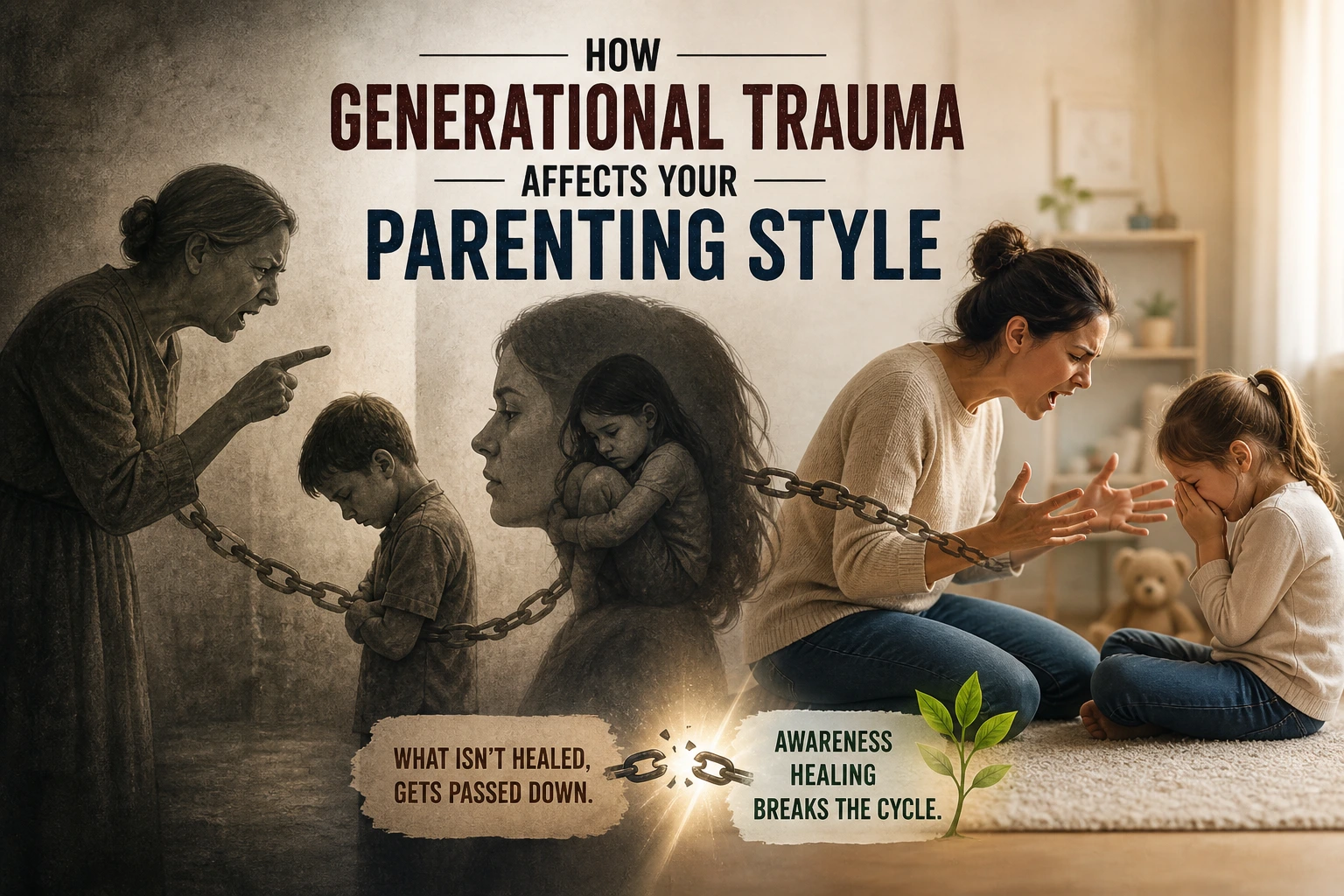
This is how the generational trauma cycle continues in families. Not because anyone plans it…But because it becomes normal. Even if nothing is explained out loud, your child still experiences it.
This cycle also explains why traditional discipline fails trauma-affected children — when patterns are inherited, standard correction methods rarely reach the root.
Why Awareness Changes Everything
Most parents aren’t trying to repeat the past. They’re just not always aware of when it’s happening. And that’s where things begin to shift. Because you can’t change what you don’t see.
But the moment you start noticing your reactions, your triggers, your patterns…
You create space. A small pause. And that pause is where something different can begin.
What Most Parents Miss When Trying to Change These Patterns
A lot of parents try to fix behavior quickly. They focus on discipline, rules, or staying calm.
But they skip something important: understanding what’s driving the reaction in the first place. That’s why tools like learning to pause, or letting your stress response settle before reacting, can make a difference.
This isn’t the full solution, but it’s a starting point.
What Changed When I Finally Saw My Own Patterns Clearly
There were moments I didn’t handle the way I wish I had. Quick reactions. Missed signals. Saying things I didn’t mean to.
Not because I didn’t care, but because I didn’t fully see what was behind those reactions.
Once I started noticing the patterns, things didn’t become perfect.
But they became more intentional. And that alone changed the way those moments played out.
You’re Not Stuck: These Patterns Can Change
If this feels familiar, it doesn’t mean you’ve failed. It means you’re becoming aware.
And that’s where things begin. These patterns may have been passed down. But they don’t have to be passed forward.
Especially when caregivers begin doing the deeper work of healing inherited trauma while raising children.
What You Should Do Next to Start Changing These Patterns
What you’re seeing in yourself right now isn’t something to just understand and leave. Because awareness alone doesn’t change the pattern.
It just makes you notice it more.
And most parents stay stuck right there, noticing… but not shifting anything.
You don’t need to fix everything at once, but you also don’t need to stay in this cycle without support.
If these reactions feel familiar to you, the Start With Calm 3-day free guide is the simplest place to begin. It helps you create small pauses in real moments when you feel yourself reacting too fast.
And if you can clearly see these patterns in your parenting style now, then the next step is not more thinking; it’s learning how to actually shift them in daily life.
That’s where The Drama-Free Parent comes in. It connects all these patterns and shows you how they change in real situations, not theory.
Because once you see it clearly, the real decision becomes simple:
You either keep repeating it… or you start changing it.
And both paths are still in your hands, but only one changes what happens next.