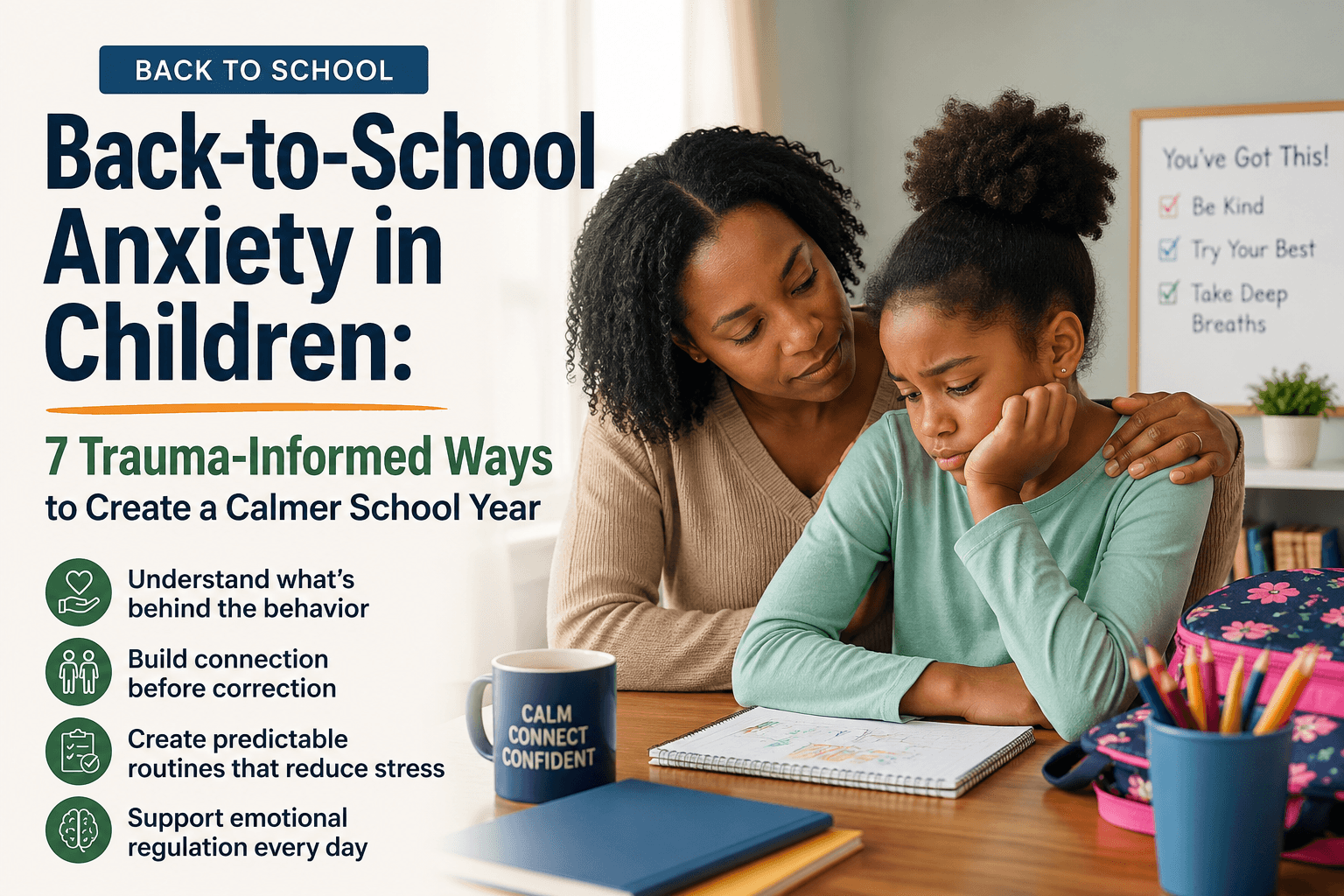
Back-to-School Anxiety in Children: 7 Trauma-Informed Ways to Create a Calmer School Year
The backpack is packed. The clothes are ready. The alarm is set.
And then the morning arrives.
Your child suddenly has a stomachache. They cannot find the right shoes. The shirt they chose last night is now completely wrong. A simple request turns into tears, yelling, shutting down, or the words every parent dreads hearing before school:
“I don’t want to go.”
If this sounds familiar, you may be dealing with back-to-school anxiety in children.
For many children, returning to school means much more than returning to a classroom. It can mean new teachers, unfamiliar expectations, changing friendships, academic pressure, separation from caregivers, sensory overload, earlier mornings, and a complete change in routine.
Those worries do not always come out as, “Mom, I’m feeling anxious.”
Sometimes anxiety looks like defiance.
Sometimes it looks like anger.
Sometimes it looks like a child refusing to get dressed at 7:15 in the morning while everyone else is trying to get out the door.
A trauma-informed approach asks us to look beyond the behavior and become curious about what may be happening underneath it.
The goal is not to eliminate every uncomfortable feeling. The goal is to help a child feel safe, supported, and capable of moving through the feeling.
What Does Back-to-School Anxiety Look Like in Children?
School anxiety does not look the same in every child.
Some children tell you directly that they are worried. Others communicate it through behavior.
You may notice:
- Stomachaches or headaches before school
- Difficulty sleeping before school days
- Clinginess or difficulty separating
- Morning meltdowns
- Sudden irritability
- Crying before school
- Repeated questions about what will happen during the day
- Refusing to get dressed or leave the house
- Arguments over seemingly small things
- Complaints about school that seem to appear suddenly
- Asking to stay home
- Big emotional releases after school
None of these behaviors automatically tells us exactly what is happening.
That is why curiosity matters.
Instead of immediately asking:
“How do I make this behavior stop?”
try asking:
“What is making this moment feel difficult for my child?”
This is one of the fundamental shifts behind The Drama-Free Parent: understanding behavior before trying to correct it.
Why Does Back-to-School Cause So Much Stress?
Adults often look at the school year as a schedule.
A child experiences it as a series of demands.
Wake up earlier.
Get dressed faster.
Leave home.
Separate from the people who feel familiar.
Walk into a classroom.
Remember the rules.
Manage friendships.
Follow instructions.
Handle noise.
Complete assignments.
Navigate disappointment.
And do it again tomorrow.
Even when a child likes school, that adjustment can require enormous emotional energy.
Children who have experienced trauma, instability, separation, foster care, adoption, major family transitions, or previous difficulties at school may experience these changes even more intensely.
Predictability can create a sense of safety. Sudden change can create uncertainty.
That is why a calmer school year often begins before the difficult behavior appears.
1. Create Predictability Before You Demand Flexibility
One of the simplest ways to reduce back-to-school stress is to make more of the day predictable.
A child who knows what is coming next does not have to spend as much emotional energy trying to figure it out.
That does not mean creating a military schedule.
It means creating a few dependable anchors.
For example:
- Wake up at roughly the same time
- Keep school clothes in a predictable place
- Pack backpacks the night before
- Create a consistent breakfast routine
- Use the same basic drop-off ritual
- Have a predictable after-school decompression period
- Keep bedtime reasonably consistent
The goal is not perfection.
The goal is reducing the number of surprises a stressed nervous system has to manage.
If your mornings regularly turn into control battles, you may also find this guide helpful: How to Stop a Power Struggle With Your Child Without Losing the Boundary.
2. Regulate Yourself Before You Try to Regulate the Morning
This may be the hardest part.
Your child is moving slowly.
You are looking at the clock.
You have somewhere to be.
Your voice gets faster.
Your instructions get longer.
Your body communicates urgency before you even realize it.
And your child’s stress rises with yours.
Before giving the next instruction, check your own body.
Are your shoulders tight?
Are you speaking faster?
Are you repeating yourself?
Are you trying to solve five problems at once?
Take one breath.
Slow your voice.
Give one instruction instead of five.
“Shoes first. I’ll help you with the backpack next.”
Children often need to borrow calm before they can access their own.
If this is difficult in your home, read 10 Co-Regulation Strategies Parents Can Use During Big Emotions.
3. Validate the Feeling Without Letting Anxiety Run the Family
There is an important difference between validating a feeling and allowing the feeling to make every decision.
If your child says:
“I don’t want to go to school.”
the first response does not have to be:
“You’re going. End of discussion.”
It also does not have to be:
“Okay, you can stay home.”
Try:
“It sounds like school feels really hard this morning. Tell me what part feels hardest.”
Maybe they are afraid of a test.
Maybe someone said something at lunch.
Maybe they are worried about getting lost.
Maybe they simply cannot explain it yet.
You can acknowledge the emotion while still maintaining the expectation:
“I hear that you’re worried. We’re still going to school, and we’re going to figure out what can make today feel more manageable.”
That is connection without giving up leadership.
4. Reduce Instructions During a Morning Meltdown
When everyone is calm, a child may be perfectly capable of following:
“Get dressed, brush your teeth, find your shoes, pack your water bottle and get your backpack.”
During emotional overload, that same list can feel impossible.
Reduce the number of words.
Instead of:
“How many times do I have to tell you? You still haven’t brushed your teeth, your shoes are upstairs and we’re going to be late again.”
try:
“Teeth first.”
Then:
“Great. Shoes next.”
This is what I call a Drama-Free Move:
Do not give five instructions to an overwhelmed brain. Give one.
Small changes like this can reduce the amount of conflict without removing expectations.
5. Create an After-School Decompression Window
Sometimes the biggest back-to-school challenge does not happen before school.
It happens afterward.
Your child’s teacher says they had a great day.
Then they come home and fall apart over the wrong snack, a sibling touching their things, homework, or one simple question.
Before assuming the problem is disrespect, remember how much regulation school can require.
Try creating a transition between school and the next demand.
That might include:
- A snack and water
- Quiet time
- Movement outside
- A favorite activity
- Music
- Physical connection if your child welcomes it
- Simply not asking ten questions the moment they walk through the door
Try:
“I’m glad you’re home. You don’t have to tell me about your day yet.”
Then give their nervous system a chance to arrive home too.
6. Look Under School Refusal Before Calling It Defiance
When a child repeatedly says they do not want to go to school, it is easy for the morning to become a battle of authority.
But “I don’t want to go” can mean many different things.
It might mean:
- “I’m afraid I won’t know anyone.”
- “I’m worried about being embarrassed.”
- “The classroom feels overwhelming.”
- “I’m struggling with the work.”
- “Someone at school is making me uncomfortable.”
- “I don’t know how to explain what I’m feeling.”
Do not assume you know the reason.
Get curious.
Talk when your child is calm, not only during the 7:20 a.m. crisis.
Ask:
“If we could make one part of school easier tomorrow, what would you change?”
That question is often easier for a child to answer than:
“Why don’t you want to go?”
If school avoidance is persistent, intense, accompanied by ongoing physical complaints, or interfering significantly with daily life, consider involving your child’s pediatrician, school counselor, teacher, or another qualified professional. Support does not mean giving up your parenting role. It means expanding the team around your child.
7. Focus on the Relationship, Not a Perfect School Week
Some mornings will still be hard.
You may lose your patience.
Your child may lose theirs.
You may say something you wish you had said differently.
A Drama-Free home is not a home where nobody ever gets upset.
It is a home where difficult moments do not have to become permanent disconnection.
Repair matters.
Later you might say:
“This morning was hard. I raised my voice and I wish I had handled that differently. Tomorrow we can try again.”
Repair teaches something perfection never can:
relationships can survive hard moments.
A Simple Back-to-School Drama-Free Routine
If your family is struggling with the transition, start small.
Before School
- Prepare as much as possible the night before
- Use fewer instructions
- Keep your voice slower than the problem
- Acknowledge anxiety without creating panic around it
- Maintain clear, predictable expectations
After School
- Reconnect before questioning
- Offer food and water
- Allow decompression
- Delay homework or correction when possible until the child has settled
- Notice patterns instead of reacting only to incidents
At Night
- Prepare clothes and bags
- Talk about worries during a calm moment
- Preview what tomorrow will look like
- Repair any conflict from the day
- Return to connection before sleep
What Would Peace Look Like in Your Home?
That question matters more than creating a perfect school morning.
Maybe peace looks like fewer arguments over shoes.
Maybe it looks like your child being able to say, “I’m nervous,” instead of screaming.
Maybe it means you can hear “I don’t want to go” without immediately feeling like everything is falling apart.
Maybe it means everyone still has hard emotions, but those emotions no longer control the entire house.
That is the larger work of Drama-Free Parenting.
Not eliminating emotion.
Building enough safety, regulation, connection, and confidence to move through it differently.
Want More Practical Tools for a Calmer Home?
If back-to-school mornings, emotional meltdowns, power struggles, or recurring conflict are exhausting your family, you do not have to start by changing everything.
You can start with one small move.
Richard Dixson’s free parenting guide offers practical tools for creating more calm and connection at home.
For a deeper roadmap, The Drama-Free Parent explores nine decisions designed to help biological parents, foster parents, adoptive parents, kinship caregivers, and grandparents move from reaction toward calm, connection, and confidence.
And if you understand the ideas but need ongoing support putting them into practice, The Parents Hub provides a trauma-informed support community for caregivers doing this work in real life.
Frequently Asked Questions About Back-to-School Anxiety in Children
Is back-to-school anxiety normal?
Some nervousness around a new school year is common. Children are adjusting to different schedules, expectations, teachers, social situations, and routines. The key is watching whether the anxiety gradually settles or continues interfering significantly with everyday life.
What are common signs of school anxiety in children?
Signs can include stomachaches, headaches, sleep problems, morning meltdowns, clinginess, irritability, repeated reassurance-seeking, crying, school avoidance, or saying they do not want to attend school.
What should I do if my child says they do not want to go to school?
Stay curious before assuming the child is simply being defiant. Ask what part of school feels difficult, acknowledge the feeling, maintain calm expectations around attendance, and work with the school or a qualified professional if the problem is persistent or severe.
How can I reduce morning meltdowns before school?
Prepare the night before, reduce unnecessary choices, give one instruction at a time, create predictable routines, allow enough time to avoid rushing, and regulate your own urgency before correcting your child.
Why does my child behave well at school but melt down at home?
Some children spend significant energy managing expectations, emotions, social interactions, and sensory input during school. Home may be the place where that accumulated stress finally comes out. A short decompression period before homework, questions, and demands can sometimes make the transition easier.
Does trauma-informed parenting mean letting children avoid difficult things?
No. Trauma-informed parenting can include clear expectations, boundaries, responsibilities, and consequences. The difference is that parents also consider emotional safety, regulation, relationship, and what may be driving the behavior before responding.
When should parents seek professional help for school anxiety?
Consider speaking with your child’s pediatrician, school counselor, teacher, or another qualified professional if anxiety is persistent, worsening, causing frequent school avoidance, creating significant physical symptoms, or interfering with your child’s ability to function at school or at home.
A Calmer School Year Starts With the Next Moment
You do not need to solve the entire school year today.
You do not need a perfect morning tomorrow.
You need the next right response.
One calmer instruction.
One moment of curiosity before correction.
One repair after things go wrong.
One opportunity to communicate:
“You are safe. I am here. We can work through this together.”
That is how calm becomes something your family practices—not something you wait for.