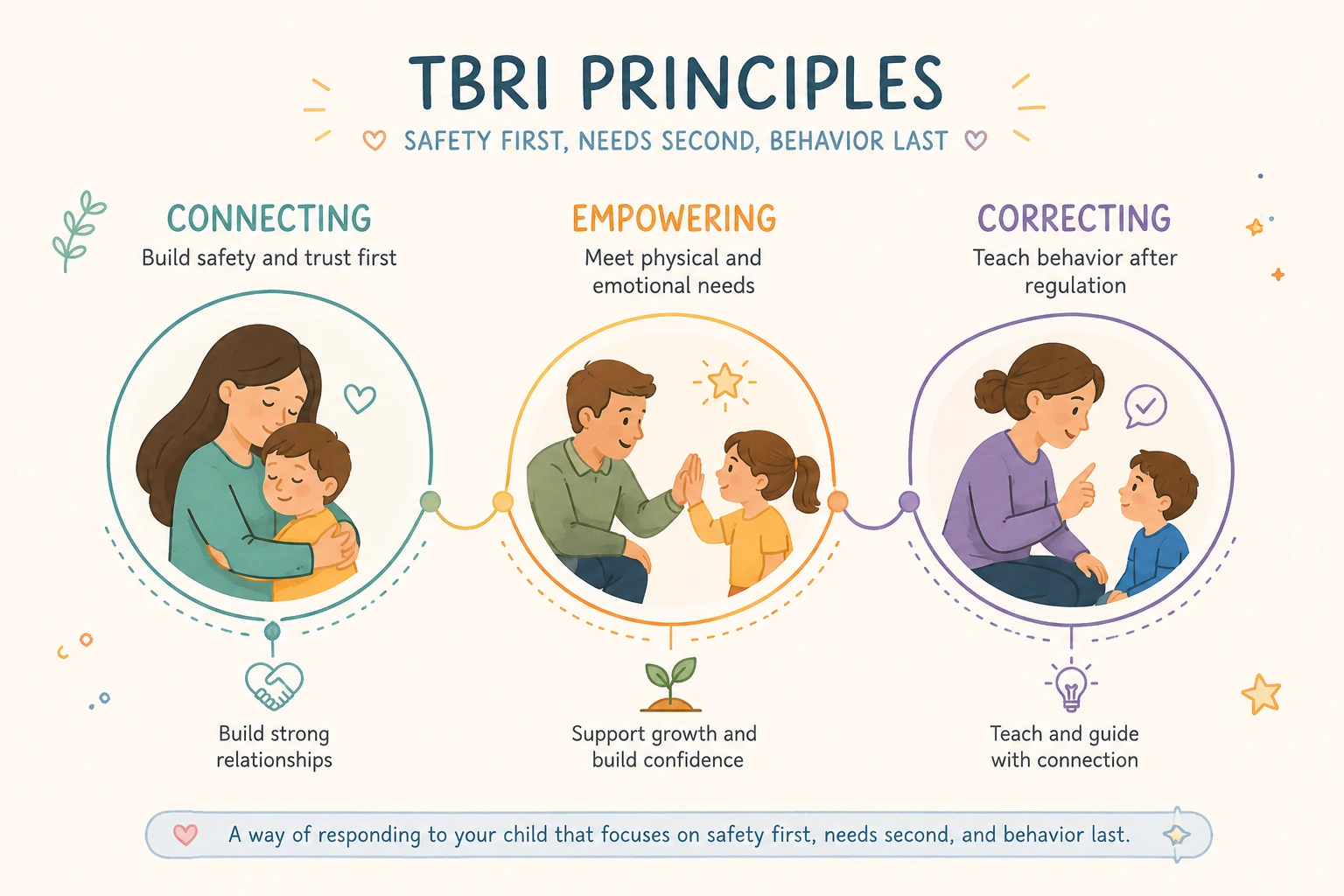
TBRI (Trust-Based Relational Intervention) is an attachment-based, trauma-informed parenting approach developed by Dr. Karyn B. Purvis and Dr. David R. Cross at the Karyn Purvis Institute of Child Development (KPICD) at Texas Christian University (TCU). It is built on three core principles, connecting, empowering, and correcting, designed specifically to meet the complex needs of children who have experienced trauma, neglect, or adversity.
I remember the moment my wife and I realized traditional parenting simply wasn’t going to work.
Our son Jordan had been diagnosed with ADHD. We left the doctor’s office with a prescription and no real answers. No roadmap. No one telling us why he was struggling or what he actually needed from us.
That search eventually led us to TBRI. It changed how we parented. Completely.
Today, my wife and I are raising our four grandchildren, and TBRI is still the framework I return to every single day. This guide will walk you through what TBRI is, what its three principles actually mean in real life, and how to begin using them, even on the hard days.
TBRI at a Glance
If you’re looking for a quick overview, here’s what you need to know:
- TBRI stands for Trust-Based Relational Intervention.
- It is a trauma-informed parenting approach developed by Dr. Karyn Purvis and Dr. David Cross.
- TBRI is built on three core principles: Connecting, Empowering, and Correcting.
- Instead of focusing only on behavior, TBRI helps caregivers understand and respond to the needs behind a child’s behavior.
- It is widely used by foster, adoptive, kinship, and trauma-informed families, but its principles can benefit any caregiver.
What Does TBRI Stand For?
TBRI stands for Trust-Based Relational Intervention.
It was developed by Dr. Karyn Purvis and Dr. David Cross at TCU’s Karyn Purvis Institute of Child Development. My wife and I became trained TBRI facilitators through KPICD — not because we were professionals, but because we were parents who needed it to work.
TBRI is not a discipline system. It’s not a behavior chart. It’s a way of understanding why children from hard places behave the way they do and responding to what’s underneath that behavior instead of just the behavior itself.
The core question TBRI asks is simple: “What does my child need right now?”
That one shift changes everything.
Is TBRI Therapy?
No. TBRI (Trust-Based Relational Intervention) is not therapy. It is a trauma-informed caregiving approach that helps parents and caregivers understand the needs behind a child’s behavior and respond in ways that build trust, emotional regulation, and connection. While therapists may use TBRI principles in their work, parents, grandparents, foster families, adoptive families, and other caregivers can also use them in everyday life.
Who Is TBRI For?
TBRI was designed with foster, adoptive, and kinship families in mind, families raising children who have experienced early trauma, neglect, loss, or adversity.
If you are caring for a child from a hard place, traditional parenting advice often falls short, not because you’re doing it wrong, but because those approaches weren’t built for children whose brains and nervous systems have been shaped by trauma.
That said, TBRI principles apply to any child who struggles with big emotions, behavioral dysregulation, or difficulty trusting the adults around them.
Because TBRI is practical and relationship-based, many caregivers also choose to complete TBRI training. Parent training helps families understand how to apply the Connecting, Empowering, and Correcting Principles consistently in everyday situations, especially when caring for children affected by trauma or chronic stress.
The 3 TBRI Principles
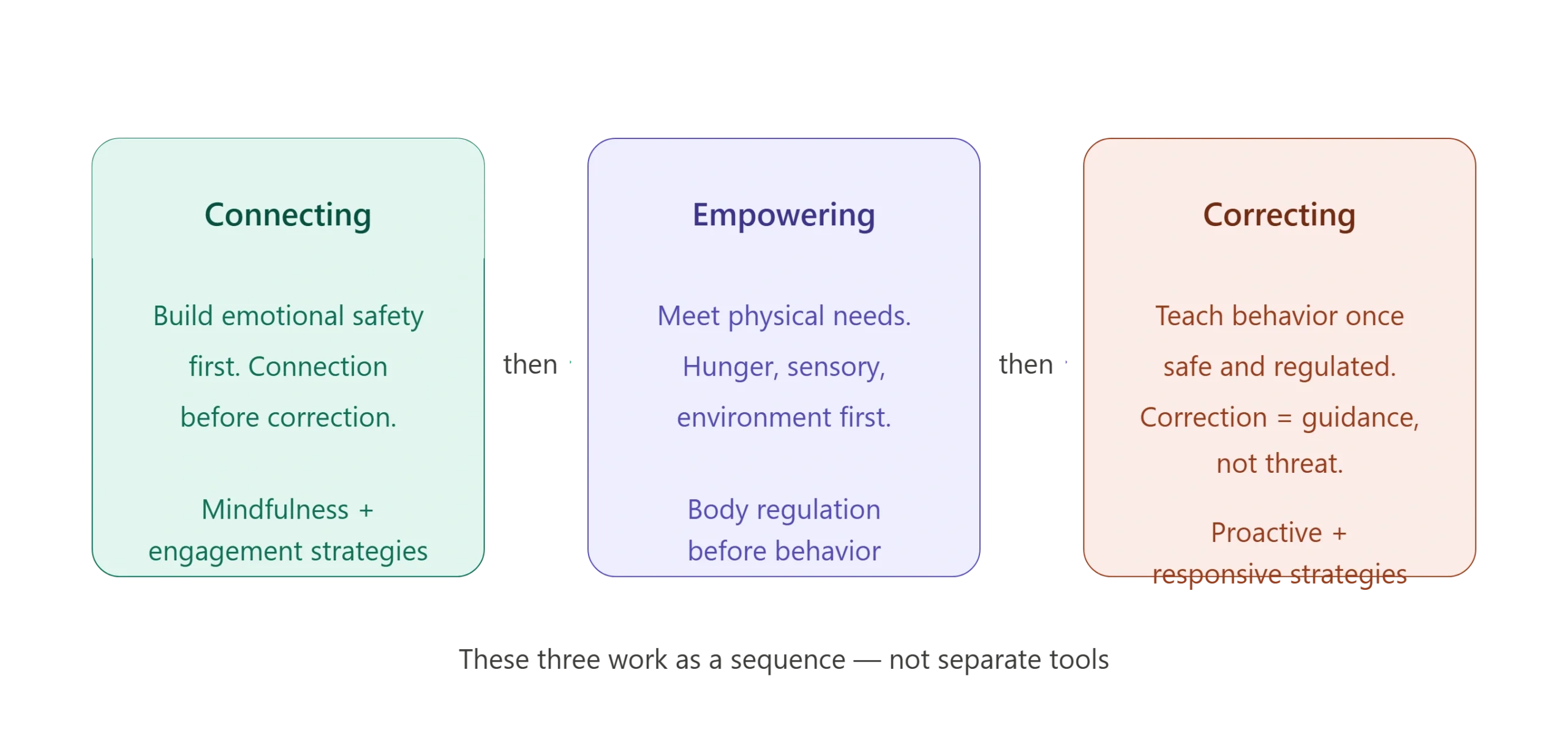
TBRI is built on three core principles that work together as a sequence, not separate tools you pick from a menu.
Principle 1: Connecting Principles
The connecting principle creates emotional safety before anything else.
Here’s what I’ve learned after years of working with families: a child who doesn’t feel safe cannot learn. They cannot regulate. They cannot receive correction. Their brain is in survival mode.
Connection is what shifts that.
Connecting principles in TBRI include two types of strategies:
A- Mindfulness strategies are about the parent first. Becoming aware of your own triggers, your tone, and your posture. Before you can connect with your child, you have to regulate yourself. (If you’ve ever wondered why you react so strongly in those heated moments, this is where that work begins.)
B- Engagement strategies are the practical tools you use with your child:
- Behavioral matching — getting on your child’s level physically and emotionally
- Playful engagement — using warmth and play to lower fear responses
- Eye contact — genuine, gentle, not demanding
- Authoritative voice — calm, warm, direct; never harsh or sarcastic
- Healthy touch — when appropriate, physical connection signals safety
The goal is for your child to feel, in their body, that they are safe with you. When that happens, doors open. This is why connection before correction is not just a phrase; it’s the foundation.
“When your child feels truly safe, doors swing open to positive change.” — Dr. Karyn Purvis
Principle 2: Empowering Principles
Before you address behavior, you have to address the body. TBRI’s Empowering Principles ask you to check: is your child hungry or thirsty, overtired, sensorially dysregulated, or struggling with their environment?
When these needs go unmet, what looks like defiance is usually dysregulation. The child isn’t choosing to act out; their body is overwhelmed.
Understanding the difference between defiance and dysregulation is something I cover in depth in what your child’s behavior is actually communicating.
Empowering principles also address felt safety around basic needs. Children who experienced food insecurity, for example, may hoard food or act out around mealtimes not because they’re manipulative, but because their bodies haven’t yet learned that they are safe.
TBRI gives caregivers practical tools to meet that need at a body level, not just a behavioral one.
When you meet the need first, many behaviors never escalate to begin with. A big part of this is also understanding co-regulation, your nervous system helping your child’s nervous system find calm.
Principle 3: Correcting Principles
Correction works. But timing is everything.
The Correcting Principle is often what parents want to get to first. I understand that you’re in the middle of a difficult moment, and you need it to stop. But TBRI is clear: correction only works after connection and regulation are in place.
When a child is dysregulated, correction feels like a threat. It escalates. When a child feels safe and regulated, correction feels like guidance. It teaches. If you’ve noticed that consequences simply aren’t working no matter how consistent you are, this is usually why.
TBRI’s Correcting Principles include two kinds of strategies:
- Proactive strategies — things you do in calm moments to build behavioral competence before challenges arise. Role-playing, choices, compromises, and life value Use short phrases like “respect,” “kind words,” and “safe hands” that create a shared language your child already understands when emotions run high.
- Responsive strategies — what you do when challenging behavior happens. This is where the IDEAL Response and Levels of Response come in.
What Is the TBRI IDEAL Response?
The IDEAL Response is TBRI’s framework for responding to behavior in the moment. The acronym stands for:
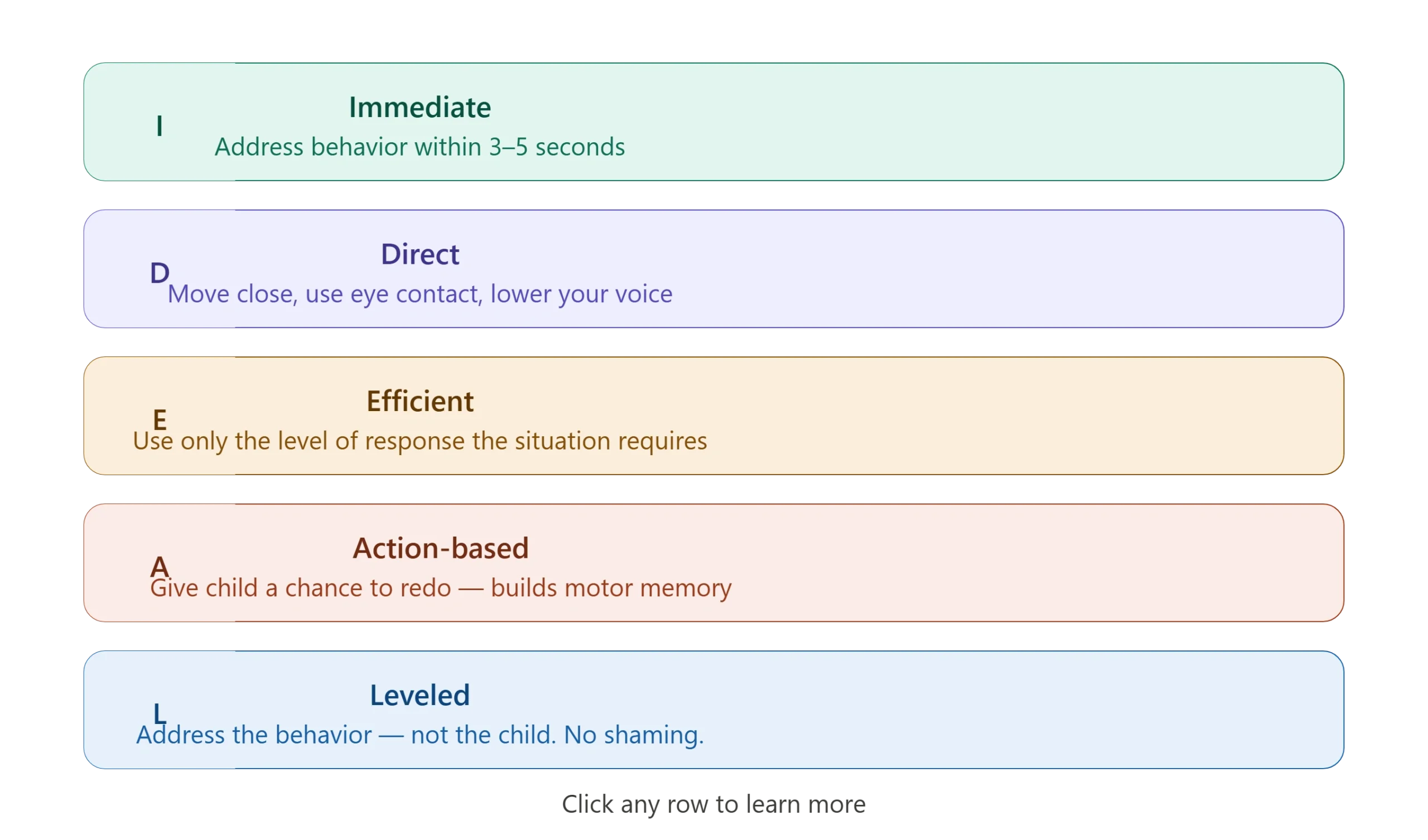
- I—Immediate: Address the behavior within 3–5 seconds
- D — Direct: Engage directly — move close, use eye contact, lower your voice
- E—Efficient: Use only the level of response the situation actually requires
- A—Action-based: Give the child a chance to redo the behavior correctly, this builds motor memory for the right response
- L — Leveled: Respond to the behavior, not the child. No shaming. No bringing up the past.
The IDEAL response keeps the connection intact even during correction. That’s what makes it different from traditional discipline.
TBRI Levels of Response
TBRI matches the intensity of your response to the level of the behavior. There are three levels:
Level 1 — Playful Engagement: For low-level challenges (mouthiness, minor disrespect). Respond playfully and redirect. Example: “Are you asking or telling?” Then guide them to a behavioral redo. Research shows 70–80% of challenging behaviors can be resolved at this level when connection is strong.
Level 2 — Structured Engagement: For moderate challenges that didn’t resolve at Level 1. Use a firmer (but still calm) tone. Offer two choices or a compromise. Allow a behavioral redo. The child’s fight-flight-freeze system isn’t fully activated here; learning can still happen.
Level 3 — Calming Engagement: For high dysregulation. The goal here is not teaching — it’s co-regulation. Stay close. Help your child return to a calm state. Correction comes later, once they’re regulated.
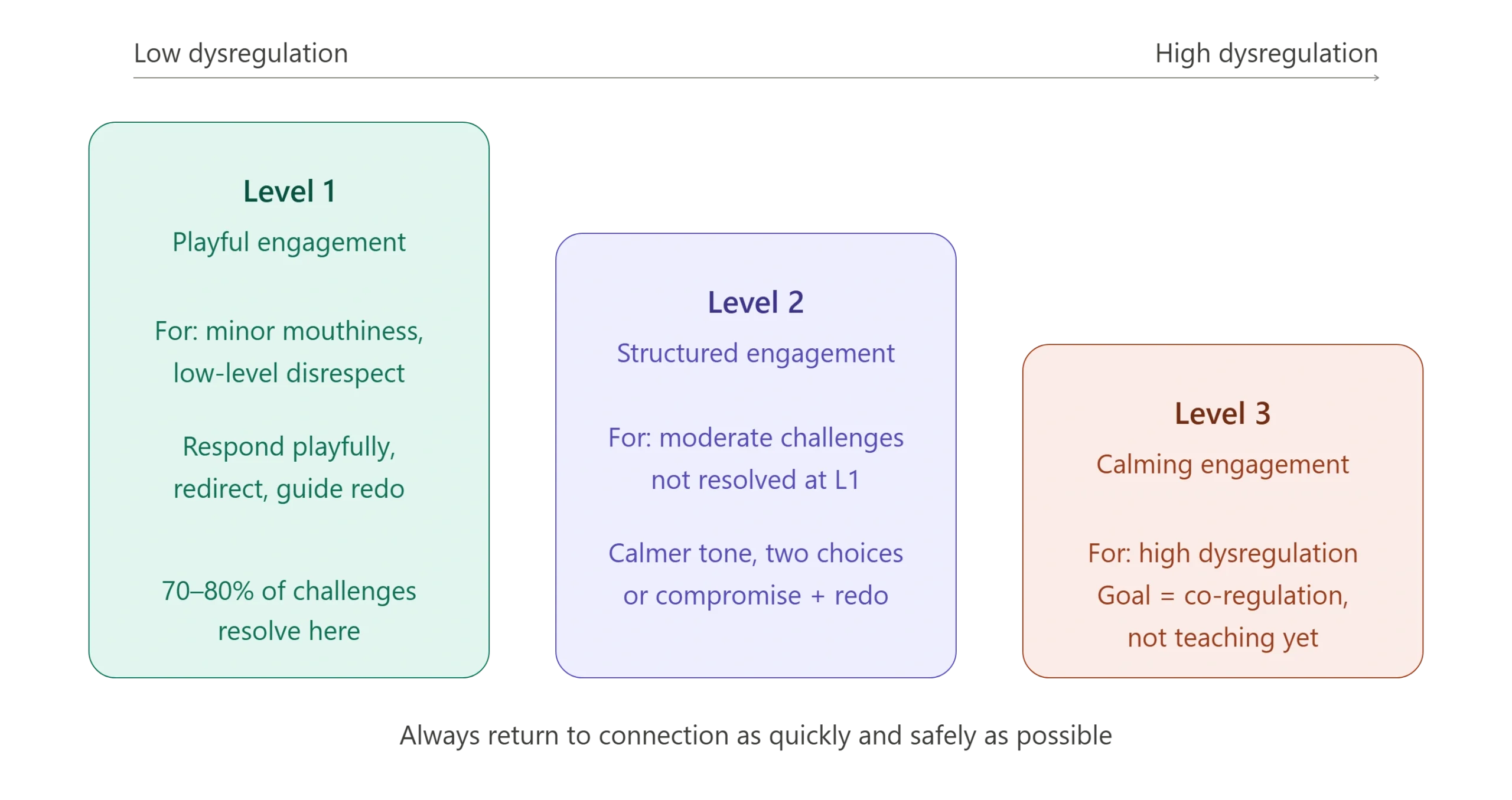
The goal of every level is to return to connection as quickly and safely as possible. You can see how this plays out in real situations in how to calm an angry foster child and in handling public meltdowns with TBRI.
How the 3 Principles Work Together
These three principles aren’t separate strategies. They’re a sequence.
- You connect before you react
- You empower by making sure your child’s body and environment are regulated
- You correct once safety and calm are in place
Together, they shift your parenting from reactive to intentional, from “How do I make this stop?” to “What does my child need right now?”
That shift is what The Drama-Free Parent is built on. And it’s what I’ve seen transform families, including my own.
Key Takeaways
- Connection comes before correction.
- Physical and emotional needs should be addressed before expecting behavioral change.
- Consistent, relationship-based responses build trust over time.
- TBRI focuses on understanding the reason behind behavior instead of reacting only to the behavior itself.
From Understanding to Applying: The Gap Most Parents Face
Understanding TBRI is not the hard part. The hard part is applying it consistently in real moments when you’re exhausted, when the same behavior is happening for the fifth time that day, when your own nervous system is activated.
Most parents default back to what they know. Not because they don’t care. But because they don’t yet have a clear, practiced system to follow.
If you want to go deeper with TBRI, a good next step is what to expect from TBRI training for parents; it walks through exactly how this approach translates into a structured learning experience.
And if you’re looking for practical tools you can start using right away, the free Trauma-Informed Parenting Guide is a good place to begin.
For a step-by-step approach to applying these principles with more calm and confidence, The Drama-Free Parent takes you through this work in a format built for real family life not a clinical setting.
→ Explore The Drama-Free Parent
And if you want ongoing support alongside other foster, adoptive, kinship, and caregiving families, The Parents Hub is where that community lives.
Frequently Asked Questions About TBRI
What does TBRI stand for?
TBRI stands for Trust-Based Relational Intervention, a trauma-informed parenting and caregiving approach developed to help children who have experienced trauma, neglect, or adversity feel safe, connected, and understood.
Who created TBRI?
TBRI was developed by Dr. Karyn B. Purvis and Dr. David R. Cross at the Karyn Purvis Institute of Child Development (KPICD) at Texas Christian University (TCU).
What are the 3 TBRI principles?
The three TBRI principles are Connecting Principles (building emotional safety and attachment), Empowering Principles (meeting physical and environmental needs), and Correcting Principles (teaching appropriate behavior while maintaining connection).
What is the TBRI IDEAL Response?
The IDEAL Response is a TBRI correcting strategy: Immediate, Direct, Efficient, Action-based, and Leveled at the behavior—not the child. It guides caregivers to respond to challenging behavior in a way that teaches rather than shames.
What are TBRI Levels of Response?
TBRI uses three levels of response matched to the intensity of the behavior: Level 1 (Playful Engagement), Level 2 (Structured Engagement), and Level 3 (Calming Engagement).
How is TBRI different from traditional parenting?
Traditional parenting focuses on the behavior and uses consequences to change it. TBRI starts with the relationship and the needs driving the behavior, connection, physical regulation, and felt safety before moving to correction.
Where can I get TBRI training?
Official TBRI training is available through the Karyn Purvis Institute of Child Development at TCU (child.tcu.edu). Parent-accessible training is also available through The Drama-Free Parent course.
Is TBRI therapy?
No. TBRI is not a therapy. It is a trauma-informed parenting and caregiving approach that helps caregivers respond to children’s emotional and developmental needs through connection, empowerment, and correction.