
The Moment I Heard His Voice Come Out of Me
It was a small moment. Nothing dramatic.
I asked my child to do something simple… and they didn’t listen. I repeated it. Louder this time. Still nothing.
And then it happened. My voice snapped sharp, harsh, and louder than I ever intended. The kind of tone I promised myself I’d never use.
For a second, everything went quiet.
Not outside. Inside.
Because in that moment, something felt… familiar. Not just the reaction, but the feeling behind it.
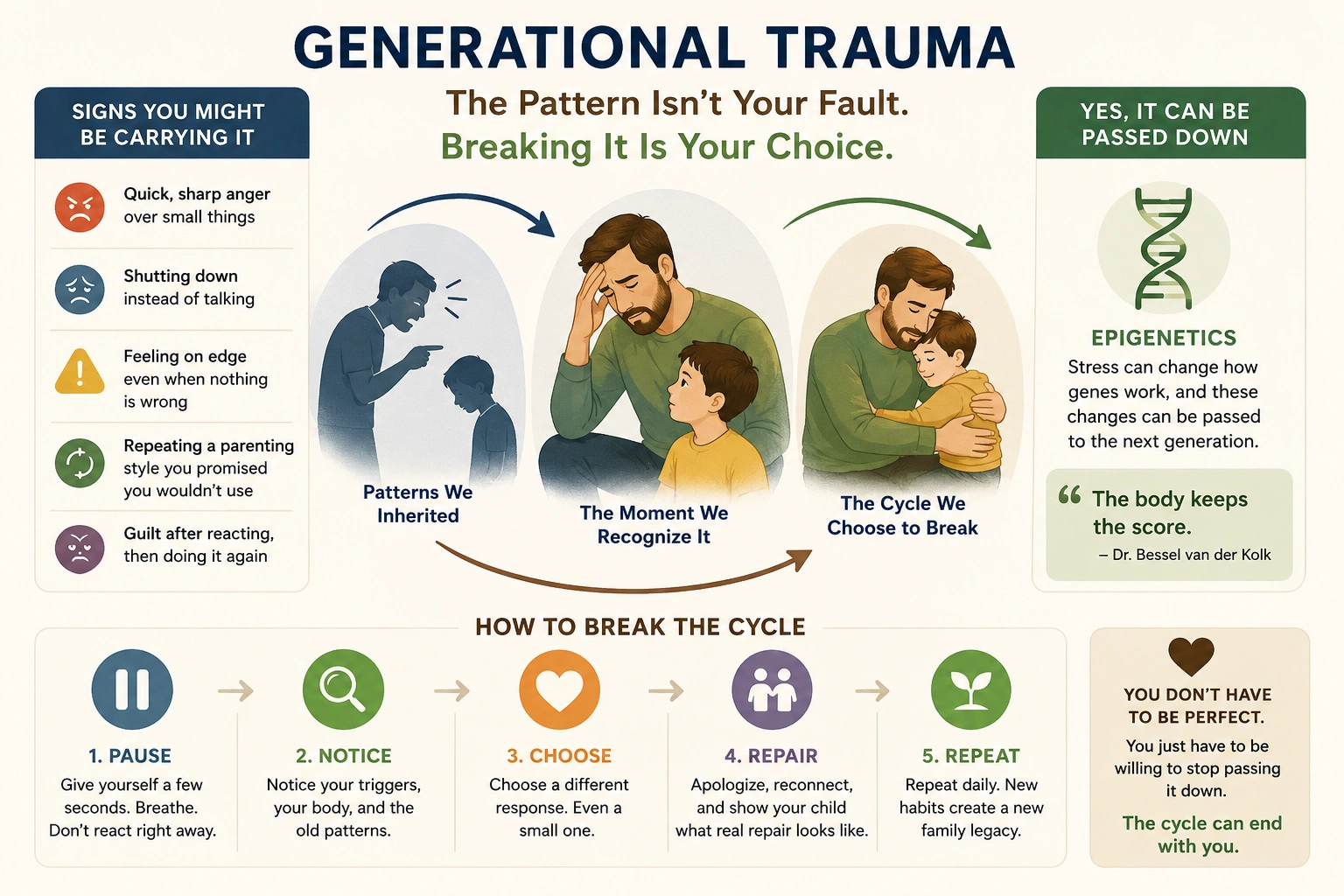
The frustration. The intensity. The loss of control. And then it hit me. I wasn’t just hearing myself anymore. I was hearing my father.
The same tone. The same reaction. The same pattern I thought I had left behind. And that realization stayed with me longer than the moment itself.
Have you ever caught yourself reacting in a way that made you stop and wonder…
“Why did I respond like that?”
Why We React Like Our Parents Without Realizing It
Most of us don’t plan to repeat our parents’ behavior. In fact, many of us promise we won’t.
And this is where most parents get stuck; they see it happening but don’t understand why it keeps repeating.
This is how generational patterns in parenting work. It’s not just habit. It’s something deeper. If you’re trying to understand where your own experience fits, it helps to first know the childhood vs generational trauma difference.
When you’re triggered, when your child ignores you, pushes back, or overwhelms you, your brain doesn’t stop to think.
It reacts.
If this sounds familiar, stay with me, because this is the part that starts to change everything.
That reaction often comes from what you experienced growing up.
It’s why so many parents quietly wonder: “Why do I react like my parents?”
Your nervous system learned those responses early. And under pressure, it goes back to what feels familiar, even if it doesn’t feel right.
If you’ve ever questioned this, understanding the subtle signs you might be missing can help you see these patterns more clearly and without judgment.
The Hidden Ways These Patterns Show Up in Parenting
Repeating your parents’ patterns doesn’t always look obvious. Sometimes it’s not yelling.
This is the part no one talks about, because these patterns don’t always look like what we expect.
Sometimes it’s
- Shutting down emotionally
- Becoming overly controlling
- Reacting too quickly, then feeling regret
- Expecting obedience instead of connection
- Feeling triggered by small behaviors
This is the difference between reactive vs responsive parenting.
Reactive parenting feels automatic. Fast. Emotional. Hard to control. And afterward… comes the guilt.
You tell yourself, “I’m not going to do that again.” But the next day, it happens again. That’s the cycle.
The Small Shift That Helped Me Pause Instead of React
The turning point for me wasn’t a big breakthrough.
It was a small realization:
👉 I don’t need to react immediately.
And most parents miss this moment completely, because everything feels too fast.
Instead of speaking right away, I started giving myself space. Even a few seconds. Even a breath.
And this is where you need to do something practical:
👉 Use the simple pause that actually works the next time you feel triggered.
Not later. Not in theory. In the moment.
Because it’s not about understanding the idea, it’s about interrupting the pattern while it’s happening.
Give your nervous system those 90 seconds to settle. Step back. Stay quiet. Let the intensity pass.
And in that space, you create a real choice:
👉 React like your past 👉 Or respond with intention
That’s where change actually begins.
What I Started Doing Differently (Without Trying to Be Perfect)
I didn’t try to become a perfect parent overnight. That never works.
Instead, I focused on small, realistic changes:
1. I noticed my triggers
I paid attention to the moments I felt overwhelmed. Not just what my child was doing, but what I was feeling inside. Over time, I started seeing patterns in when and why I reacted.
2. I paused before responding
Not always perfectly, but more than before. Even a few seconds gave me space to slow things down. That pause helped me respond with intention instead of reacting automatically.
3. I focused on connection first
Instead of correcting immediately, I worked on why connection changes behavior. I reminded myself that my child needed to feel understood before being guided. That small shift changed the tone of our interactions.
4. I repaired after mistakes
When I got it wrong, I didn’t ignore it; I came back and repaired the moment. Sometimes it was a simple apology or a calm conversation later. That repair helped rebuild trust and showed my child a different way.
This is a big part of healing childhood patterns.
It’s not about perfection; it’s about awareness… and repair.
What Changed in My Home When I Stopped the Pattern
The change wasn’t instant. But it was real. The tension started to ease. The reactions became less intense.
And something unexpected happened… My child started responding differently too.
Because when we shift from reaction to response, we don’t just change ourselves. We change the environment our children grow up in.
After years of repeating patterns I didn’t even realize I had, and now navigating the real challenges of raising grandchildren, I’ve seen how deeply these reactions can be wired and how powerful even small changes become over time.
If You See Yourself in This, You’re Not Alone
If you’ve had that moment, where you hear your parent in your voice… You’re not alone. And more importantly, you’re not stuck. These patterns are learned. Which means they can be unlearned.
That’s what breaking the cycle really looks like. Not perfection. Not instant change.
But awareness… choice… and small shifts over time.
What Comes Next When You Start Noticing the Pattern
That moment, the one where you recognize the pattern, is where everything begins.
But recognizing it isn’t enough. If you’re serious about changing this, you need to take the next step.
Start by exploring the step-by-step way to break this pattern and actually applying it in your daily parenting, not just reading and moving on.
Because real change only happens when you act on what you now see.
This shift from reactive patterns to calm, intentional parenting is exactly what I break down step by step in The Drama-Free Parent.
If you’re serious about not passing this behavior forward, awareness is not enough; you need a clear system to actually change how you respond in real moments.
👉 Read The Drama-Free Parent and start applying it in your daily parenting today.
You can also explore the Parents Hub for ongoing support, practical tools, and encouragement as you continue this journey.
If you’re not ready for the full book yet, start here:
👉 Download the free guide and take your first step today.
Pause the next time you feel triggered, but don’t stop at just realizing it. That’s where most people stay stuck.
Because this cycle doesn’t break on its own, it breaks when you take control of it.