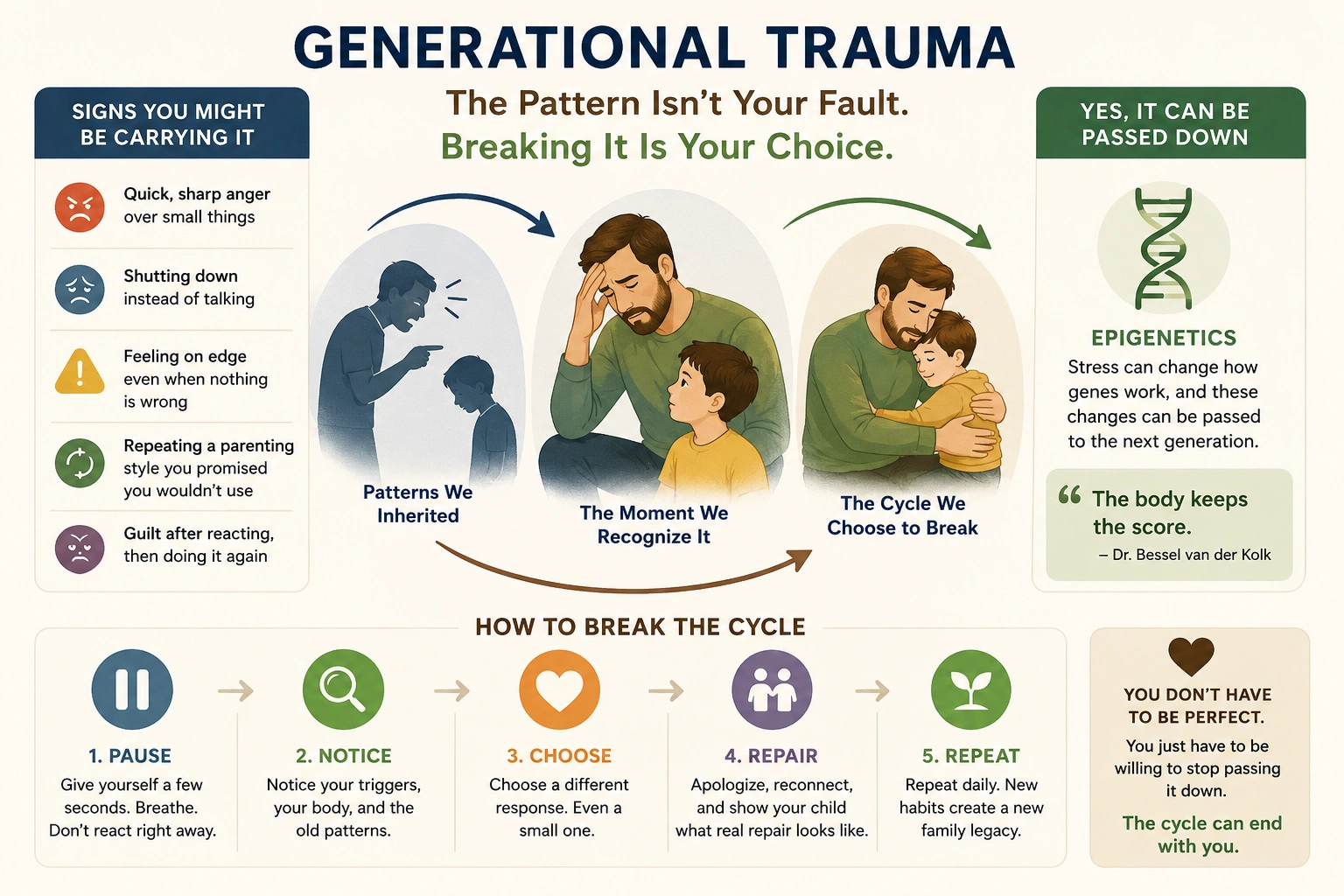

You know the moment I am talking about.
The dinner is burning. Juice is spilled on the floor again. Your name has been called so many times you have lost count. Then the small thing happens, the one that should not matter but somehow pushes you over the edge.
Your voice gets sharp. The words come out before you can stop them. You see the look on your child’s or grandchild’s face change. And just like that, the guilt rushes in.
I have been there more times than I can count.
As a grandparent raising four grandchildren, I know how quickly stress can take over. I am not a bad caregiver. I am simply a human being whose nervous system sometimes gets flooded.
You are not a bad parent. You are a dysregulated one. There is a difference, and that difference is everything.
Today, I am giving you one tool that works in the worst moment. Not a strategy for calm days. A tool for the hardest ones.
What Is Actually Happening in Your Body When You Snap
When stress hits, your brain does not ask for permission. It detects a threat even if that threat is just spilled juice and a tired five-year-old. The amygdala sounds the alarm. Your body releases cortisol and adrenaline. Your thinking brain, the part that chooses kind words and considers consequences, gets pushed to the side.
This is not a willpower problem. This is biology.
Your body does not always know the difference between a real danger and a hard moment with a child. It just knows something feels wrong, and it reacts to protect you.
When your child is out of sorts, they are not trying to give you a hard time. They are having a hard time. That is exactly why it matters so much to understand what your child’s behavior is communicating.
The good news is you do not have to stay stuck in that reaction. You can learn to interrupt the cycle.
What the 90-Second Rule Actually Means for Parents
Dr. Jill Bolte Taylor, a Harvard-trained neuroscientist, discovered something powerful while studying her own brain. The initial chemical surge of an emotion lasts about 90 seconds in the body. After that, what keeps the feeling going is usually the story we keep telling ourselves.
Let me be honest with you. For those of us carrying trauma or raising children who have experienced hardship, that 90-second window can sometimes feel shorter. Chronic stress changes things. But the idea is still useful.
You do not need to become a calm person overnight. You only need to outlast the first wave.
That small pause gives your thinking brain a chance to come back online. It gives you the space to respond instead of react.
How I Use the 90-Second Rule in Our Home
Here is what it looks like in real life with my grandkids.
One evening my granddaughter was having a meltdown because she did not want to brush her teeth. I felt the heat rising in my chest. My jaw tightened. I knew the wave was coming.
Instead of snapping, I did three simple things:
- I noticed the feeling in my body.
- I pressed both feet firmly into the floor and took a longer exhale.
- I quietly said to myself, “Ninety seconds. Just get through the next ninety seconds.”
I stayed close to her without speaking right away. After a short time, I felt my shoulders drop. My voice came back softer.
I knelt down and said, “I see you are really upset. I am right here. Let us take a breath together and then figure this out.”
That small pause changed the entire moment.
What to Do When You Miss the 90 Seconds
Some days the wave comes faster than you can catch it. You raise your voice. You say something you regret. The guilt comes fast.
Here is what I do when that happens. I go back and repair.
I say something simple and honest:
“I raised my voice. That was not okay. I am working on staying calm. I love you.”
If the moment has already escalated, knowing how to calm an angry child without making it worse can help you find your footing faster.
Those few words do more than any perfect parenting moment ever could. They teach my grandkids that relationships can survive hard moments and that adults can come back and make it right.
A Gentle Reminder for Grandparents and Kinship Caregivers
If you are a grandparent raising grandchildren, you are carrying two stories at once, your own and theirs. Your nervous system may have learned to react quickly because life taught you that was necessary.
That does not make you a bad caregiver. It makes you human.
The 90-second rule is not about getting it right every time. It is about getting better at catching yourself and choosing connection more often than you did yesterday.
You are already doing the hardest part by showing up for these children every single day.
Would you like a simple tool to help you practice this at home? The free 3-Day Reset guide I created for exhausted caregivers is available on the site. It is short, practical, and designed for real life.
Download the Free 3-Day Reset Guide
You do not need to be perfect. You only need to keep showing up and choosing connection, one moment at a time.
I am right here with you on this journey.